

For CFOs and finance directors at high-growth global companies, the administrative tax is a silent killer of scale. This tax isn't financial, but operational-a death by a thousand cuts from manual processes, regulatory compliance, and fragmented systems. Nowhere is this more acute than in the dual processes of Know Your Business (KYB) verification and subsequent global payouts.
As you expand into new markets and engage a growing network of vendors, freelancers, and affiliates, the operational drag of vetting and paying them can bring growth to a grinding halt.
Managing this complexity is no longer just a back-office function; it's a strategic imperative that directly impacts your ability to scale. The traditional, siloed approach-where a compliance team manually handles KYB and an accounts payable team separately processes payments-is fundamentally broken for a global, digital-first economy. This playbook provides a framework for CFOs to architect a modern, automated system that unifies KYB and payouts, transforming a critical compliance burden into a competitive advantage and a core part of a 'Touchless Finance' operating system.
What is KYB and Why It's a Board-Level Concern
Know Your Business (KYB) is the due diligence process that businesses must perform to verify the identity of their corporate and business partners. It's the business-to-business equivalent of Know Your Customer (KYC). The goal is to prevent illicit activities like money laundering, terrorist financing, and fraud by understanding the ownership structure and legitimacy of the entities you transact with.
For a company disbursing funds to thousands of vendors across 150+ countries, this is not a trivial task.
Beyond a Checkbox: KYB as a Strategic Imperative
Historically viewed as a compliance cost center, KYB is evolving into a key pillar of operational risk management and business enablement. A robust KYB process ensures you are not exposing your company to financial crime or reputational damage. More importantly, an efficient and streamlined KYB process accelerates vendor onboarding, reduces payment friction, and enables you to scale your partner ecosystem with confidence.
Conversely, a poor process creates bottlenecks, frustrates partners, and puts a hard ceiling on your growth.
The process requires businesses to collect and verify crucial information, including official company registration documents, tax identification numbers, and location details. A critical step involves identifying the Ultimate Beneficial Owners (UBOs)-the natural persons who ultimately own or control the business entity. As one guide on the process explains, KYB processes must follow the ownership chain until the individuals at the top are identified. This is often the most complex and resource-intensive part of due diligence.
The Patchwork of Global Regulations
There is no single global standard for KYB, creating a complex compliance matrix for international businesses. Regulations differ across jurisdictions, though most national frameworks are aligned with the standards set by the Financial Action Task Force (FATF). For example, the European Union enforces its 5th and 6th Anti-Money Laundering Directives (AMLD), while the United States has FinCEN’s Customer Due Diligence (CDD) Rule.
Each framework has specific mandates for verifying legal entities and identifying UBOs.
This regulatory fragmentation means a one-size-fits-all approach is doomed to fail. Companies must adopt a risk-based approach, tailoring the depth of their due diligence to the specific country, industry, and risk profile of each vendor. The administrative burden of manually tracking and complying with these varied and evolving requirements is immense, which is why a growing number of businesses are recognizing that automation is crucial to KYB compliance.
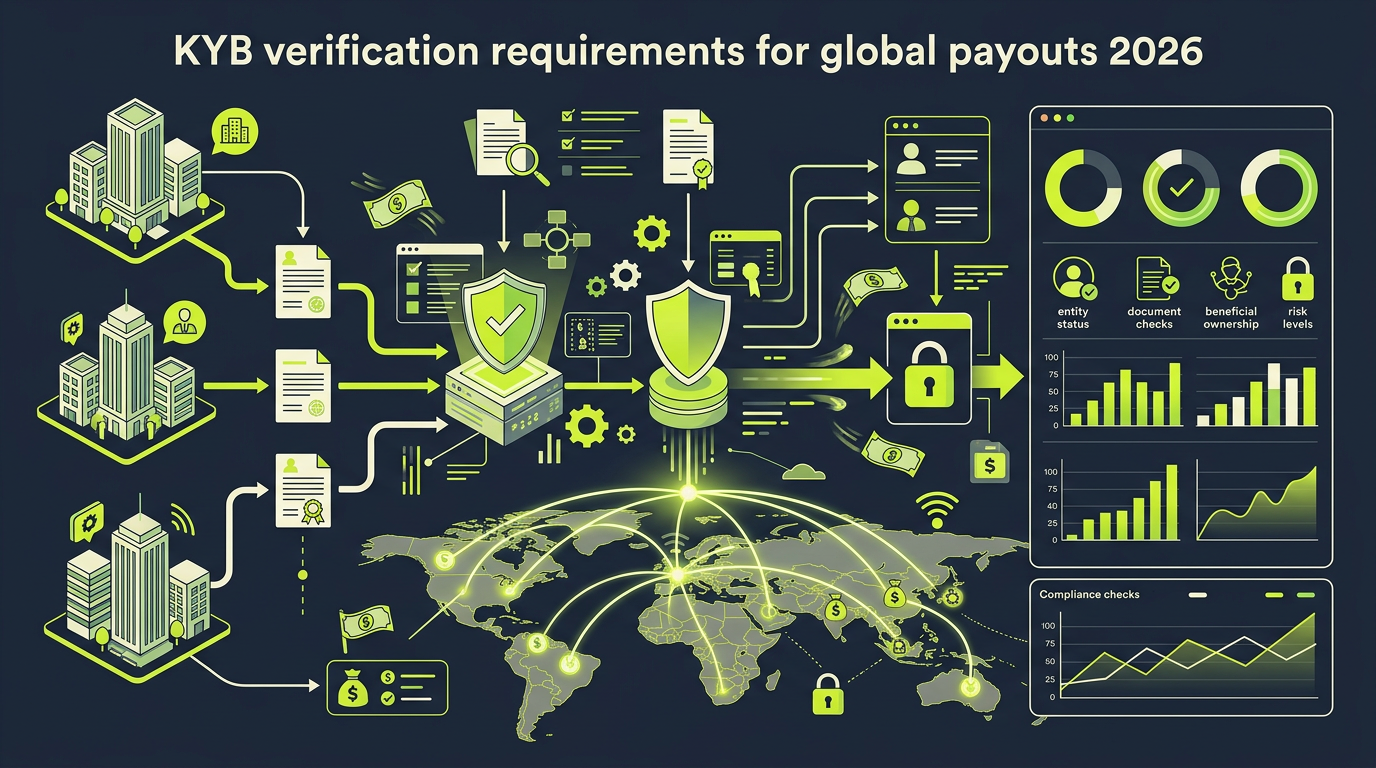
The Manual vs. Automated KYB Playbook: A Side-by-Side Comparison
For finance leaders architecting their operational stack, the central choice is between building an in-house, manual process or leveraging a specialized automation platform. The decision has profound implications for cost, speed, compliance, and scalability.
Approach 1: The In-House, Manual Workflow
In this model, a finance or compliance team manually collects documents from vendors via email, saves them in shared drives, and uses a mix of spreadsheets and disparate tools to track verification status. An analyst must then manually review the documents, potentially use a third-party data provider for a specific check, and then update the vendor's status in another system before Accounts Payable can even begin to process a payment.
The weaknesses of this approach become apparent quickly as a company scales. It is incredibly resource-intensive, requiring significant headcount to manage the administrative workload. It's prone to human error, from data entry mistakes to missed follow-ups.
The fragmented data makes audits a nightmare and provides zero real-time visibility into onboarding bottlenecks or risk exposure. Fundamentally, this manual workflow creates friction at every step, slowing down the entire process from vendor onboarding to final payment.
Approach 2: The Automated, Platform-Driven Workflow
A modern, platform-driven approach collapses the entire KYB and payout process into a single, unified workflow. It starts with a branded, self-service Vendor Portal where suppliers can upload their own W-8/W-9 tax forms and verification documents. The platform then automates the validation checks, using AI and integrated data sources to verify identity, screen against sanctions lists, and confirm business registration in real-time.
Once verified, the vendor's profile is automatically approved for payment within the same system. When it's time for a payout, the platform can execute thousands of payments simultaneously via API or file upload. This 'Touchless Finance' model removes the administrative tax entirely. leading global payout platforms are designed for exactly this challenge, allowing you to trigger thousands of payments with a single instruction while ensuring compliance is handled natively. This unified system provides a single source of truth, a complete audit trail, and the operational capacity to scale infinitely without adding headcount.
Key Components of a Modern, Scalable KYB and Payout Framework
Building a truly scalable financial operating system requires more than just bolting on a verification tool. It demands a holistic view that connects onboarding, compliance, and payments into a seamless, automated loop. This is the core philosophy of an Operations-First FinTech platform: finance tools built not just for moving money, but for optimizing the operations around it.
Unified Onboarding and Data Management
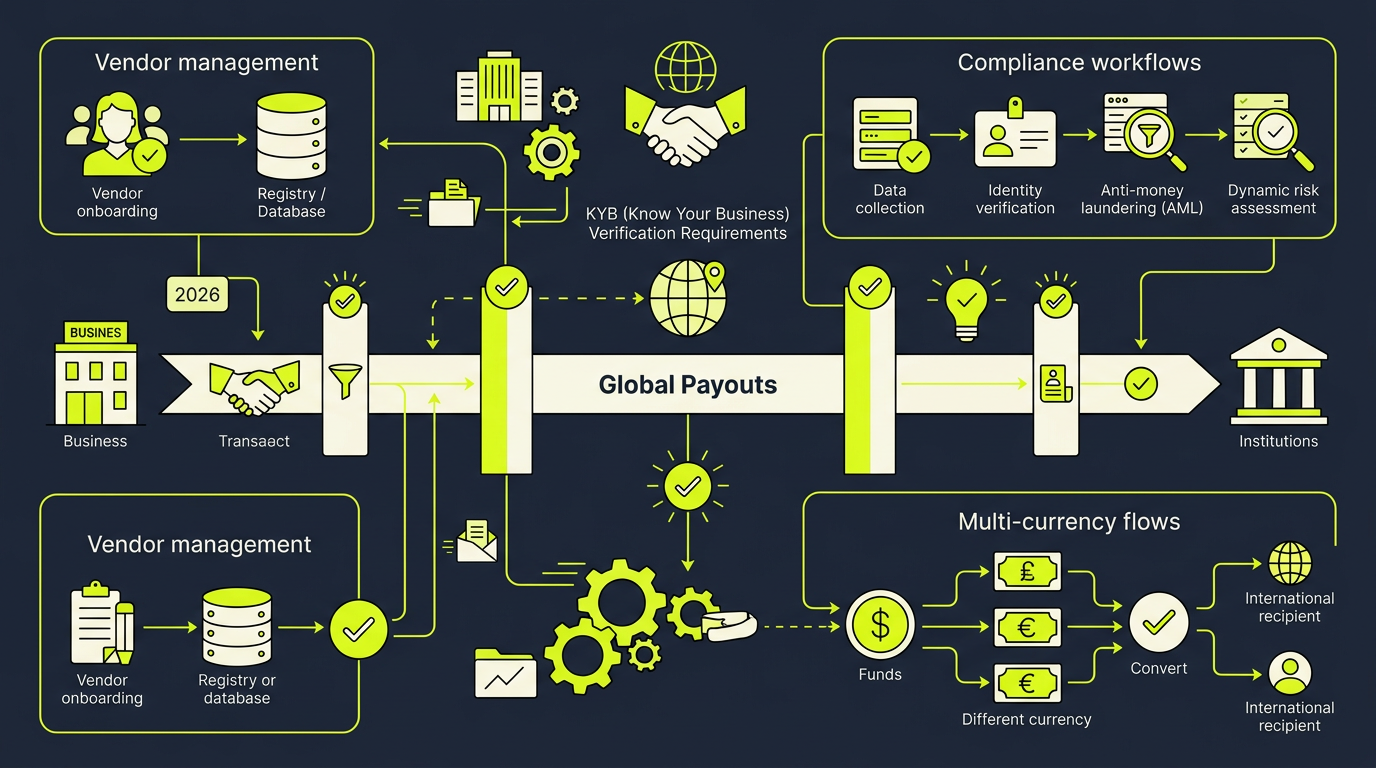
The foundation of a scalable system is a single, unified platform for vendor lifecycle management. This begins with a self-service portal that guides payees through the entire onboarding process, from data collection and KYB verification to tax form submission (W-9/W-8 series) and payment method selection. By consolidating this process, you eliminate the endless email chains and data silos that plague manual workflows.
This unified approach directly impacts your ability to manage multi-currency payouts efficiently. A central platform provides the necessary infrastructure for handling the complexities of global payments, as explored in the 7 Strategies for Optimizing Multi-Currency Marketplace Payouts with Automation. All payee data, compliance status, and payment history are stored in one place, creating an auditable, golden record for every vendor you work with.
Risk-Based Assessment and Ongoing Monitoring
Compliance is not a one-time event. The regulatory landscape and the risk profile of your vendors can change. An effective KYB system must include risk-based ongoing monitoring that automatically screens your payee-base against updated sanctions lists and adverse media. A modern platform can automate these checks, flagging potential issues for review without requiring manual intervention for every single vendor.
This capability is essential for any business operating at scale, as manually re-vetting thousands of vendors periodically is simply not feasible. By automating ongoing monitoring, you ensure continuous compliance with FATF recommendations and other global standards, protecting your business from emerging threats and regulatory penalties.
Integrating KYB into a 'Touchless Finance' Operating System
The ultimate goal is to create a financial operating system where the entire procure-to-pay lifecycle, including KYB, is automated. This closes the loop between compliance, operations, and finance, allowing the business to run faster and more efficiently.
The Role of ERP Integrations and Universal Connectors
A critical piece of this puzzle is deep integration with your existing financial stack. A payout automation platform must act as a central hub, not another data island. This is where Universal Connectors and robust ERP integrations come in. A modern automated system should offer pre-built integrations with systems like NetSuite, QuickBooks, Xero, and SAP.
This level of integration enables true automation. For example, once an invoice is approved in your ERP, the payment can be automatically triggered through the payout platform, with all data reconciled back to your general ledger without manual intervention. For companies looking to expand, understanding How to Scale Global Payouts with NetSuite Connectors provides a blueprint for this kind of operational efficiency. This seamless data flow is the defining characteristic of a 'Touchless Finance' department.
From Fiat to Stablecoins: The Future of Settlement
As global operations mature, so do the payment rails that support them. While traditional banking and SWIFT remain dominant, they often come with high fees, slow settlement times, and a lack of transparency. Forward-thinking platforms are now incorporating stablecoins as a settlement layer for cross-border B2B payments. Using stablecoins like USDT or USDC can dramatically reduce transaction fees and provide near-instant settlement, 24/7.
This isn't about speculation; it's about utility. For a CFO, the ability to pay a vendor in Asia-Pacific instantly on a weekend, for a fraction of the cost of a wire transfer, is a powerful operational advantage. Platforms that offer both fiat and crypto payout options provide maximum flexibility and cost-effectiveness. This evolution represents The Future of Global Payouts: Beyond SWIFT to Stablecoin Settlement, where financial infrastructure is chosen for its efficiency, not just its legacy.