

For decades, the architecture of international B2B payments has remained largely unchanged. A complex web of correspondent banks, governed by the SWIFT messaging system, has been the default rail for moving money across borders. This system, while reliable, is a product of a pre-digital era.
It introduces settlement delays, high transaction costs, and operational opacity-an "administrative tax" that burdens finance teams and slows down global growth. As businesses become increasingly borderless, the friction of this legacy infrastructure becomes a critical barrier to scaling operations.
Now, a fundamental shift is underway, driven not by speculative cryptocurrency trading, but by the practical utility of stablecoins as a settlement layer. For CFOs and Operations Managers at high-growth digital companies, this isn't about "crypto" in the popular sense. It's about leveraging a new, more efficient infrastructure to solve age-old problems: paying vendors, creators, and suppliers across 150+ countries quickly, cost-effectively, and with full transparency.
This is the move from analog financial plumbing to a digital, programmable, and operations-first financial system.
From Days to Seconds: Why Settlement Speed Is a Strategic Advantage
The most immediate and tangible benefit of stablecoin settlement is the dramatic reduction in settlement time. Traditional cross-border payments can take anywhere from 3 to 7 business days to finalize, a delay that introduces counterparty risk and ties up working capital. This is a topic we've explored in detail when analyzing why your global vendor payouts settle in days, not seconds. These delays are not arbitrary; they are the result of multiple intermediaries, each with its own processing schedule and cutoff times, operating across different time zones.
In stark contrast, blockchain-based settlement is nearly instantaneous. Research shows that settlement finality can be as fast as 400 milliseconds on networks like Solana or under 15 seconds on Ethereum. This capability transforms vendor payments from a multi-day waiting game into a real-time transaction.
For businesses managing large networks of international freelancers, affiliates, or suppliers, this speed is more than a convenience-it's a powerful competitive differentiator that enhances vendor relationships and optimizes cash flow.
The Operational Impact of Instantaneous Finality
Instant settlement unlocks new operational efficiencies. When a payment to a vendor in another country finalizes in seconds, the need for extensive reconciliation processes shrinks. Finance teams no longer have to spend hours tracking payments through the correspondent banking maze or fielding inquiries from vendors about payment status. This reduction in manual effort allows the finance function to evolve from a reactive administrative center to a strategic driver of growth.
Furthermore, this speed enhances liquidity for your partners. Platforms that facilitate creator payouts or manage affiliate programs can offer near-instant payments, a significant value proposition for their users. This is a core component of "Advanced Payment" models, where vendors gain immediate access to liquidity. The ability to pay on demand, rather than on a rigid weekly or monthly schedule, fosters loyalty and helps attract top-tier global talent.
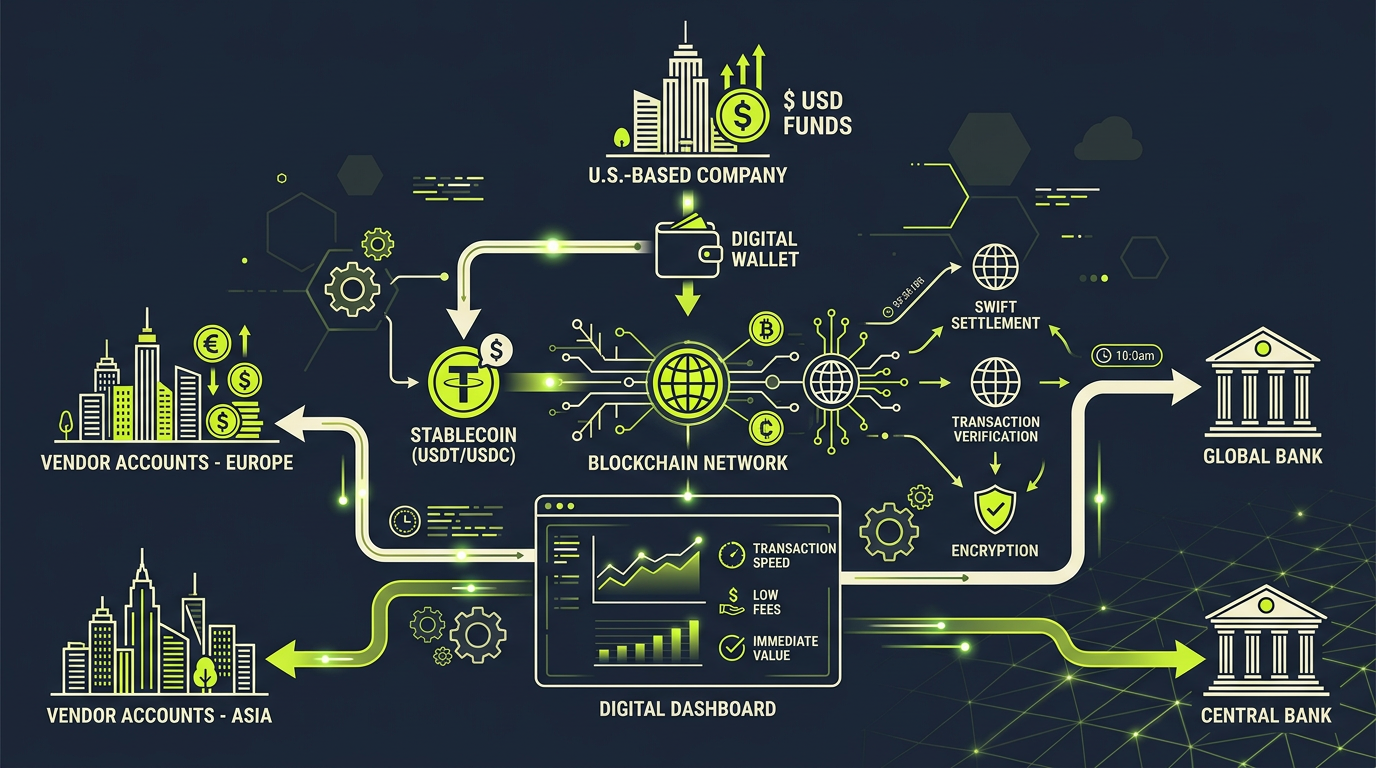
Stablecoins as a Utility: Differentiating Transfer Rails from Payments
A critical distinction for any finance leader to understand is the difference between stablecoins as a settlement rail versus a consumer payment method. While headlines often focus on buying coffee with crypto, the most significant adoption is occurring behind the scenes. According to a 2026 report, the annualized stablecoin settlement volume was estimated at around $33 trillion in 2025, dwarfing the approximately $390 billion in actual consumer-facing payments.
This highlights that stablecoins are already a massive, functioning transfer mechanism for moving value, even if they aren't yet a common way to pay at the point of sale.
This gap between settlement volume and payment volume represents the immense growth potential for B2B applications. For platforms paying thousands of vendors globally, the value isn't in the end-user adopting crypto; it's in using stablecoins like USDC and USDT as a frictionless bridge between traditional financial systems. com, for example, enables businesses to fund their accounts with fiat currency and disburse payments in either fiat or stablecoins, abstracting away the complexity for the payor and providing optionality for the payee.
USDC and USDT: The 95% Market Share Dominance
In the world of stablecoin settlement, two assets-USDC and USDT (Tether)-command over 95% of the market share. This concentration is a key enabler of liquidity and interoperability. Unlike the fragmented world of emerging, less-proven stablecoins, USDC and USDT have deep liquidity pools, making it feasible to settle large transaction volumes without significant price slippage. This dominance provides a reliable foundation for building scalable payout operations.
These stablecoins act as digital dollars, moving on global, 24/7 blockchain rails. For businesses, this means the ability to settle cross-border payments without being constrained by banking hours or national holidays. As noted by industry experts, this turns payments into a programmable and automated process, where B2B treasury and liquidity management can be optimized in ways legacy systems simply cannot support.
Programmable Treasury and the Automation of Global Finance
Perhaps the most profound long-term impact of stablecoin settlement is the concept of "programmable money." When payments exist on a blockchain, the logic governing their settlement can be defined upfront. This moves intelligence from downstream, disconnected systems directly to the settlement layer itself. A payment can be structured to release funds automatically only after a specific condition is met, such as API confirmation of a service milestone or delivery.
This programmability is a for treasury management. As one analysis on the topic points out, if a predefined signal for a transaction never arrives, the funds can automatically revert. This capability drastically reduces the risk and complexity of managing global payables. For marketplaces, this could mean automated, multi-party splits that settle instantly upon a successful transaction. For ad networks, it could mean performance-based bonuses paid out in real-time as conversion goals are hit.
Consolidating Global Treasury Operations
Large global companies often manage hundreds of bank accounts across various subsidiaries to handle regional payments and foreign exchange. This creates enormous operational overhead from reconciliation, FX conversion fees, and slow settlement times. Stablecoins enable a consolidated approach to treasury, where a central digital dollar wallet can be used to fund payments across the globe instantly and 24/7, a process that improves efficiency in what some call programmable treasury management.
By leveraging a unified payout platform with deep ERP integrations-Payouts.com offers over 600 connectors for systems like NetSuite, QuickBooks, and SAP-this new treasury model becomes even more powerful. Transactions initiated in the ERP can trigger automated crypto or fiat payouts, with reconciliation data flowing back into the system in real-time. This creates a "touchless finance" workflow, eliminating the manual entry and fragmented data that plagues scaling companies.
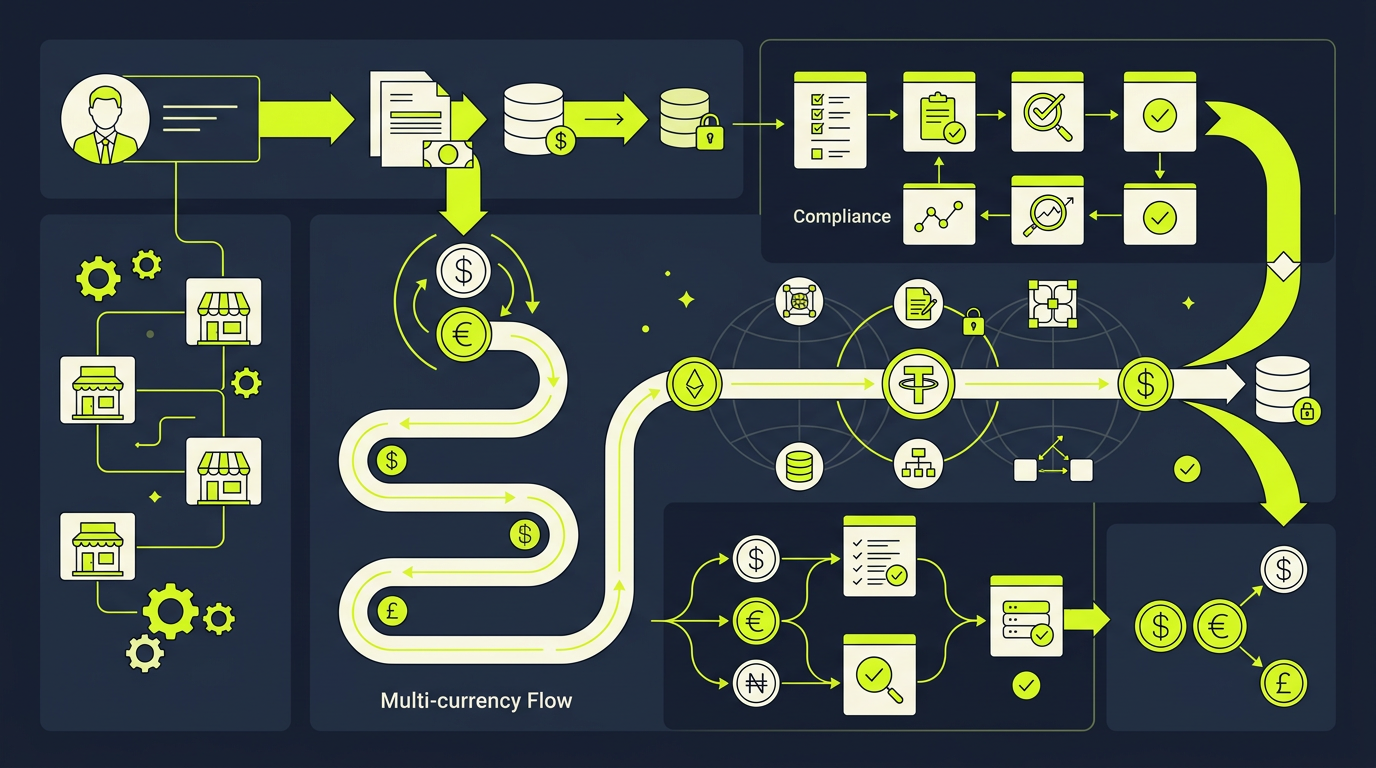
The Operations-First Approach to Crypto Payouts
The adoption of stablecoin settlement is not a technology-led trend; it is an operations-led one. The primary drivers are CFOs, Finance Directors, and Operations Managers who are tasked with building scalable, resilient financial infrastructure. These leaders are not crypto speculators; they are pragmatists seeking to eliminate inefficiency.
The total market capitalization of stablecoins grew by nearly $100 billion in 2025, reaching over $308 billion, signaling massive institutional and corporate adoption.
This growth is a response to real-world demand. As companies in the creator economy, ad tech, and online marketplaces expand globally, they encounter the limitations of traditional payment rails. As noted by Circle, large platforms and online marketplaces are adopting stablecoins to streamline international payouts to sellers and creators. A platform like Payouts.com facilitates this by providing a single interface for managing both fiat and crypto disbursements, complete with integrated KYC, tax compliance (W-8/W-9), and vendor management portals.
Beyond the Hype: Focusing on Utility and Compliance
An operations-first approach means focusing on utility and compliance, not hype. The conversation has moved past speculative fervor to practical application, as demonstrated by the sharp rise in stablecoin transaction volume. The fact that stablecoin volume has surpassed that of major card networks like Visa underscores its significance as a settlement layer. The recent analysis showing significant year-over-year growth in stablecoin usage for global payments further validates this trend.
For businesses, this means partnering with platforms that prioritize regulatory adherence and operational resilience. This includes robust compliance frameworks covering KYC/AML, adherence to evolving regulations in jurisdictions like the EU and US, and the ability to operate across both traditional and digital payment rails. The future of global payouts isn't about choosing one over the other, but about having a unified financial operating system that can leverage the best of both worlds to drive efficiency and scale.