

In today's digital-first economy, the nature of collaboration has fundamentally changed. Businesses are increasingly reliant on a global network of vendors, from freelancers and influencers to affiliate partners and strategic suppliers. This borderless ecosystem presents immense opportunities for growth but also exposes a critical operational flaw in many organizations: a fragmented, manual approach to vendor onboarding.
This process, often a patchwork of emails, spreadsheets, and disconnected systems, is not just inefficient-it's a significant source of compliance and financial risk.
For CFOs and Operations Managers at high-growth digital companies, this administrative friction is a familiar pain. Manual data entry, chasing tax forms like W-8s and W-9s, and navigating the complexities of international identity verification create an 'administrative tax' that stifles scalability. As your company expands into new markets and engages more partners, these manual workflows become unsustainable, prone to error, and a direct threat to your ability to operate with agility and control.
The solution lies in shifting from a reactive, manual posture to a proactive, automated one-a concept we call 'Touchless Finance.' This means building a financial operating system that automates the entire vendor lifecycle, from initial data ingestion and identity verification to tax compliance and final payment. It’s about creating a single, authoritative system that ensures every vendor is onboarded correctly, compliantly, and efficiently, no matter where they are in the world.
The Anatomy of Modern Vendor Verification: Beyond the Basics
Effective global vendor management starts with robust identity verification, a process that has evolved far beyond simple checks. The market for digital onboarding is growing rapidly, reflecting a critical need to tie identity verification and workflow orchestration directly to compliance deadlines and fraud control. This is especially true for non-financial industries, where spend on third-party Know Your Customer (KYC) and Know Your Business (KYB) systems is projected to grow significantly as they grapple with escalating identity fraud.
Understanding the Entity: The Rise of KYB (Know Your Business)
While KYC (Know Your Customer) is a familiar concept for verifying individuals, KYB (Know Your Business) applies this rigor to legal business entities. This is crucial when onboarding agencies, corporate partners, or other businesses as vendors. A proper KYB process involves verifying the company’s registration details, identifying its Ultimate Beneficial Owners (UBOs), and screening the entity and its owners against global sanctions lists and watchlists.
This isn't just good practice; it's a core requirement for anti-money laundering (AML) compliance.
The increasing complexity and regulatory scrutiny are driving more businesses outside the traditional financial sector to adopt formal KYB systems. Choosing the right partner is key to balancing these regulatory demands with operational efficiency. An effective solution should offer global coverage and the flexibility to handle complex ownership structures, ensuring you have a clear line of sight into who you are doing business with.
Verifying the Individual: KYC for a Global Gig Economy
For platforms in the creator economy, ad networks with thousands of affiliates, or marketplaces onboarding a global army of freelancers, KYC is paramount. The Identity Verification Market is experiencing major growth, with the KYC and onboarding segment expected to hold the largest market share. This is driven by the need for seamless customer experiences combined with rising fraud risks.
Effective KYC in this context means validating government-issued IDs, performing liveness checks, and screening individuals against Politically Exposed Persons (PEP) lists and other risk databases. Automating this process is the only way to scale. When you are onboarding hundreds or thousands of individuals a month, manual verification is not only impossible but also creates a poor experience for the very partners you want to attract.
Perpetual Monitoring: From One-Time Check to Lifecycle Management
A common mistake is viewing KYC/KYB as a one-time, set-it-and-forget-it task during onboarding. The reality is that risk is dynamic. A vendor’s status can change overnight. Modern compliance demands a shift towards what industry experts call 'perpetual KYB,' which ensures continuous visibility by assessing every business against current data. This closes the gap between onboarding and ongoing transaction risk.
This continuous, automated monitoring supports stronger fraud decision-making and ensures resilient alignment with global anti-money laundering (AML) frameworks like those guided by the Financial Action Task Force (FATF). If a vendor is added to a sanctions list months after being onboarded, a perpetual monitoring system will flag it immediately, protecting your business from regulatory penalties and reputational damage.
An Integration Blueprint: Enabling Touchless Onboarding with Payouts.com
Payouts.com is designed as an 'Operations-First FinTech' platform, acting as a financial operating system to automate the complex workflows associated with managing and paying a global vendor network. Instead of forcing you to rip and replace your existing systems, our platform integrates with your tech stack to create a unified, automated flow for vendor onboarding and compliance. This integration-first approach is key to achieving touchless finance.

Step 1: Standardize Data Intake with Universal Connectors
The first step in automation is to standardize supplier data, documentation, and intake processes. Payouts.com achieves this through our Universal Connectors and a robust API. Whether your primary system of record is an ERP like NetSuite or QuickBooks, an affiliate tracking platform, or a custom-built internal dashboard, we connect to it. With over 600+ ERP integrations, we can pull new vendor data automatically as it's created in your source system.
This eliminates manual data entry and ensures that the information flowing into the verification process is consistent and accurate. When a new affiliate signs up or a new vendor is added to your ERP, Payouts.com ingests that data in real-time, creating a single source of truth and triggering the next step in the automation chain. This is a common pain point explored in our article on Why Your Tech Stack Isn't Your Real Scaling Problem.
Step 2: Orchestrate Automated KYC/KYB and Tax Compliance Workflows
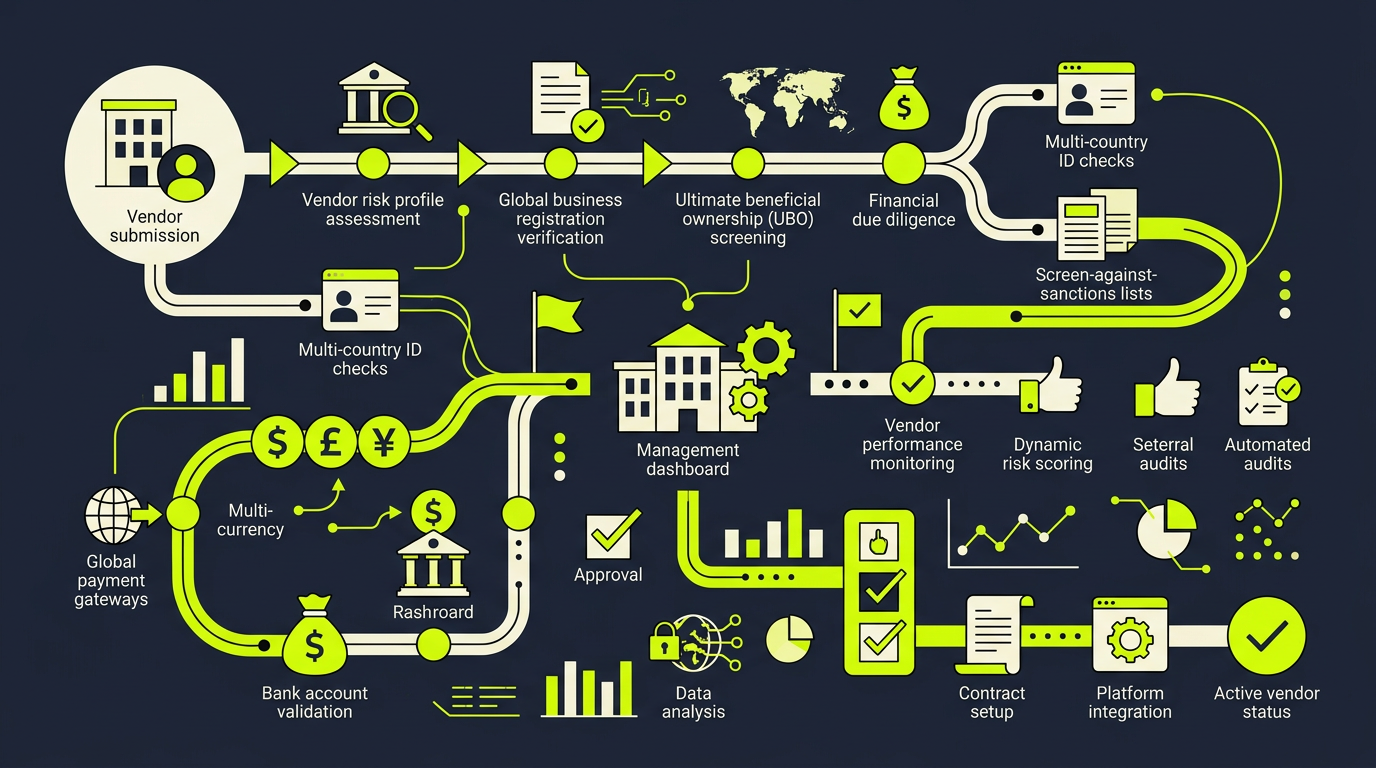
Once vendor data is ingested, Payouts.com orchestrates a series of automated compliance workflows through a branded, white-labeled Vendor Portal. The vendor is invited to the portal to complete their profile, which includes submitting necessary documentation and tax forms (W-9 for US persons, W-8 series for non-US persons) through a simple, digitized process. This is a critical component for companies looking at How to Automate KYC/AML for Global Mass Payouts.
Behind the scenes, the Payouts.com engine gets to work. We bring customer or supplier information together from multiple sources, running the provided data against thousands of global watchlists, sanctions lists, and adverse media sources for both individuals (KYC) and business entities (KYB). The system automatically verifies tax identification numbers and flags any discrepancies, creating a comprehensive risk profile before a single payment is ever made.
Step 3: Maintain a Two-Way Sync for a Perpetual System of Record
A true integration is a two-way street. After a vendor is successfully onboarded and verified within Payouts.com, their status, approved payment methods, and compliance documentation are synced back to your ERP or source system. This ensures that all your core systems share the same, up-to-date information, eliminating data silos and providing complete visibility across the organization.
This closed-loop system is the backbone of Touchless Finance. It ensures that your finance team, operating from the ERP, only sees and processes payments for fully vetted, compliant vendors. It transforms vendor onboarding from a fragmented, high-risk process into a streamlined, automated, and auditable function of the business.
The Strategic Impact of an Automated Onboarding Engine
Implementing a unified platform for vendor onboarding and payments is more than an operational upgrade; it's a strategic advantage. It allows your business to scale globally without the linear increase in administrative headcount, risk exposure, and payment friction that typically accompanies such growth.
Massively Reduced Operational Drag
By automating data collection, verification, and tax compliance, you eliminate countless hours of manual work for your finance and operations teams. The self-service Vendor Portal empowers vendors to manage their own information, reducing the query load on your team. This allows your talent to focus on high-value activities like financial analysis and strategic planning instead of chasing documents and correcting data entry errors.
Fortified Global Compliance and Risk Mitigation
An automated system applies the same rigorous compliance standards to every vendor, every time, across more than 150 countries. This consistency is impossible to achieve through manual processes. With automated, perpetual monitoring and auditable records of all verification steps, you are always prepared for an audit and protected from the risks of transacting with sanctioned entities. This is particularly crucial for platforms learning How Marketplaces Automate KYC & AML for Seamless Global Payouts.
A Superior Partner Experience
Your vendors are vital to your business. A smooth, transparent, and fast onboarding process sets the tone for the entire relationship. As Gaurav Gupta of Signzy notes in an article on choosing the best vendor onboarding platform, transforming complex regulatory workflows into seamless, automated products is key. Quick verification leads to quicker payments, which is a significant competitive advantage in attracting top talent and partners.
Furthermore, a platform like Payouts.com enhances the vendor experience with flexible payment options, including fiat payouts in local currencies and crypto payouts using stablecoins like USDT and USDC as a settlement layer. Features like Advanced Payment, providing instant liquidity to vendors, further solidify your status as a preferred partner to work with, driving loyalty and growth for your entire ecosystem.