

For any high-growth digital company-be it an ad network, a creator economy platform, or a marketplace-scaling globally is the primary objective. But expansion brings complexity, especially in payments. As you onboard hundreds or thousands of vendors, affiliates, or creators across 150+ countries, the administrative burden of managing Know Your Customer (KYC) and Anti-Money Laundering (AML) compliance can quickly overwhelm your finance and operations teams.
This 'administrative tax' doesn’t just add costs; it creates friction that stifles growth, delays payouts, and introduces significant regulatory risk.
Manually verifying identities, checking sanctions lists, and documenting compliance for every single payee is not a scalable model. Each transaction becomes a point of failure, risking delayed payments for your partners and legal penalties for your business. The challenge is to build a financial operating system that embeds compliance directly into the payment workflow, creating a 'touchless' process that is both efficient and secure.
This allows you to focus on operational scaling and financial optimization rather than getting bogged down in manual, repetitive tasks.
This guide provides a step-by-step framework for automating KYC and AML compliance for bulk international payouts. It outlines how to move from a manual, reactive approach to a proactive, automated system that supports growth, ensures regulatory adherence, and strengthens your relationships with your global partners. By implementing a robust compliance infrastructure, you can remove the operational bottlenecks that kill scaling companies and build a resilient payment ecosystem.
Understanding the Intersection of Payouts, KYC, and AML
At its core, KYC is the process of verifying the identity of your vendors or payees. It’s the foundational step of due diligence. AML refers to the broader set of procedures, laws, and regulations designed to prevent financials systems from being used for illegal activities. For businesses making mass payouts, KYC is a critical component of a larger AML compliance strategy. You cannot have effective AML without robust KYC.
The stakes are high. Global regulatory bodies like the Financial Action Task Force (FATF) and domestic agencies such as the Financial Crimes Enforcement Network (FinCEN) in the US mandate stringent compliance. Non-compliance can lead to severe fines, operational freezes, and reputational damage.
As your payout volume and geographic reach expand, so does your risk exposure. The complexity of global financial transactions and increasing regulatory demands are driving significant growth in the market for AML software.
Why Manual Compliance Fails at Scale
Early-stage companies often start with manual processes. A finance manager might personally collect W-9 forms or passports and manually check names against a government sanctions list. This works for a handful of vendors but collapses under the weight of hundreds or thousands. The process is slow, prone to human error, and creates a poor onboarding experience for payees who are eager to get paid.
Furthermore, a manual approach creates fragmented data silos. Vendor information lives in one system, payment instructions in another, and compliance documentation in a third. This lack of a unified view makes audits a nightmare and real-time risk assessment impossible. An effective payment operation requires a robust payments ecosystem where data flows seamlessly from onboarding to final settlement.
A Step-by-Step Guide to Automating Global KYC/AML
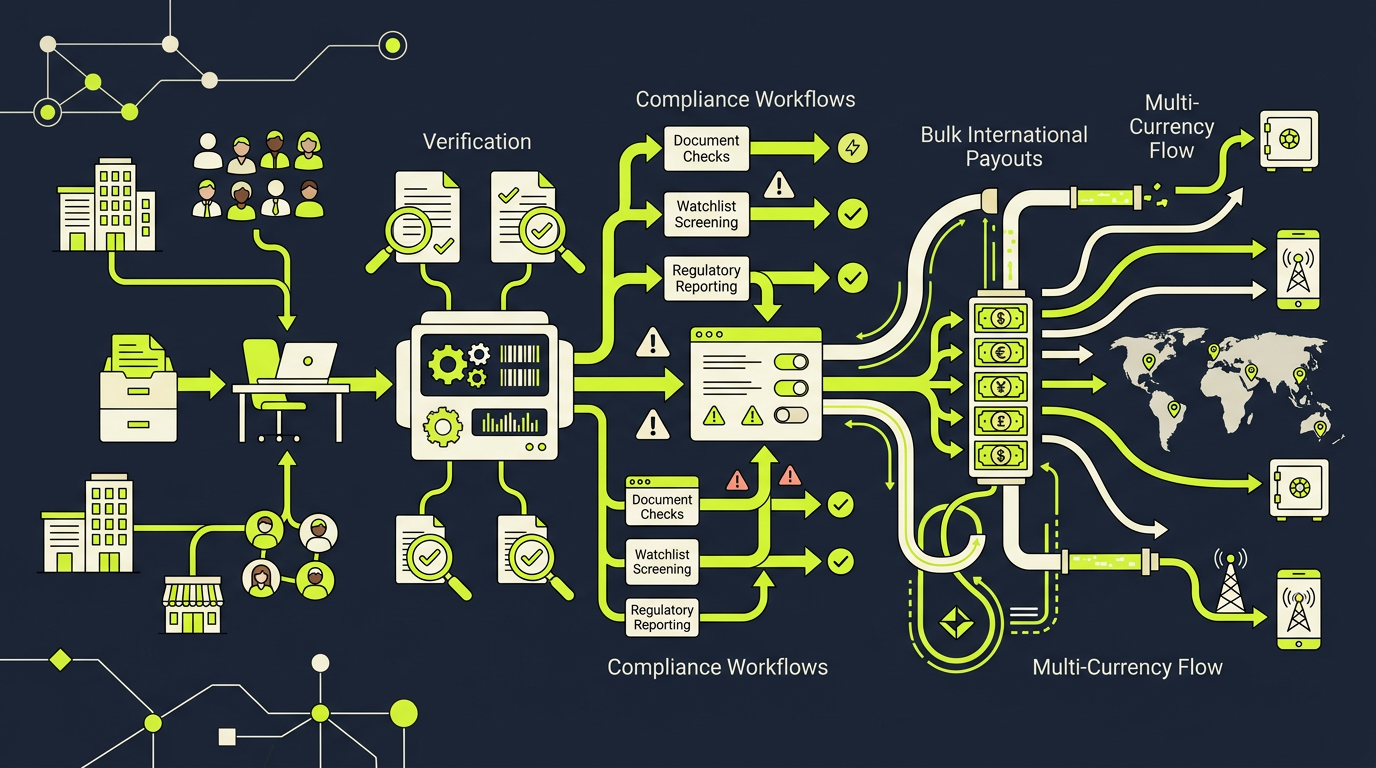
Transitioning to an automated system requires a strategic approach. It's about designing a workflow that is both compliant and frictionless. An Operations-First FinTech platform provides the necessary tools to build this system, integrating compliance into every stage of the payment lifecycle. Here’s how to structure your automated compliance framework.
Step 1: Centralize Vendor Onboarding with a Self-Service Portal
The first step is to eliminate manual data entry. A secure, white-labeled vendor portal allows payees to onboard themselves, providing all necessary identity information and payment details in one go. This is a core component of creating a Vendor Onboarding That Scales. The portal should be intelligent, dynamically requesting the right information based on the payee’s country and entity type.
For example, a US-based freelance writer would be prompted to submit a W-9, while a UK-based agency would provide their VAT number and company registration details. This self-service approach not only reduces the administrative load on your team but also empowers your vendors, giving them control and visibility over their information and payment status.

Step 2: Automate Identity Verification and Risk Screening
Once the data is collected, the verification process must be automated. Modern payout platforms integrate with global data sources and watchlists to perform KYC and AML checks in real-time. This includes screening individuals and entities against thousands of sanctions lists, Politically Exposed Persons (PEP) lists, and adverse media sources.
Automation replaces the tedious and error-prone task of manual checks. The system can automatically flag high-risk profiles for further review while allowing low-risk payees to be approved instantly. This risk-based approach is a cornerstone of effective AML and KYC compliance, ensuring your team's resources are focused where they are needed most. This level of automation is crucial for businesses managing payments for the creator economy or large affiliate networks.
Step 3: Integrate Compliance into the Payment Workflow
Compliance cannot be an afterthought; it must be embedded directly into the payment execution flow. An automated payout platform achieves this by linking the verified status of a vendor directly to their payment eligibility. If a vendor’s documentation is expired or they are flagged during a routine screening, payments can be automatically paused until the issue is resolved.
This integration ensures that not a single dollar goes out the door to an unverified or sanctioned entity. Platforms connect this compliance layer to over 600+ ERPs, including NetSuite, QuickBooks, and SAP. This means your core financial system always has a real-time, audit-ready record of both the payment and its underlying compliance status, a critical aspect explained in How Marketplaces Automate KYC & AML for Seamless Global Payouts.
Step 4: Leverage a Unified Platform for Ongoing Monitoring
KYC and AML are not one-time events. A payee’s risk profile can change over time. A robust system provides continuous monitoring, automatically re-screening your entire vendor database against updated watchlists. This ensures you remain compliant as global regulations and sanctions lists evolve.
A unified platform provides a single source of truth for all vendor data, tax forms (W-8/W-9), identity documents, and payment history. This holistic view is invaluable for audits and for providing executive-level reporting on your organization’s compliance posture. It’s a key element of building a resilient financial infrastructure that can handle high-volume batch payments with ease. The evolution towards real-time payments makes deep integration with payment APIs essential for businesses to stay competitive.
The Role of Technology: Financial Operating Systems for Global Scale
Addressing global compliance requires more than just a payment gateway; it requires a comprehensive financial operating system. Modern platforms are designed for businesses with complex, high-volume payout needs. These systems combine Payout Automation, a Vendor Management Suite, and Universal Connectors to create a touchless finance workflow from data ingestion to final settlement.
A flat-fee per transaction model is often preferred for scale, contrasting sharply with percentage-based fees that penalize growth. This is particularly beneficial for businesses in the ad tech and creator economy spaces, where transaction volumes are high. By unifying tax compliance, vendor onboarding, cross-border payments (in both fiat and crypto), and ERP integration, these platforms remove the operational friction that finance teams constantly battle.
Extending Compliance to Crypto Payouts
As businesses expand their payment options, the ability to pay out in stablecoins like USDT and USDC is becoming a key differentiator, especially for reaching payees in regions with challenging local banking infrastructure. However, crypto payouts introduce another layer of compliance complexity. Regulatory demands like KYC/AML are becoming increasingly important for digital assets, a trend observed in markets like Colombia where compliance obligations are increasing.
An automated payout platform extends the same rigorous KYC and AML standards to crypto transactions. Wallet addresses are screened, and the same identity verification rules are applied before any funds are disbursed. This treats crypto as a frictionless settlement utility-not a speculative asset-ensuring that even these modern payment rails are fully compliant. This is crucial for maintaining a strong compliance posture, a topic also covered in The CFO's Playbook for Global KYB Compliance and Payouts in 2026.
Conclusion: Building a Touchless Finance Function for Global Scale
For CFOs, Finance Directors, and Operations Managers at high-growth companies, the goal is to build systems that facilitate scale, not hinder it. Manual KYC and AML checks for international payouts are a significant hindrance-an administrative tax that consumes resources and introduces risk. Automating this critical compliance layer is fundamental to building a 'Touchless Finance' function.
By leveraging a unified platform to automate vendor onboarding, identity verification, risk screening, and payment execution, you can transform your payment operations from a cost center into a strategic advantage. You can pay tens of thousands of partners across 150+ countries as easily as you pay ten, all while maintaining the highest standards of regulatory compliance. This operational excellence is what frees your team to focus on strategic growth initiatives, secure in the knowledge that your global payout infrastructure is built to last.