

For high-growth digital companies, the obsession with the product and sales technology stack is relentless. Founders and CFOs rightly focus on tools that build, market, and sell. Yet, as companies scale globally, it’s rarely the product stack that breaks first.
The real scaling bottleneck - the one that silently grinds progress to a halt - is the operational and financial infrastructure. This hidden 'administrative tax' on growth is paid in manual hours, payment errors, and vendor dissatisfaction, stemming from a financial 'stack' that was never designed for global complexity.
The common response is to buy more software - another point solution for AP, a separate tool for tax forms, a third for international wires. This only exacerbates the problem, creating a Frankenstein's monster of disconnected systems. The solution isn’t more technology; it's a new operational paradigm. It’s time to move beyond fragmented tools and embrace a 'Touchless Finance' framework - an integrated financial operating system designed for scale.
This framework isn't about a single piece of software but an operations-first mindset. It's about designing financial workflows that are automated, compliant, and scalable by default. For businesses paying hundreds or thousands of stakeholders globally - from ad networks and affiliate agencies to creator platforms and AI influencer agencies - this isn't a luxury. It's the fundamental blueprint for sustainable global growth.
The Anatomy of Scaling Friction: Where Financial Operations Break Down
Scaling friction doesn't appear suddenly. It’s a slow-burning fire that starts in the finance department and eventually consumes operational capacity. The symptoms are familiar to any Finance Director at a high-growth startup: month-end close takes weeks instead of days, vendor payments are frequently delayed, and the CFO lacks a real-time view of cash flow. These issues are almost always rooted in deep operational fragmentation.
The Myth of the 'Single Solution' Stack
The search for a single, magical software solution is often where the trouble begins. In reality, finance teams are left to stitch together a patchwork of systems that don’t communicate. It's not uncommon for companies to be wrestling with numerous systems to manage their payment operations. A recent study highlights this dysfunction, revealing that many companies face significant problems with their payment systems precisely because their processes are fragmented across an average of 9.5 different systems.
This digital fragmentation forces finance professionals into a role they were never meant to fill: manual data integrators. They spend their days exporting CSVs from one system, manipulating them in spreadsheets, and importing them into another. This not only invites human error at every step but creates data silos that make a unified view of the company’s financial position an impossibility. This is where Your Top Talent is Wasted on Manual Finance Tasks.
Manual Processes: The Invisible Handbrake on Growth
While fragmentation creates chaos, manual work is the engine that drives it. Onboarding a new global freelance writer, for example, might involve a dozen manual steps: emailing for bank details, manually validating a W-8BEN form, keying the vendor into the ERP, and then again into the payment platform. Each step is a potential point of failure and a drain on resources.
This manual workload is a powerful handbrake on a company's ability to scale. It creates a direct, linear relationship between growth and administrative headcount. Want to expand into a new region? You need to hire more finance personnel to handle the unique payment and compliance needs. This approach is unsustainable, turning the very growth you’re striving for into an operational nightmare.

The Touchless Finance Framework: An Operations-First Approach
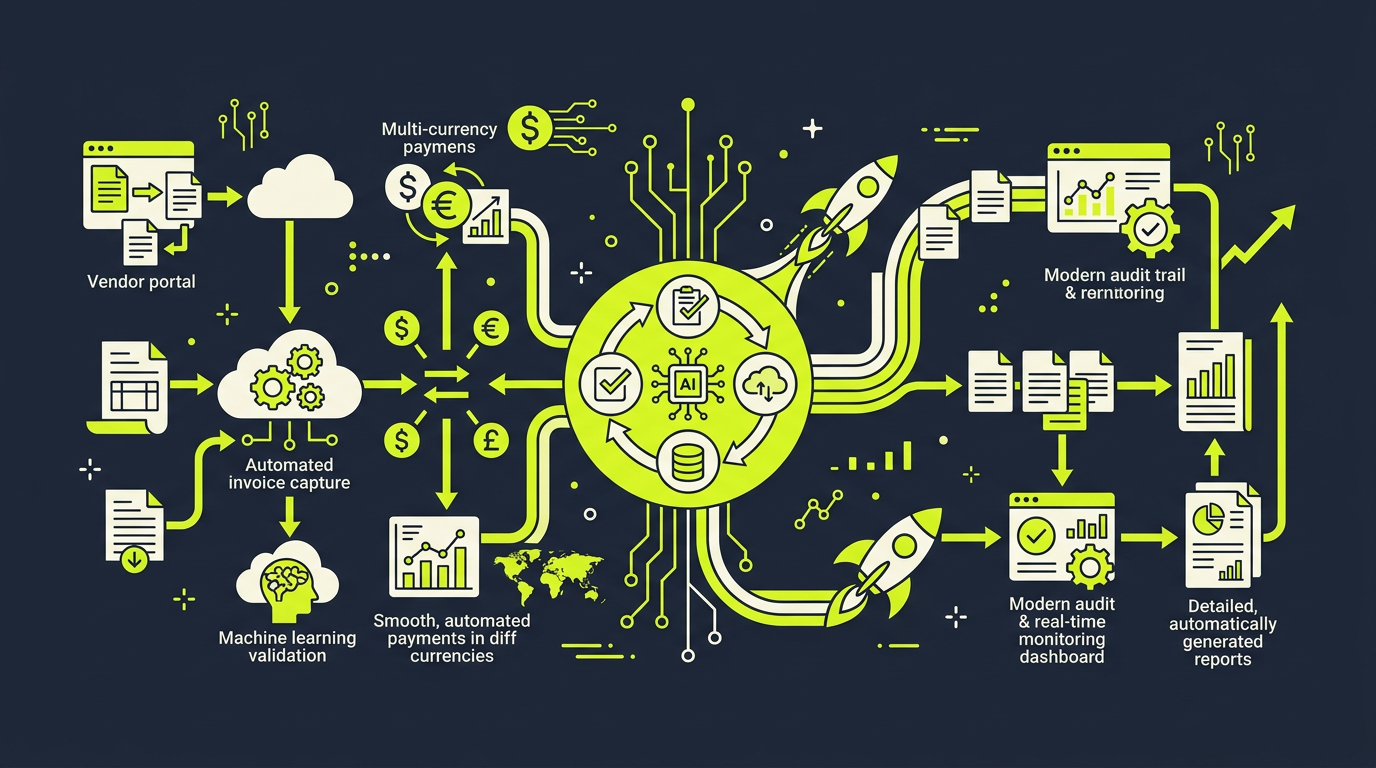
A 'Touchless Finance' framework directly counters this vision of fragmented, manual operations. It re-envisions financial processes, especially accounts payable and vendor payouts, as a unified, automated flow from end to end. The goal is to transform financial operations by automating invoice and payment handling from receipt to payment without constant human intervention.
This is the essence of being an 'Operations-First FinTech'. The technology must serve the operation, not the other way around. Instead of forcing your team to conform to the limitations of multiple disconnected tools, a financial operating system provides a single, cohesive platform. It orchestrates the entire payment lifecycle, from data ingestion and tax compliance to multi-currency disbursement and real-time reconciliation.
The Core Pillars of a Touchless Finance Model
Building a touchless finance model requires focusing on four interconnected pillars. Implementing them cohesively allows a business to remove the 'administrative tax' and build a financial foundation capable of handling hyper-growth. This structured approach, supported by a unified platform, is what separates companies that scale frictionlessly from those that crumble under their own operational weight.
Pillar 1: Unified Data Ingestion and Integration
The entire process begins with data. For a marketplace or creator platform, payout data might originate from a proprietary system. For a digital publisher, it comes from multiple ad networks. A touchless framework demands a single point of entry for all this data, eliminating manual uploads. This is achieved through a platform with robust API capabilities and a library of pre-built connectors.
This is why integration is paramount. A true financial operating system must connect seamlessly with your existing ecosystem. Platforms like Payouts.com ensure that payment data flows automatically, creating a single source of truth from your core business systems all the way to the final payment record.
Pillar 2: Automated Global Compliance and Vendor Management
For companies operating globally, compliance isn't just a best practice; it's a critical license to operate. Manually collecting and validating tax forms like W-9s for US vendors and W-8s for international ones is a high-risk, time-intensive task. A touchless framework embeds this process directly into the vendor onboarding workflow, making it a self-serve, automated function.
Through a dedicated Vendor Portal, payees can securely submit their own information. The system can then automatically validate tax information, perform necessary KYC (Know Your Customer) and KYB (Know Your Business) checks, and screen against sanctions lists. This codifies compliance, turning it from a manual bottleneck into an automated checkpoint. As experts note, establishing a strong culture of compliance is a strategic advantage, and automation is the key to achieving it at scale. You can learn more about How to Automate Global Tax Compliance for Seamless Vendor Payouts.
Pillar 3: Multi-Rail, Multi-Currency Disbursement
Once a payment is approved and compliant, the next friction point is the disbursement itself. Traditional banking systems are slow and expensive, especially for cross-border payments. High wire fees and punitive FX conversion rates eat into your margins and frustrate your vendors. A touchless model utilizes a multi-rail payment infrastructure to route payments intelligently.
Once a payment is approved and compliant, the next friction point is the disbursement itself. Traditional banking systems are slow and expensive, especially for cross-border payments. High wire fees and punitive FX conversion rates eat into your margins and frustrate your vendors. A touchless model utilizes a multi-rail payment infrastructure to route payments intelligently.
This means offering a range of payout options to vendors - from local bank transfers to instant virtual card issuance and even crypto payouts. Using stablecoins like USDT as a settlement layer, for example, provides a near-instant, low-cost way to pay vendors in regions with volatile local currencies or underdeveloped banking, all without engaging in cryptocurrency speculation. Adopting a flat-fee per transaction model further optimizes costs, providing predictable pricing that scales with your business.
Pillar 4: Real-Time, Two-Way Reconciliation
The final, and often most neglected, pillar is reconciliation. In manual systems, the finance team's work only begins after the payments are sent. They must manually match thousands of individual payment records from bank statements against the invoices in their ERP. This process is tedious and error-prone, leaving the books inaccurate for days or weeks.
A touchless framework closes the loop with automated, two-way data synchronization. When a payment is successfully processed, that status is automatically pushed back into the ERP, marking the corresponding invoice as paid. This creates a perpetual, real-time audit trail and eliminates the need for after-the-fact reconciliation, enabling a faster, more accurate month-end close.
From Tactical Burden to Strategic Enabler
The cumulative effect of this framework is a fundamental transformation of the finance function. The financial process automation market is projected to reach $23.54 billion by 2030 at a compound annual growth rate (CAGR) of 13.8%, driven by the growing focus on touchless finance operations. The most successful organizations are those that empower their finance and operations teams to automate without having to wait in line for IT resources.
By removing the 'administrative tax' of manual work, the Touchless Finance framework liberates your finance team to focus on high-value strategic activities. Instead of chasing down invoices and correcting payment errors, they can analyze spending trends, model cash flow, and optimize working capital. They shift from being financial historians to strategic business partners who can proactively identify opportunities and risks.
This strategic shift unlocks new capabilities. For instance, with a fully automated payables system, a company can offer 'Advanced Payment' options, providing instant liquidity to key vendors and creators. This isn't just a payment feature; it's a powerful tool for building loyalty and a competitive advantage in your ecosystem. Ultimately, solving for the financial operating stack isn't just about efficiency; it's about building an organization that is structurally capable of winning.
The organizations that will lead their industries are not necessarily the ones with the most sophisticated technology. As one analysis of no-code adoption states, they are the ones that figured out how to give their operations and finance teams the ability to build and automate without being stuck in IT backlogs. That ability to act is the ultimate competitive advantage.