

- Understand the Scope: What MiCA Defines as a Regulated Activity
- Embrace Authorization as a Strategic Advantage
- Fortify Your Internal Compliance and Governance
- Audit and Upgrade Your Payout Technology Stack
- Adopt a Forward-Looking, Phased Approach
- Conclusion: From Regulatory Burden to Operational Excellence
The European Union's Markets in Crypto-Assets (MiCA) regulation is no longer a distant concept; it's an operational reality for any global business that leverages digital assets for payouts. For CFOs, Finance Directors, and Operations Managers, MiCA represents a fundamental shift in the compliance landscape. It’s not about crypto speculation but about the utility of stablecoins and other crypto-assets as a frictionless settlement layer for paying vendors, creators, affiliates, and freelancers across the globe.
This regulation introduces a harmonized framework that brings clarity and legitimacy but also demands stringent operational adjustments.
Viewing MiCA through an 'Operations-First' lens is critical. This isn't just another compliance hurdle; it's a catalyst for building a more resilient, scalable, and efficient global payout infrastructure. For high-growth companies in the creator economy, ad tech, and digital marketplaces, using crypto for payouts solves real-world problems of speed and cross-border fees.
The challenge now is to integrate these benefits within a robust regulatory framework. This guide outlines the key strategic preparations your organization must undertake to navigate the impact of MiCA on corporate crypto payouts, turning a regulatory mandate into a competitive advantage.
- Understand the Scope: What MiCA Defines as a Regulated Activity
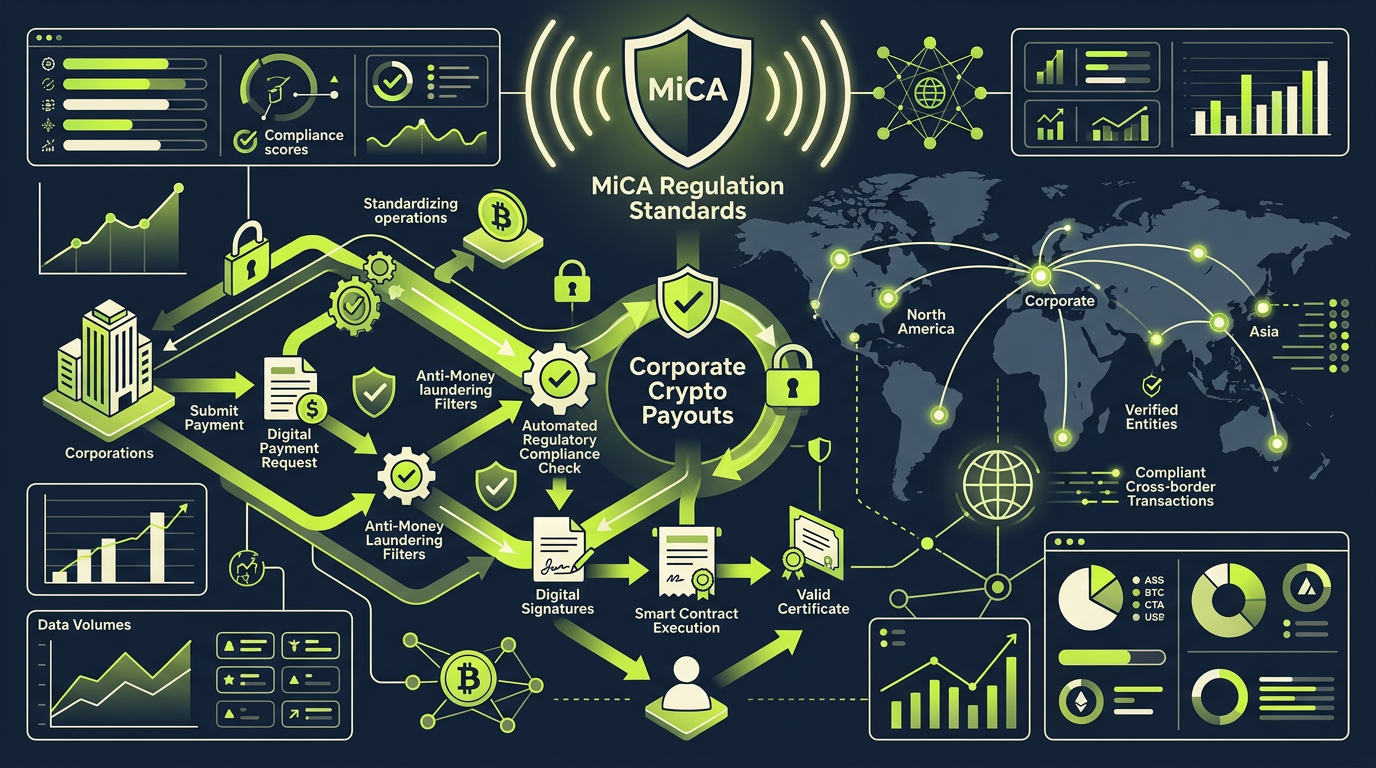
The first step in MiCA readiness is understanding its jurisdiction. The regulation is broad, targeting entities that issue crypto-assets or provide services related to them within the EU. For businesses that pay global stakeholders in stablecoins (categorized as asset-referenced tokens or e-money tokens), this means you are likely engaging in a regulated activity.
The EU's goal is to create a level playing field and protect consumers and investors, which it achieves by licensing Crypto-Asset Service Providers (CASPs).
Defining Your Role as a CASP
A core component of the legislation involves the authorization and supervision of CASPs. If your company facilitates the transfer or payment of crypto-assets to third parties, you may fall under this definition. This requires a deep your payment flows. Are you simply sending assets from a corporate wallet, or are you providing a more structured service for your payees? Understanding this distinction is fundamental, as becoming a licensed CASP involves significant governance, capital, and reporting obligations. Regulators are actively working to map the current landscape of entities providing these services to ensure consistent application.
Asset Categories and Future Considerations
MiCA categorizes crypto-assets into distinct groups, including asset-referenced tokens (ARTs), e-money tokens (EMTs), and utility tokens. The stablecoins most commonly used for corporate payouts (like USDT or USDC) fall squarely into these regulated categories. It’s also important to monitor the regulatory periphery.
For instance, the European Commission is currently assessing the need for specific regulations around NFTs, which could impact marketplaces and creative platforms. Staying informed on these developments helps future-proof your payment operations.
- Embrace Authorization as a Strategic Advantage
Achieving MiCA authorization should not be viewed as a purely defensive compliance measure. For scaling businesses, it is a significant strategic asset and a powerful competitive differentiator. In an environment where trust is paramount, being a regulated entity sends a clear signal to institutional partners, vendors, and banking relationships. It demonstrates a commitment to robust governance and long-term stability, which is crucial for building and maintaining a global payout network.
The Competitive Edge of a 'Passportable' License
One of MiCA’s most powerful features is the concept of 'passporting.' Once a company is authorized as a CASP in a single EU member state, it gains the right to operate across all 27 EU countries without needing separate licenses in each one. This dramatically reduces the administrative burden and cost of expansion, allowing businesses to scale their services across the European single market efficiently. This passport is widely considered a strategic necessity for any firm with serious ambitions in the region, providing a mark of legitimacy that attracts institutional-grade partners.
- Fortify Your Internal Compliance and Governance
MiCA mandates that CASPs have robust governance arrangements, including clear organizational structures and risk management policies. This is where operational readiness becomes critical. Your finance and operations teams must work in lockstep to build a framework that is both compliant and efficient, ensuring that the 'administrative tax' of regulation doesn't inhibit your ability to scale.
Integrate Robust AML/CFT and KYC/KYB Protocols
Strong Anti-Money Laundering (AML) and Counter-Financing of Terrorism (CFT) controls are a cornerstone of MiCA. This includes rigorous Know Your Customer (KYC) and Know Your Business (KYB) checks for all payees. For companies managing mass payouts to a global network of freelancers or affiliates, manual verification is not sustainable. The ability to automate KYC/AML for global mass payouts is essential for compliant scaling. The forthcoming establishment of a central EU Anti-Money Laundering Authority (AMLA) will only increase the scrutiny on these processes.
Prepare for New Tax Reporting Frameworks
Beyond AML, tax compliance is another critical frontier. Effective January 1, 2026, the Crypto-Asset Reporting Framework (CARF), integrated into the EU's DAC8 directive, will require CASPs to collect and report detailed transactional data on users for tax purposes. The first automatic exchange of this information between member states is set for 2027. This introduces a new layer of complexity that mirrors existing frameworks like FATCA and CRS, making it imperative to have a system that can handle diverse global tax requirements. Now is the time to review how to scale global tax compliance for 2026.

- Audit and Upgrade Your Payout Technology Stack
Your existing financial technology stack may not be equipped to handle the dual requirements of fiat and crypto payouts under a regulated environment. MiCA is a compelling event that should trigger a full audit of your payout infrastructure. The core question to ask is: does our current system reduce complexity or add to it?
A fragmented approach using multiple vendors for KYC, sanctions screening, tax compliance, and multi-currency disbursement creates operational drag and compliance blind spots.
The Power of a Unified Payout Platform
This is where a unified global payment automation platform becomes indispensable. By consolidating all payout functions into a single operating system, you can centralize compliance and data management. com, for example, is designed as an Operations-First FinTech platform that handles the entire lifecycle - from vendor onboarding and KYB/KYC to multi-currency disbursement in over 150 countries, including both fiat and crypto.
This approach allows your team to manage global payouts from a single dashboard, with compliance built into the workflow.
Seamless ERP Integration is Non-Negotiable
Real-time data synchronization is crucial for accurate financial reporting and reconciliation, especially in a regulated environment. A modern payout platform must offer deep, bi-directional integrations with your accounting or ERP system. With over 600+ ERP connectors to systems like NetSuite, QuickBooks, Xero, and SAP, Payouts.com ensures that all payment data, whether fiat or crypto, is accurately reflected in your general ledger. This eliminates manual data entry and provides a clean, auditable trail for compliance purposes. This level of automation is a core pillar of the CFO's Playbook for Global KYB Compliance and Payouts in 2026.
- Adopt a Forward-Looking, Phased Approach
MiCA compliance is not a one-time project but an ongoing process. The regulatory landscape will continue to evolve, and your operational strategy must be agile enough to adapt. Regulators have acknowledged that a one-size-fits-all approach may not be appropriate, suggesting that compliance rules should be tailored to the size and experience of the company. However, this should not be mistaken for a pass on core requirements.
Plan for 2026 and Beyond
With key deadlines approaching, particularly the CARF/DAC8 tax reporting requirements starting in 2026, the time to act is now. As discussed in a detailed analysis of MiCA regulation and EU crypto rules, businesses must begin implementing systems to collect the necessary user and transaction data. Waiting until the deadline is a recipe for operational disruption and compliance failure. A proactive approach involves building the necessary infrastructure today.
Conclusion: From Regulatory Burden to Operational Excellence
The Markets in Crypto-Assets regulation is a watershed moment for digital finance in Europe and a blueprint for regulators globally. For businesses leveraging crypto for mass payouts, it presents a clear choice: treat compliance as a burdensome cost center or embrace it as a catalyst for operational transformation. By understanding the scope, seeking authorization strategically, fortifying governance, and upgrading your tech stack, you can turn the MiCA challenge into a significant competitive advantage.
An Operations-First approach, powered by a unified payout automation platform, is the key to navigating this new era. It allows you to remove the administrative tax of manual compliance, scale with confidence, and focus on your core business, knowing your global payment operations are built on a resilient and compliant foundation. The regulatory framework is set; the time to build your operational response is now.