

For any high-growth digital company, the end of the year triggers a familiar, resource-intensive scramble: tax compliance. S. contractors and validating W-8 series forms for international partners grows exponentially.
This manual effort is more than just a seasonal headache-it's an operational drag that directly hinders your ability to scale. The administrative tax of chasing forms, validating TINs, and manually preparing filings consumes valuable finance resources that should be focused on strategic growth.
The complexity is intensifying. 1 Billion by 2034, driven by evolving regulations and the critical need for efficiency. For CFOs and Operations Managers at ad networks, creator economy platforms, and global marketplaces, the question for 2026 isn't whether to automate, but how.
Choosing the right approach is critical. A piecemeal solution can create more data silos and friction, while a unified strategy can transform compliance from a cost center into a streamlined, 'touchless' component of your financial operations.
This article provides a comparative analysis of the primary methods for managing global tax compliance, from basic e-filing tools to fully integrated payout platforms. We will evaluate the pros and cons of each approach to help you determine which model best supports your company's scale, geographic footprint, and operational goals for 2026 and beyond. The aim is to move from reactive, manual compliance to a proactive, automated system that supports global growth.
The Expanding Scope of Tax Compliance for Global Businesses
The conversation around contractor tax compliance often centers on Form 1099-NEC, but for businesses operating globally, this is only half the picture. Every international vendor or individual you pay requires the proper Form W-8 (e.g., W-8BEN or W-8BEN-E) to certify their foreign status and potentially claim treaty benefits to reduce tax withholding. Failing to collect and validate these forms creates significant compliance risk.
Furthermore, the regulatory environment is in constant flux. Beyond federal requirements, companies face a growing patchwork of state-level tax information reporting rules that add another layer of complexity. The deadlines for these filings, particularly the strict January 31st due date for Form 1099-NEC, leave no room for error. As noted by some experts, penalties for late filings can escalate quickly, turning what should be a routine process into a significant financial liability.
Evaluating Your Options: A Comparison of 1099 & W-8 Automation Strategies
As finance leaders plan for the 2026 tax season, they are generally faced with three distinct approaches to managing their compliance obligations. Each has vastly different implications for scalability, cost, and operational efficiency. The choice ranges from fragmented point solutions that solve a single problem to comprehensive platforms that redesign the entire payout workflow. We will explore these options side-by-side to clarify the trade-offs.
Approach 1: Standalone Tax E-Filing Software
The first step away from manual spreadsheets for many small businesses is standalone e-filing software. These tools are designed to do one thing: prepare and file 1099 forms with the IRS. To use them, you typically export payment data from your accounting system or payment ledger, manually upload it into the software, and use their interface to generate and submit the forms. Many services offer features to mail recipient copies and handle basic state filing requirements.
While this is a clear improvement over paper filing, this approach is fundamentally limited. It is a point solution that only addresses the final step of the compliance journey. It does not solve the critical upstream challenges of vendor onboarding, tax form collection (W-9/W-8), or TIN validation.
Your team is still responsible for manually collecting forms, tracking down corrections, and aggregating payment data from potentially disparate systems before the filing process can even begin. This method perpetuates data fragmentation and fails to create a single source of truth for vendor and payment information.
Approach 2: Accounts Payable (AP) Automation Suites
The next level of maturity is the AP automation suite. Platforms like Tipalti have built robust systems designed to streamline the entire accounts payable cycle, from invoice processing to payment execution and tax reporting. These platforms are particularly effective for companies managing a high volume of traditional vendor invoices and looking to centralize their AP workflow.
They often include supplier portals that facilitate the collection of tax forms and payment details, significantly reducing manual data entry.
AP automation tools excel at providing global tax compliance features for finance teams managing complex operations. They effectively unify the process from onboarding to payment and reconciliation within a traditional invoice-to-pay framework. This is a powerful solution for organizations whose primary need is to automate payments to vendors who submit formal invoices. However, for digital platforms like ad networks, creator marketplaces, or affiliate agencies with mass payout needs, this model may not be the optimal fit. Their focus is often on streamlining payments for thousands of recipients who are not submitting traditional invoices, requiring a different operational workflow.

Approach 3: Unified Payout Automation Platforms (The Operations-First Model)
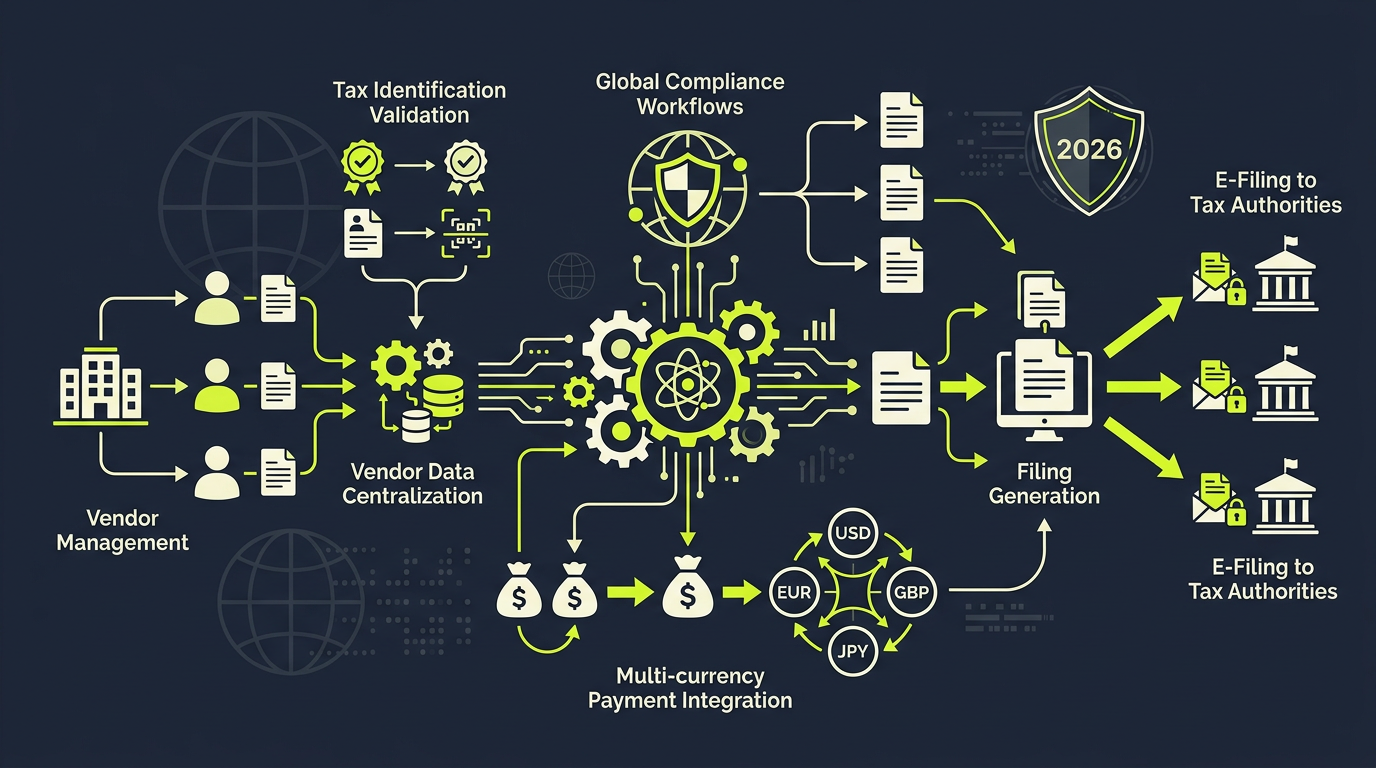
The most advanced approach transcends both standalone tools and traditional AP automation. A unified payout automation platform is an 'Operations-First FinTech' solution, a financial operating system designed specifically for businesses that need to pay large numbers of global stakeholders. This model integrates tax compliance directly into the payout workflow, creating a 'touchless finance' experience from end to end.
The entire process-from vendor onboarding and identity verification to tax form collection, payment disbursement, and year-end reporting-is handled within a single, cohesive system.
This is where Payouts.com operates. A self-service vendor portal is the cornerstone of this model. Payees are invited to the portal where they onboard themselves, selecting their country and payment method. The system intelligently prompts them for the correct tax form-W-9 for U.S. persons, W-8BEN/E for foreign entities-and validates the information in real-time. This completely removes the administrative burden of chasing and manually checking forms from your finance team. You can learn more about how to automate this entire process in our guide on How to Automate Global Tax Compliance for Seamless Vendor Payouts.
A Single Source of Truth for Payments and Compliance
Unlike fragmented approaches, a unified platform ensures that payment data and tax data live in the same place. When it comes time to generate 1099s, the system automatically aggregates all payments made throughout the year and populates the forms. There is no need for manual data export or import, which eliminates a major source of potential errors.
This is crucial for businesses with complex data flows, such as ad networks pulling impression data from one system and affiliate agencies calculating commissions in another.
With deep ERP integrations, platforms like Payouts.com can sync this data seamlessly with systems like NetSuite, QuickBooks, and Xero. This creates a fully reconciled financial ecosystem, providing CFOs with a real-time, accurate view of their payout operations and compliance status. This deep integration is a key component of building a scalable financial infrastructure, a topic we explore further in The CFO's Playbook for Global KYB Compliance and Payouts in 2026.
Optimizing for Global Scale and Cost Efficiency
For companies making thousands of payments globally, cost structure is paramount. Many payment solutions rely on percentage-based fees, which can become prohibitively expensive for high-volume payouts. A unified platform built on a flat-fee per transaction model offers predictable, transparent pricing that scales efficiently. This model is particularly advantageous for marketplaces and creator platforms that often deal with a high frequency of lower-value payments.
Furthermore, this model embraces modern settlement rails to reduce cross-border friction. Payouts.com leverages stablecoins like USDT as a settlement layer, enabling faster, more efficient international payments without the overhead of traditional correspondent banking. This is not about crypto speculation but about using distributed ledger technology as a utility to solve real-world payment friction for global businesses.
Making the Right Choice for Your 2026 Strategy
Choosing the correct tax compliance strategy depends entirely on your company's operational maturity and growth trajectory. There is no one-size-fits-all answer, but there are clear indicators that signal when it's time to evolve your systems.
When Standalone Tools or AP Suites Are Sufficient
If your business pays fewer than 20-30 domestic contractors annually and already uses a manual but manageable system, a simple e-filing tool like those reviewed on sites like 1099online.com might be enough to meet basic IRS deadlines. Likewise, if your company's primary challenge is automating invoice processing from a few hundred corporate vendors, a dedicated AP automation platform can provide immense value and is a significant upgrade over manual methods. These systems are powerful for the specific problems they are designed to solve.
When to Choose a Unified Payout Platform
The tipping point arrives when the complexity of your payout operations begins to actively slow down your growth. If your finance team is spending days each month on reconciliation, if you are paying vendors in more than a dozen countries, or if your payment data is scattered across affiliate networks and accounting software, you need a unified system. High-volume businesses require comprehensive automation that includes not just 1099-NEC and 1099-MISC capabilities but also robust W-9 and W-8 workflow support, as highlighted in expert breakdowns of best-in-class 1099 automation platforms.
Ultimately, the move to a unified platform like Payouts.com is a strategic decision to invest in a financial operating system built for global scale. It's about eliminating the 'administrative tax' of manual work and empowering your team to focus on high-value activities. By integrating vendor onboarding, global payments, and tax compliance into one touchless workflow, you build a resilient financial infrastructure that can handle the demands of a rapidly growing digital business.