

For any digital business scaling globally-be it an ad network, creator economy platform, or online marketplace-the promise of a borderless talent pool is immense. Yet, this expansion comes with a significant operational drag: managing tax compliance for a diverse and growing base of international vendors. S.
S. vendors. This is not just a paperwork problem; it's a fundamental barrier to scale.
The manual processes many companies still rely on are fragile, error-prone, and unsustainable. Chasing down vendors via email, manually verifying forms, and holding payments create bottlenecks that increase operational costs and, more importantly, damage crucial vendor relationships. As high-growth companies expand, this administrative tax stifles agility and diverts high-value finance talent to low-value tasks.
Achieving a state of "Touchless Finance," where payment operations are fully automated from vendor onboarding to final reconciliation, requires a strategic shift away from these outdated methods.
The Hidden Costs of Manual Tax Form Management
The inefficiency of manual tax compliance extends far beyond the hours spent on administrative work. It represents a significant and often unmeasured drain on company resources, introducing risks and operational friction that can impede growth. When finance teams are forced to act as compliance watchdogs, their strategic capacity is diminished, and the entire payout process becomes a source of frustration for both internal teams and external partners.
The Compliance Black Hole: Missing Forms and Payment Holds
In a manual system, vendor onboarding is often decoupled from compliance. A vendor might be approved and begin work long before a W-9 or W-8 form is requested. The result is a frantic, year-end scramble to collect missing documentation before 1099/1042-S filing deadlines.
This retroactive effort inevitably leads to payment holds, as finance cannot legally disburse funds without proper tax information on file. This creates a cascade of problems, including inaccurate financial forecasting, strained vendor communication, and an ever-present risk of non-compliance with IRS regulations.
The complexity is magnified in global settings. Distinguishing between a W-8BEN, W-8BEN-E, or W-8ECI requires specific expertise that AP clerks may not possess. Manual validation is often a superficial check for a signature rather than a thorough review of the information provided, leaving the company exposed to penalties. As a result, finance teams spend an inordinate amount of time managing exceptions instead of optimizing cash flow and strategy. This is a classic example where your top talent is wasted on manual finance tasks that are ripe for automation.
Damaging Vendor Relationships Before They Start
For a freelancer, creator, or affiliate, the onboarding experience is their first real impression of your company's operational competence. A clunky process involving email attachments, printable PDFs, and confusing instructions signals inefficiency. Top-tier global talent has choices, and they gravitate toward platforms that offer a seamless, digital-native experience.
When they have to chase payments or receive confusing communications about tax forms, it erodes trust and makes them less likely to prioritize working with your company.
Furthermore, communication barriers such as language differences and time zones can turn a simple request into a major hurdle. Unclear instructions can lead to incorrectly filled forms, creating more rework for both the vendor and the finance team. This friction-filled experience not only delays payments but also positions your platform as difficult to work with, impacting your ability to attract and retain the best global partners.

Comparing Approaches to W-8 & W-9 Automation
As businesses recognize the limitations of manual processing, they typically explore three different paths to automation. Each approach offers varying levels of efficiency, scalability, and integration, and choosing the right one depends on a company's operational maturity and long-term growth strategy.
Method 1: The 'DIY' Stack (Spreadsheets + Email + PDF)
This is the default starting point for most companies. The process involves emailing a PDF of a W-9 or W-8 form to a new vendor, who then has to print it, fill it out, sign it, scan it, and email it back. The AP team then manually transfers this information into a spreadsheet or accounting system. This method is fraught with security risks, as sensitive taxpayer identification numbers (TINs) are transmitted insecurely over email and stored in disparate, uncontrolled documents.
The'DIY' stack offers no real-time validation, meaning errors are only caught much later, typically during an audit or year-end filing. It provides no audit trail, no version control, and is completely unscalable. As the number of vendors grows from dozens to hundreds or thousands, this system collapses under its own weight, making it impossible to manage compliance effectively across a global vendor base.
Method 2: Point Solutions for Tax Form Collection
An improvement over the manual approach is the adoption of specialized software designed specifically to automate the collection of W-8 and W-9 forms. These tools provide a digital interface for vendors to complete their tax information, often with guided wizards and electronic signatures. Some solutions offer TIN validation to check the accuracy of the data against IRS databases in real-time, significantly reducing errors.
While these point solutions solve the immediate problem of form collection, they often introduce a new challenge: data fragmentation. The tax compliance tool becomes another siloed system that is disconnected from the core accounts payable and payment platforms. This means that finance teams still have to manually move data between systems or build costly, brittle API integrations to connect their tax software to their payment infrastructure, which may not be a core competency.
Method 3: Unified Payout and Compliance Platforms
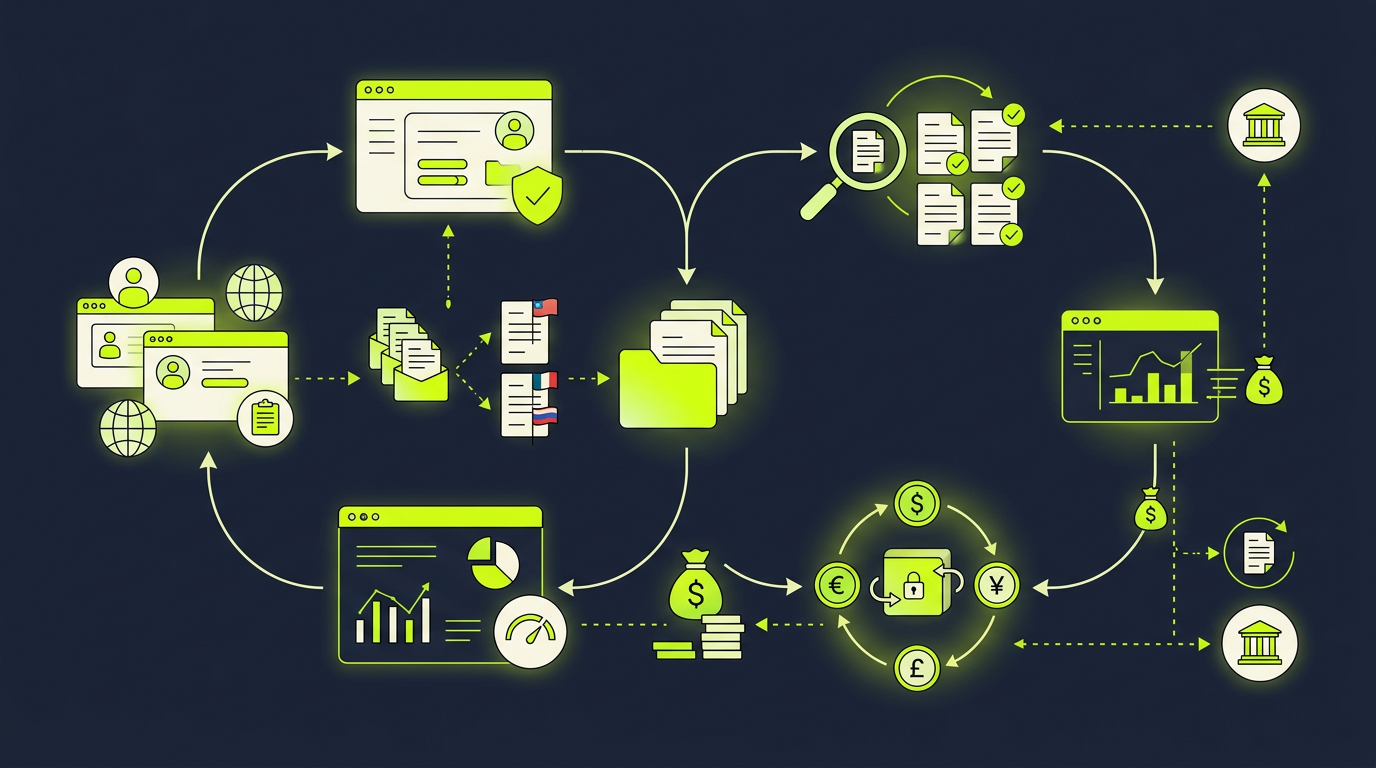
The most advanced approach integrates tax compliance directly into the vendor payment lifecycle. A unified platform treats tax form collection as a mandatory, automated step within a holistic vendor onboarding that scales. Instead of being an afterthought, compliance is built into the first interaction. A new vendor signs up through a branded portal, provides their payment details, and is immediately guided through a digital W-8/W-9 submission process before their first payment can even be initiated.
This 'Operations-First FinTech' model creates a single source of truth for all vendor data-identity, tax status, and payment preferences. With integration capabilities for various enterprise financial systems, the validated tax data flows seamlessly into the systems of record without manual intervention. This not only ensures 100% compliance before payment but also automates the entire procure-to-pay workflow, freeing the finance team to focus on strategic objectives instead of administrative tasks.
Beyond Forms: The Strategic Value of Integrated Compliance
Thinking of tax automation merely as a way to collect forms misses the larger strategic opportunity. When compliance is woven into the fabric of your financial operating system, it becomes a powerful tool for de-risking global operations and building a scalable, efficient foundation for growth. This is especially critical as tax authorities worldwide are accelerating their adoption of digital administration and reporting.
Creating a Single Source of Truth for Vendor Data
Fragmented vendor data is a silent killer of operational efficiency. When affiliate payout details are in one system, marketplace seller information in another, and freelancer invoices in an accounting package, a comprehensive view is impossible. A unified platform consolidates everything into a secure vendor portal. This centralization ensures that when a vendor updates their information, it propagates automatically, maintaining data integrity across the board.
This single source of truth is the bedrock of automation. It enables touchless workflows where an approved invoice can trigger a payment that is automatically reconciled in the ERP with the correct tax information attached. There's no need for manual data entry or cross-referencing spreadsheets, which dramatically reduces the risk of payment errors and compliance failures. This is the core principle behind building scalable financial infrastructure.
De-Risking Global Operations
An automated, integrated system provides an indelible audit trail for every vendor. From the moment they onboard to every payment they receive, their tax status, the form they submitted, and its validation are time-stamped and recorded. This robust documentation is essential for satisfying regulatory scrutiny and is a key component outlined in The CFO's Playbook for Global KYB Compliance and Payouts in 2026. It transforms compliance from a reactive, stressful event into a proactive, automated background process.
For companies operating globally, this risk reduction is paramount. The platform can automatically collect the correct tax forms based on a vendor's country of residence and validate their information against local requirements where possible. This embedded intelligence ensures that your organization remains compliant with a complex web of international regulations without needing a large, specialized internal team.
What to Look for in a Global Tax & Payout Solution
When evaluating platforms, it's crucial to look beyond a single feature and assess the entire system's ability to create a seamless operational workflow. The goal is to eliminate manual work and data silos, not just shift them around. A true operational-first platform should serve as the central nervous system for your global payouts.
Key Feature Checklist
First, look for automated, digitized tax form collection as a non-negotiable feature. The platform should guide vendors to the correct W-8 or W-9 form and validate the information in real-time. Second, a unified, self-service vendor portal is essential. This empowers vendors to manage their own information, reducing the support burden on your finance team. Effective AP automation and mass payments software should require tax form collection before enabling the first supplier payment.
Third, deep ERP integration is what separates a truly automated system from a glorified point solution. Ensure the platform has connectors for your financial system of record. Fourth, the platform must have robust global payment rails, supporting payouts across various countries and currencies. Finally, analyze the pricing model. A transparent, flat-fee per transaction model is typically more cost-effective for high-volume payouts than a percentage-based fee structure that penalizes scale.
Conclusion: From Administrative Burden to Strategic Advantage
Manually managing W-8 and W-9 forms is more than just an inconvenience; it's a strategic liability that actively hinders a company's ability to scale globally. The time, resources, and risk associated with outdated manual processes constitute an administrative tax that directly impacts profitability and operational agility. Chasing paper forms and correcting manual errors are not scalable activities.
By shifting from a fragmented, manual approach to a unified platform where tax compliance is an integrated part of the payment workflow, companies can eliminate this burden. An 'Operations-First' approach turns compliance into a strategic advantage, enabling faster vendor onboarding, ensuring global regulatory adherence, and freeing up finance teams to drive the business forward. This isn't just about better payment processing; it's about building a resilient financial operating system that supports infinite scale.