

For Chief Financial Officers, the current landscape presents a frustrating paradox. 8% for the coming fiscal year. Yet, converting that revenue into bottom-line profit remains a significant challenge; one collaborative study found that while 73% of CFOs expected revenue to increase, only 52% anticipated a corresponding rise in profitability.
This gap highlights a critical issue: operational friction is silently eroding margins and negating the impact of growth.
This friction is the "administrative tax"-a collection of manual, repetitive tasks that consumes the time of your most valuable asset: your finance team. It's the hours spent chasing invoices, manually reconciling cross-border payments, verifying tax forms, and patching together data from disparate systems. For high-growth digital companies-like ad networks, creator economy platforms, and online marketplaces-this tax isn't just a nuisance; it's a direct inhibitor to scaling.
As the volume of global vendors, freelancers, and affiliates multiplies, the administrative burden grows exponentially.
This operational drag is why an overwhelming 78% of CFOs report that fixing finance operations is their primary focus for technology spending. The objective is to transition to a state of "touchless finance." This isn't a distant, futuristic concept but a strategic imperative for survival and growth. It's about building a financial operating system that automates the entire payout lifecycle, freeing human capital to focus on strategic analysis and driving the business forward.
What is Touchless Finance, Really?
Beyond Simple Automation: An Operations-First Mindset
True touchless finance extends far beyond isolated automation tools. While some solutions may automate a single step like invoice scanning, a genuine touchless approach re-engineers the entire financial workflow from end to end. It's an operations-first model that prioritizes efficiency, accuracy, and scalability above all else.
Instead of simply digitizing a broken process, it creates a new, inherently automated one that requires human intervention only for strategic exceptions, not routine tasks.
This shift involves moving from slow, period-end closing cycles to a model of continuous, real-time financial data. As one analysis of finance trends notes, when systems are continuously updated, issues are surfaced as they happen, preventing bottlenecks and providing a much clearer view of an organization's financial health. Agentic AI can help finance teams move beyond individual task automation and instead continuously collect, coordinate, and analyze data from multiple sources to manage complex processes.
The Core Components of a Touchless Finance Ecosystem
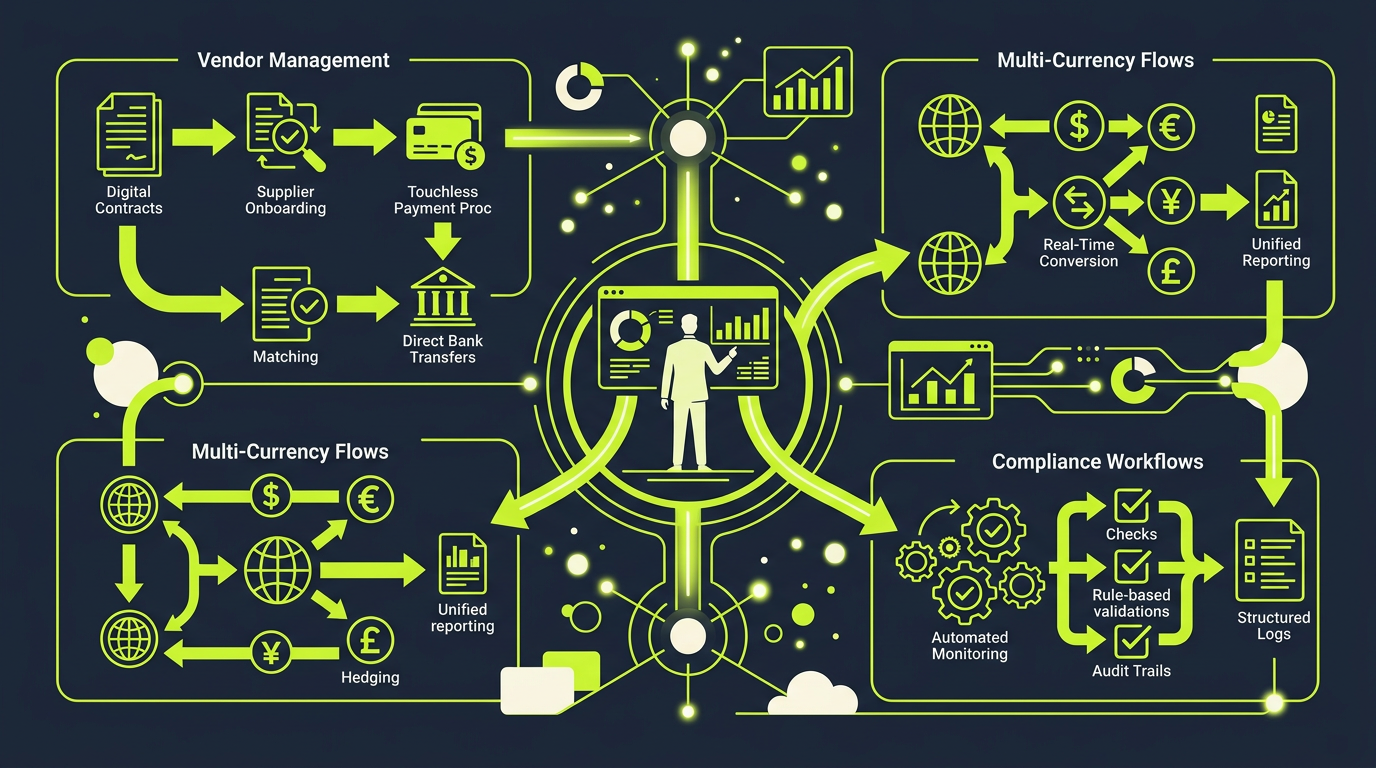
A comprehensive touchless finance platform is a unified financial operating system built on several key pillars. It starts with data ingestion and validation, using connectors to pull payment data directly from affiliate, ad network, or partner platforms, eliminating manual entry. Next, it handles the complete vendor lifecycle management, from digital onboarding and KYC/AML screening to the automated collection and validation of global tax forms like W-8s and W-9s.
Once data is in the system, touchless invoice processing and payment authorization take over, linking seamlessly with your ERP. The final stages are global disbursement and real-time reconciliation. This means executing payments across more than 150 countries and 135 currencies-including both traditional bank rails and stablecoins-and automatically closing the loop by posting all transaction data back to the general ledger. Every step is logged, visible, and auditable within a single system.
The CFO's 5-Step Roadmap to Implementing Touchless Finance
Transitioning to a touchless model is a strategic project that requires a clear, phased approach. For CFOs and Finance Directors, the goal is to systematically dismantle the manual processes that create drag on the organization and replace them with an automated, scalable, and compliant infrastructure. The following five steps provide a roadmap for this transformation.
Step 1: Audit Your 'Administrative Tax'
The first step is a thorough internal audit to quantify the cost of your manual operations. Task your team leaders to map every step of the current accounts payable and payout process, from vendor onboarding to final reconciliation. Where are the primary bottlenecks? Is it the time spent verifying banking details, approving invoices, managing currency conversions, or handling payment rejection queries? Identify the highest-volume, lowest-value tasks that consume the most person-hours.
For many global companies, a major source of friction is realized when they attempt to pay a diverse network of international partners. This is because, often, your payout stack was built for employees, not global contractors. The systems designed for domestic payroll are ill-equipped to handle the complexities of cross-border compliance, multi-currency disbursements, and the varied payment methods preferred by freelancers and vendors worldwide. Pinpointing this specific friction is crucial.
Step 2: Unify Your Vendor and Payment Data
Fragmented data is the enemy of automation. When vendor information resides in one system, invoices in another, and payment instructions in a third, manual reconciliation is unavoidable. The solution is to establish a single source of truth for all payee data. This involves centralizing vendor onboarding, banking information, tax documentation, and payment history into one unified platform.
A modern Vendor Management Suite achieves this by providing suppliers with a self-service portal. Here, vendors can onboard themselves, upload tax forms (which are automatically validated), choose their preferred payment method, and track payment status in real-time. Universal Connectors then sync this data with your other business systems, ensuring consistency and eliminating the risk of data entry errors. This creates a clean, auditable data foundation upon which all automation can be built.

Step 3: Integrate with Your Core Financial Stack
A touchless payout platform cannot operate in a silo. To deliver true efficiency, it must be deeply integrated with your financial core-your Enterprise Resource Planning (ERP) system. The goal of this integration is to enable a seamless, bi-directional flow of information. Approved bills and payment instructions flow from the ERP to the payout platform, and detailed reconciliation data flows back once payments are completed.
Look for a platform that offers extensive, pre-built ERP integrations. With connectors to leading systems like NetSuite, QuickBooks, Xero, and SAP, you can ensure that your general ledger is updated in real-time without manual journal entries. This continuous reconciliation provides an accurate, up-to-the-minute view of cash flow and financial positioning. As finance leaders who have completed their own AP automation journey can attest, this integration is fundamental to realizing value.
Step 4: Automate Global Compliance and Disbursements
Managing global payouts introduces significant compliance and logistical complexity. A touchless system must automate these processes to enable seamless scaling. This begins with embedding tax compliance directly into the vendor onboarding workflow. Digital W-8 and W-9 forms can be automatically collected, validated for accuracy, and stored for audit purposes, drastically reducing the administrative burden on your finance team.
The disbursement engine itself should be robust and flexible, offering multiple payment rails to serve a global payee base. This means supporting payouts to numerous countries in various local currencies, giving vendors the choice to receive funds in their preferred way. For businesses operating in the creator economy or with partners in emerging markets, leveraging stablecoins like USDT as a settlement layer can offer near-instant, low-cost transactions.
Pairing this capability with a transparent pricing model provides cost predictability.
Step 5: Leverage Data for Strategic Insight, Not Just Reporting
With a fully automated and integrated financial operating system, the role of the finance team undergoes a profound transformation. The focus shifts from historical data entry and reconciliation to forward-looking strategic analysis. While many finance leaders see ROI from AI, a staggering 71% admit they struggle to measure it accurately. A unified platform solves this by providing a comprehensive, real-time dataset on payment operations, costs, and cycle times.
This data can be used to optimize working capital, negotiate better terms with partners, and identify opportunities for cost savings. Furthermore, advanced platform capabilities like "Advanced Payment"-which provides instant liquidity to vendors-can be used as a strategic tool to attract and retain top-tier talent and suppliers. The CFO's function evolves from chief accountant to a strategic business partner, using data to drive growth and profitability.
The Tangible Outcomes of a Touchless Operating Model
Adopting a touchless finance model delivers clear and measurable benefits that directly address the core challenges faced by modern CFOs. The foremost advantage is a dramatic reduction in operational costs. By automating manual workflows, a business can fundamentally lower the cost to process an invoice and execute a payment, which is one of the key advantages of touchless invoice processing. This efficiency translates directly to improved margins and profitability.
Second, it unlocks unprecedented scalability. A touchless system allows a business to onboard and pay thousands of new global vendors, content creators, or affiliates without needing to hire additional finance staff. This operational elasticity is critical for high-growth companies looking to expand into new markets or launch new partnership programs. You are no longer constrained by the linear relationship between transaction volume and headcount.
Finally, this model enhances financial controls and strengthens the CFO's strategic position. Centralized data, automated compliance checks, and a complete audit trail significantly reduce the risk of errors, fraud, and regulatory penalties. This frees the finance team from its tactical burdens, allowing it to focus on higher-value activities.
8% annually, a touchless data foundation is what will enable CFOs to capitalize on these advanced analytical tools and truly guide the business.