

For high-growth digital companies-marketplaces, ad networks, and creator economy platforms-scale is everything. Your business model relies on expanding your network of vendors, affiliates, and creators across the globe. But as your payee count grows from hundreds to thousands, a silent, administrative tax begins to cripple your finance and operations teams: manual tax compliance.
Chasing down W-9 forms from US-based freelancers and the correct W-8 series forms from international partners is more than just a nuisance; it’s a direct threat to your ability to scale efficiently and compliantly.
This isn't a simple paperwork problem. Every missing or incorrect form represents a potential compliance breach, a delayed payment to a valuable partner, and hours of wasted operational time. The manual approach, often involving emails, spreadsheets, and manual data entry, is fundamentally broken for businesses operating at a global scale. It creates a significant Global Vendor Onboarding Compliance Risk that can lead to severe financial penalties and damage your company’s reputation. As you expand into new markets and engage talent across 150+ countries, the complexity multiplies, making a robust, automated solution not just a 'nice-to-have,' but a core requirement for survival and growth.
The Crushing Weight of Manual W-8 & W-9 Management
The administrative burden of manual tax form collection is a significant operational drag. Finance teams in rapidly growing companies are often consumed by low-value tasks that directly inhibit strategic growth. Instead of focusing on financial planning and analysis, they are bogged down in the tactical, repetitive work of requesting forms, checking for completeness, and manually keying information into various systems.
This administrative tax only increases as the company grows, creating a cycle of inefficiency that is impossible to escape without a fundamental process change.
1 Billion by 2034, driven by this rising need for efficiency. This highlights a market-wide recognition that manual processes are no longer viable. For platforms paying hundreds or thousands of global vendors, the cost of this inefficiency isn't just measured in wasted hours.
It's measured in delayed partner payments, strained relationships, and the inability to seize growth opportunities because the back-office cannot keep up with the front-office's ambitions.
The High Cost of Data Entry and TIN Mismatches
Manual data entry is inherently prone to error. A single typo in a name or Taxpayer Identification Number (TIN) can create a mismatch that has significant financial consequences. For payments to US persons, a missing or incorrect TIN on a Form W-9 can trigger a mandatory 24% backup withholding. As one compliance guide notes, this penalty can be avoided by implementing real-time TIN validation at the point of onboarding to catch mismatches before they become a liability. This prevents the need to withhold funds, which can damage the trust and goodwill you’ve built with your payees.
The problem extends beyond simple typos. Payees may submit incomplete forms, forget a signature, or provide an out-of-date version. Each of these issues requires a finance team member to initiate a time-consuming follow-up process, further delaying the onboarding and payment cycle.
For international vendors submitting W-8 forms, the complexity is even greater. , a W-8BEN for an entity instead of a W-8BEN-E) can lead to incorrect tax withholding and treaty benefit claims, creating a messy and costly cleanup process down the line.
Audit Risk and the Specter of Non-Compliance
Maintaining a complete and accurate record of all W-8 and W-9 forms is not just good practice; it’s a legal requirement. In the event of an IRS audit, your organization must be able to produce the correct, validated tax form for every vendor payment made. Manually managed systems, often relying on a patchwork of email inboxes and shared drives, make this nearly impossible. According to an industry best practice, it's critical to centralize storage and maintain a single source of truth for all collected forms. Without it, finding the correct, current form for thousands of vendors becomes a monumental task.
The consequences of failing an audit can be severe, ranging from financial penalties for non-compliance to reputational damage. The IRS does not view operational inefficiency as a valid excuse for missing documentation. A fragmented, manual system exposes the business to unnecessary risk. This is why a proactive approach to compliance is essential, understanding Why Just Filing 1099s & 1042s Isn't Enough. The underlying data collection and validation process must be auditable and complete.
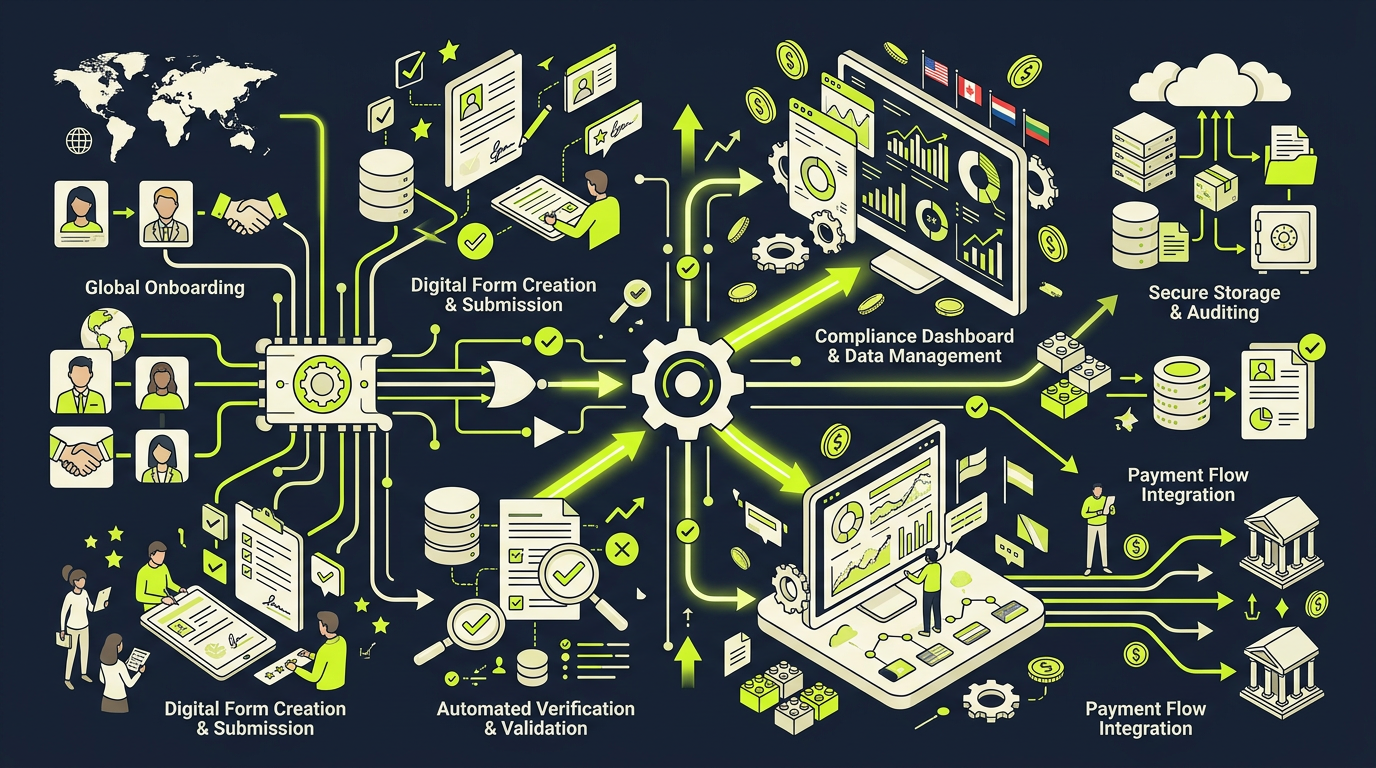
The Operations-First Approach to Tax-Compliant Onboarding
To truly solve the challenge of W-8/W-9 collection at scale, companies need to adopt an 'Operations-First' mindset. This means fundamentally re-architecting the process away from a post-payment correction nightmare to a pre-payment validation workflow. The goal is to build a touchless finance infrastructure where compliance is an integrated, automated part of the payee onboarding journey, not a manual, after-the-fact cleanup project.
This approach redefines tax compliance as a seamless, digital experience for the payee and an automated, error-proof process for the payer. By embedding the collection and validation of tax information directly into the vendor portal and initial setup, you ensure that 100% of your payees are compliant before a single dollar is disbursed. It's a strategic shift that transforms compliance from a cost center into a competitive advantage, enabling smoother global operations and faster, more reliable payments.
Shifting from Remediation to Prevention
The traditional model of tax form collection is reactive. A payment is scheduled, the finance team realizes a W-9 is missing or expired, and a frantic chase begins. This puts the finance team in a constant state of fire-fighting. An automated, operations-first model is proactive. As noted in a guide to W-9 automation, modern AP automation software requires tax form collection before enabling the first supplier payment. This simple but powerful rule change eliminates the downstream chaos of remediation.
By gating payments on the successful submission and validation of a tax form, you create a powerful incentive for payees to provide accurate information promptly. This preventative approach ensures that your vendor master file is always clean, your compliance posture is always strong, and your finance team is freed from the endless cycle of chasing down missing paperwork. It turns the onboarding process into the primary line of defense against compliance risk.
Key Components of a Scalable Tax Automation System
Building a touchless system for global tax compliance requires more than just a digital form. It requires a holistic platform that integrates the user experience, data validation, and backend financial systems into a unified workflow. This system becomes the financial operating system for managing your global network of payees, providing a single source of truth for both your operations team and your vendors.
A Unified Vendor Portal with Guided Self-Service
The foundation of a modern tax compliance system is a self-service vendor portal. Instead of emailing PDFs, you provide payees with a secure, branded environment where they can manage their own information. A critical feature of this portal is a guided tax form wizard.
This tool asks the payee a series of simple questions to determine the correct tax form they need to fill out-whether it’s a W-9 for a US person or the appropriate W-8 for a foreign individual or entity. This removes the guesswork for payees and prevents the submission of incorrect forms.
This self-service approach not only improves data accuracy but also enhances the payee experience. Vendors appreciate a clear, streamlined process that helps them get paid faster. By providing clear instructions and support, you can educate vendors and help them easily navigate the digital submission process. This automated, guided workflow is central to Scaling Global Tax Compliance for 2026: A Comparison of 1099 & W-8 Automation, making compliance a frictionless part of the relationship.
Real-Time TIN Validation and Verification
A digital form is only as good as the data it contains. The most crucial piece of data on a W-9 or W-8 form is the Taxpayer Identification Number (TIN). An automated system must include real-time TIN validation against IRS databases at the point of entry. When a vendor submits their form, the system should instantly check if the combination of name and TIN is valid. This catches typos and errors before they ever enter your system.
This immediate feedback loop is critical for preventing the 24% backup withholding penalty associated with incorrect TINs. As platforms that pay contractors and gig workers know, catching mismatches before they result in withholding obligations is essential for maintaining smooth payout operations. If a mismatch is detected, the vendor is instantly prompted to correct their information, resolving the issue in seconds without any manual intervention from your finance team.
This single feature saves countless hours and eliminates a major source of payment friction and compliance risk.
Seamless ERP Integration for a Single Source of Truth
A tax automation solution cannot operate in a silo. To achieve a true 'touchless finance' state, the data collected and validated in your vendor portal must flow seamlessly into your core financial systems. That’s why deep, bi-directional integration with ERPs and accounting systems like NetSuite, QuickBooks, Xero, and SAP is a non-negotiable requirement.
This ensures that your ERP, the ultimate system of record for your financials, is always up-to-date with the latest, validated vendor tax information.
This integration eliminates the need for manual data entry between systems, which is a major source of errors and inefficiency. Best practices for automation success emphasize the need to connect your automation tool with your ERP. When a vendor updates their information in the portal, it automatically syncs to your accounting system, ensuring consistency and accuracy across your entire tech stack.
This creates a single source of truth, providing a complete and auditable trail for every vendor from onboarding to final payment.
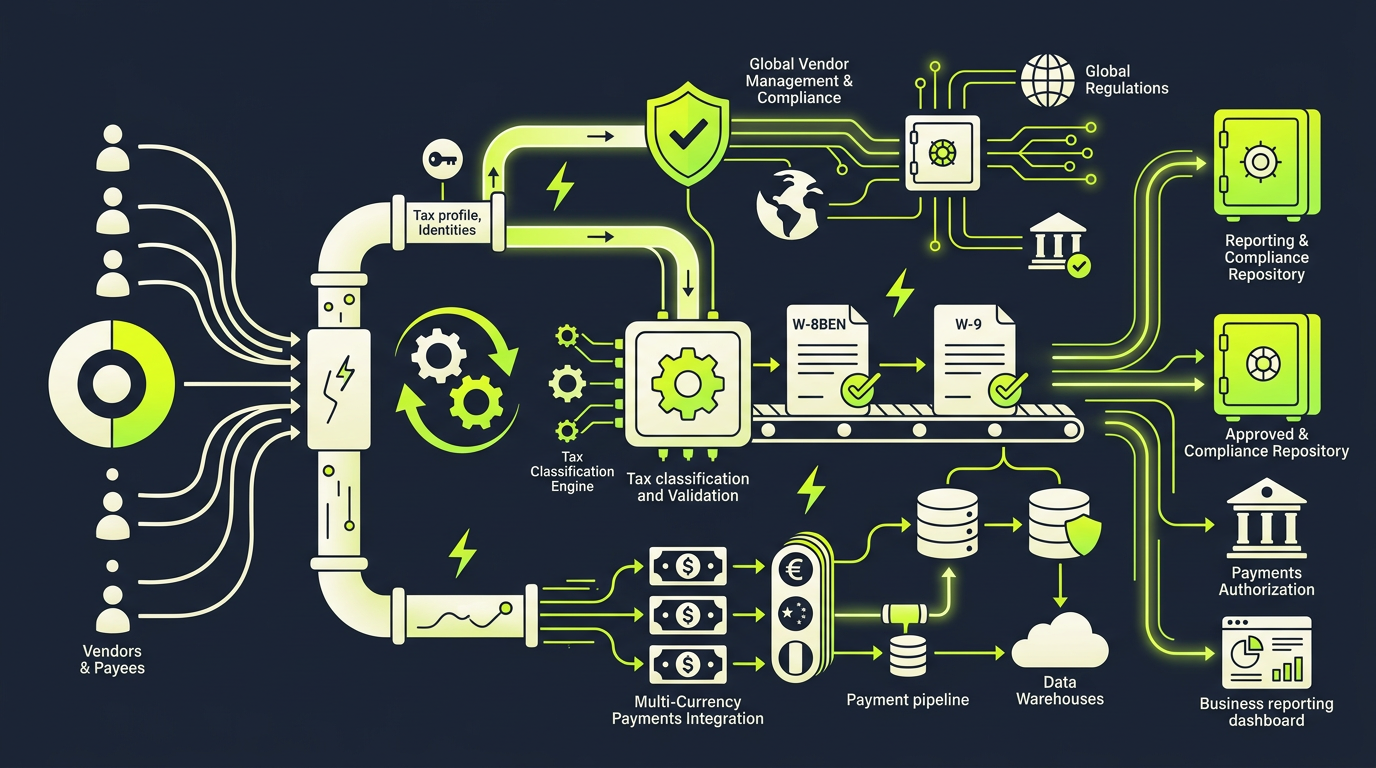
From Static Collection to Lifecycle Management
Tax compliance is not a one-time event. It's a continuous process that requires ongoing management. A W-8 form, for example, typically expires after three years, and a vendor's status can change. A truly automated system accounts for this lifecycle, managing not just the initial collection but also the ongoing validity of the forms in your system.
This means your system must automatically track expiration dates and trigger reminders to vendors to submit updated forms well before the old ones become invalid. This proactive management prevents compliance lapses and ensures that your records are always current. By automating these recurring tasks, you can standardize the workflow and maintain compliance without constant manual oversight, closing gaps that are otherwise exposed in high-volume payee environments.
The Future is Touchless and Global
For companies competing on a global stage, manual processes are no longer a viable option. The administrative tax of chasing W-8s and W-9s, correcting TINs, and managing expirations directly inhibits the speed and agility required to win. The future of financial operations is touchless, where compliance is an automated, integrated, and invisible part of a seamless global payment infrastructure.
By embracing automation, you aren't just buying software; you are investing in a scalable foundation for growth. You are liberating your finance team to focus on strategic initiatives, improving relationships with your global payees, and building a resilient, compliant business that is ready for any opportunity, anywhere in the world. Platforms built for scale know that W-9/W-8 automation is the first, critical step towards simplifying tax data management and unlocking true operational efficiency.