

The global affiliate marketing industry is in a state of sustained growth, with projections showing it will expand at a compound annual growth rate of nearly 10% through 2027. For CFOs and finance directors at high-growth ad networks, creator economy platforms, and marketplaces, this expansion brings a significant operational challenge: scaling global payouts. As your network of affiliates, influencers, and vendors expands across borders, the complexity of tax compliance grows exponentially.
The conversation often gets stuck on a seemingly simple question: should we issue a Form 1099-NEC or a Form 1042-S?
This question, while important, is a distraction from the real issue. Focusing only on which form to file is like worrying about the color of a car when you haven't built the engine. The true challenge isn't identifying the correct form; it's architecting a scalable, automated financial operating system that handles tax compliance, cross-border payments, and data management seamlessly. Without this
This guide provides a different perspective. We argue that the 1099-NEC vs. 1042-S debate is the wrong starting point. Instead, we'll outline a step-by-step approach for building a robust operational framework that makes tax compliance a byproduct of an efficient payout system, not a manual, year-end scramble. It's time to move beyond the forms and build a touchless finance function.
Understanding the Core Distinction: 1099-NEC for U.S. Payees
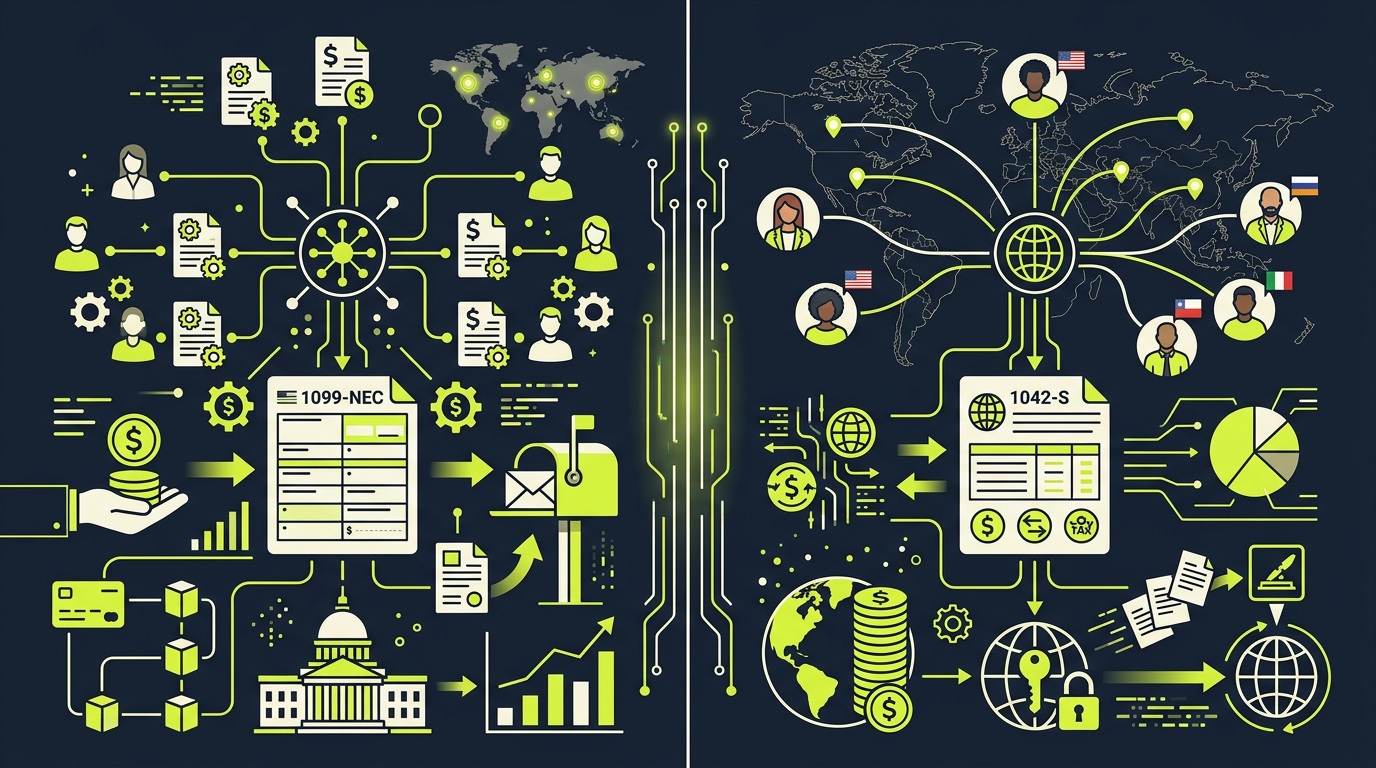
At its core, the distinction is straightforward. Form 1099-NEC is used to report compensation of $600 or more paid to nonemployees for services performed within a tax year. The key determinant for this form is the payee's tax status. A 1099-NEC is exclusively for U.S. persons and entities. This seems simple enough, but the process of verifying that status is where the first operational crack appears.
The Role of Form W-9
Before you can even consider issuing a 1099-NEC, you must have a valid Form W-9, Request for Taxpayer Identification Number and Certification, on file for the payee. This form is how your U.S.-based affiliates, freelancers, or vendors certify their name, address, and Taxpayer Identification Number (TIN). Collecting these forms manually via email is a non-starter for any scaling business; it's insecure, inefficient, and prone to human error.
A scalable system digitizes this process. By integrating W-9 collection directly into a vendor onboarding portal, you automate the collection and validation of this critical data from day one. This proactive approach ensures you have the necessary information long before the payment is even made, transforming compliance from a reactive task into a proactive, automated workflow.
The right platform can even perform TIN matching to ensure the data provided is accurate, reducing the risk of B-Notices from the IRS.
Beyond the $600 Threshold
The $600 threshold for filing a 1099-NEC is a well-known rule, but relying on manual tracking to monitor payments for thousands of global vendors is an operational bottleneck. A modern payout platform tracks payment totals for each vendor automatically. This removes the administrative burden and ensures that as soon as a U.S. vendor crosses the threshold, they are flagged for 1099-NEC reporting without any manual intervention from your finance team.
It is also crucial to understand which payments are excluded. Payments made via credit cards or third-party payment networks like PayPal often fall outside the scope of 1099-NEC reporting, as the processor may have its own reporting obligations (like Form 1099-K). Building a system that can differentiate between payment methods is a key part of an effective strategy for Best 1099 Automation Platforms (January 2026) | Routable.
The Global Component: When Form 1042-S is Required
Form 1042-S, Foreign Person's U.S. Source Income Subject to Withholding, governs payments made to non-U.S. persons and entities. This is where the complexity multiplies for global affiliate networks and marketplaces. The form is required for reporting payments of U.S. source income, which includes commissions and service fees earned by foreign affiliates for activity connected to the United States.
The trigger for a 1042-S is not a dollar threshold but the combination of the payee's status (foreign) and the income's origin (U.S. source). To properly manage this, you must first correctly identify your non-U.S. vendors. This is accomplished by collecting the appropriate Form W-8 (e.g., W-8BEN for individuals or W-8BEN-E for entities), which certifies the payee's foreign status.
The Critical Role of Withholding
Unlike most 1099-NEC filings, payments reported on a 1042-S are subject to a mandatory U.S. tax withholding. According to IRS guidelines, the 1042-S default withholding rate is a flat 30% of the gross payment. This is the single biggest operational challenge for companies paying foreign vendors manually. Failing to withhold and remit this tax to the IRS can result in significant penalties and liabilities for your business.
S. and the payee's country of residence. S. or foreign TIN on their Form W-8. A payout platform built for global operations can automatically calculate the correct withholding amount based on the vendor's country and the information provided on their digitized W-8, removing a massive compliance and calculation burden from your team.
A How-To Guide: Building a Scalable Tax Compliance Workflow
Simply knowing the difference between the forms is insufficient. The solution lies in building an operational machine that handles compliance automatically. This transforms your finance function from a cost center burdened by administrative tasks into a strategic enabler of global growth.
Step 1: Automate Vendor Onboarding and W-8/W-9 Collection
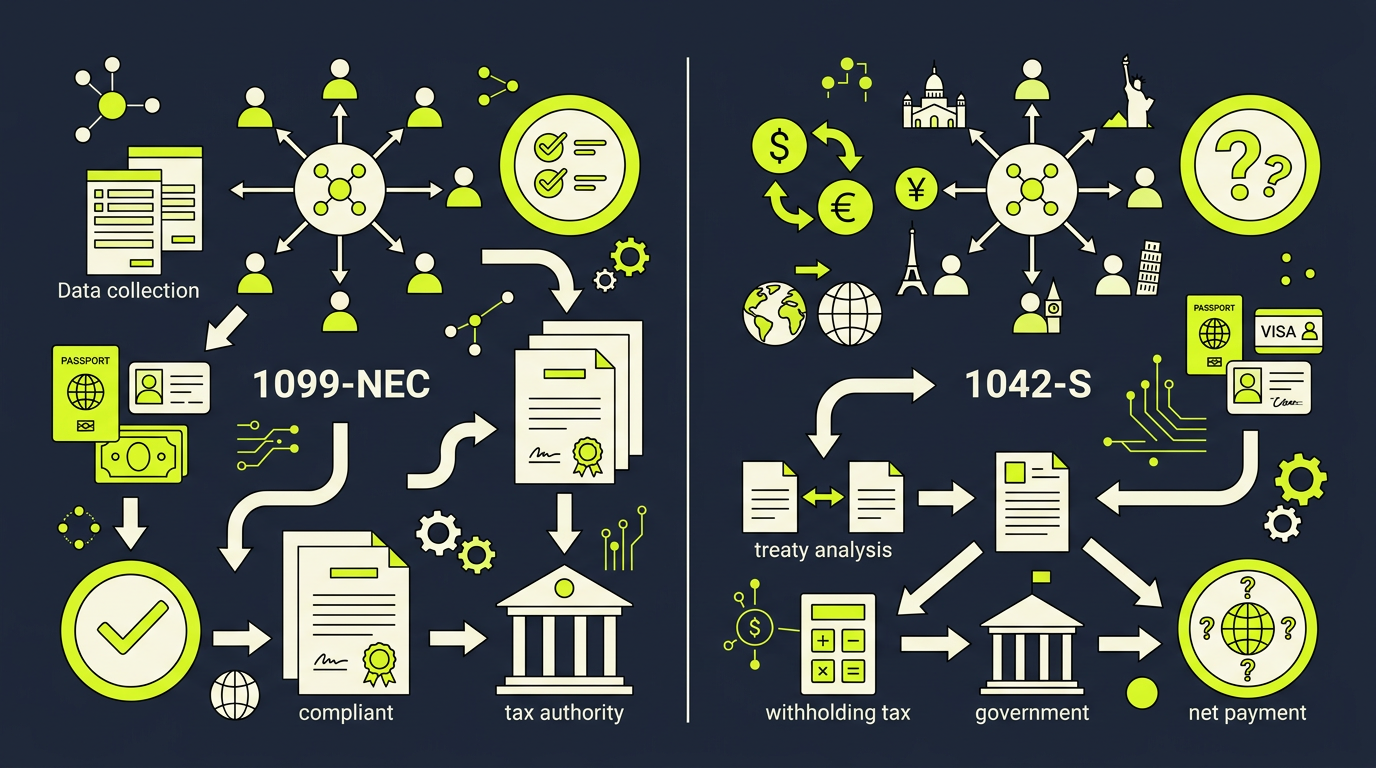
The foundation of a touchless system is a self-service vendor portal. When a new affiliate or creator joins your network, they should be directed to an online portal to enter their own information. The system should intelligently guide the user, asking a series of questions to determine whether they are a U.S. or foreign person. Based on their answers, it should present them with a digital, easy-to-complete Form W-9 or the appropriate Form W-8.
Step 2: Integrate Tax Status into Your Payout Logic
Once a vendor's tax status is captured and validated, that data point must be integrated directly into your payables workflow. This is not just about storage; it's about action. A payee's status as a U.S. person (from a W-9) or a foreign person (from a W-8) should automatically dictate the compliance path for every single payment made to them. This eliminates the guesswork and manual checks that kill efficiency when scaling global influencer payouts.
Step 3: Implement Real-Time Withholding Calculations
For your foreign payees, the system must automatically apply the correct withholding rules. -Germany tax treaty rate, and calculate the appropriate withholding (if any) before the payment is executed. The withheld funds are then automatically tracked for remittance to the IRS, and the net payment is sent to the affiliate.
This level of automation is impossible with spreadsheets and manual wire transfers.
Step 4: Centralize Data for Year-End E-Filing
Throughout the year, the platform should aggregate all payment data, vendor tax information, and withholding amounts into a single, unified ledger. When tax season arrives, generating and e-filing Forms 1099-NEC and 1042-S becomes a simple, automated process. The filing deadline for Form 1042-S is March 15, and a centralized system ensures you meet this deadline without a last-minute fire drill. This unified approach is a core principle discussed in articles on 1099, TIN Matching, B-Notice, FATCA, 1042-S Compliance Seminar.
Furthermore, this centralized data allows for a streamlined correction process. If you discover an error, there's no need to dig through old files. As guidance from experts at Paychex suggests, correcting a form often requires filing a new, corrected version and sometimes zeroing out the old one. An automated system simplifies this by maintaining a clear audit trail, a stark contrast to the chaos of manual record-keeping.
Beyond the Forms: Operationalizing Touchless Finance
A truly mature finance operation thinks beyond individual tax forms and focuses on the underlying infrastructure. The goal is to create a financial operating system that connects vendor management, tax compliance, and global payments into a single, automated workflow. This eliminates the
ERP Integration: The Single Source of Truth
Your payout platform should not be another data silo. To achieve true touchless finance, it must have deep, bi-directional integration with your ERP system. A modern payout platform offers numerous ERP integrations with platforms like NetSuite, QuickBooks, and SAP.
This ensures that when a payment is made, the transaction, associated fees, and any withheld taxes are automatically reconciled in your general ledger. This single source of truth eliminates countless hours of manual data entry and reconciliation.
Payment Rails and Compliance: Fiat and Crypto
A global affiliate network requires payment flexibility. A unified platform allows you to pay vendors in over 135 currencies across more than 150 countries, giving your partners the convenience of receiving funds in their local currency. This minimizes friction and improves partner relationships. This global reach is supported by robust compliance frameworks that adhere to regulations like GDPR and directives from FinCEN.
Furthermore, modern platforms are embracing stablecoins like USDT as a settlement layer. This isn't about speculation; it's about utility. Crypto payouts can offer a faster, more cost-effective way to pay vendors in regions with challenging banking infrastructure.
By leveraging a platform that handles both Fiat and Crypto payouts within the same compliance framework, businesses can optimize payment routes for cost and speed without adding operational complexity. This utility is a far cry from the volatility of other digital assets and is becoming a key tool for operational efficiency.
Ultimately, the 1099-NEC vs. 1042-S question is the first step on a much longer journey. The answer isn't a form; it's a system. By building an automated, scalable financial operating system, you move beyond mere compliance and create a strategic advantage, enabling your business to scale globally without being crushed by the administrative tax of manual operations. Embracing a holistic solution like an API for affiliate software can provide the necessary tax compliance solution.