

69 billion in 2026. This rapid scaling presents a significant operational challenge for the platforms that power the creator economy-ad networks, affiliate agencies, and marketplaces. As the number of creators you pay grows from dozens to thousands, the administrative burden of tax compliance can quickly overwhelm manual processes, creating a direct barrier to growth.
The complexity of collecting forms, validating tax IDs, and filing year-end reports becomes an 'administrative tax' that consumes valuable finance and operations resources.
For CFOs and Finance Directors, this challenge is not merely administrative; it's a strategic issue of scalability and risk management. Errors in tax reporting can lead to significant penalties, while inefficient payment operations damage creator relationships and retention. As payment volumes increase, platforms inevitably face a decision point: how to evolve their financial operations to support, rather than hinder, global expansion.
The solution lies in automation, but not all automation approaches are created equal.
In this article, we will compare three distinct models for managing influencer and creator tax reporting: the traditional in-house manual approach, the use of specialized point solutions for tax, and the adoption of a unified global payout and compliance platform. By evaluating the costs, scalability, and risks associated with each, finance leaders can make an informed decision on the right operational infrastructure to enable touchless finance and secure a competitive advantage.
Model 1: The Manual In-House Approach (Spreadsheets & Email)
The default starting point for most emerging networks and platforms is a manual, in-house system. This process typically involves a finance or operations manager using spreadsheets to track all creator payments throughout the year. When a new creator is onboarded, an email is sent requesting a W-9 for U.S.-based individuals or a W-8 series form for international creators. These forms are then saved in a folder, and the data is manually keyed into the master spreadsheet.
At year-end, this spreadsheet becomes the source of truth for generating 1099-NEC and 1042-S forms. This often involves more manual data entry into a separate filing service or software. The entire workflow is held together by checklists, email threads, and the diligence of the person responsible. While seemingly straightforward for a handful of creators, this model is fraught with hidden costs and risks.
Pros and Cons of Manual Processing
The primary advantage of the manual approach is the perceived low initial cost. There are no new software subscriptions to purchase; it relies on existing tools like Excel and Outlook. It also offers a sense of complete control over the process, as every step is handled internally. However, this control is an illusion that quickly shatters under the weight of volume.
The disadvantages are extensive. The process is incredibly labor-intensive and error-prone. A single typo in a Taxpayer Identification Number (TIN) can trigger a B-Notice from the IRS, creating more administrative work.
Chasing creators for forms via email is inefficient and provides a poor onboarding experience. Furthermore, the compliance landscape is not static; for instance, understanding changing reporting thresholds requires constant vigilance. This entire workflow represents a significant operational cost that isn't immediately obvious on a balance sheet but is acutely felt in personnel hours and scaling limitations.
The Breaking Point for Manual Systems
Every manual system has a breaking point. For creator payouts, this typically occurs when a platform scales beyond 50 to 100 monthly payments. At this stage, the process is no longer a small part of someone's job but a full-time role dedicated to chasing paperwork, correcting errors, and managing a high volume of low-value transactions. This is the moment that defines why your manual influencer payouts are killing your margins.
The operational bottleneck created by manual tax compliance directly inhibits business growth. Onboarding new cohorts of influencers becomes a dreaded task, and the finance team is perpetually stuck in a reactive cycle of fixing past problems instead of enabling future growth. The risk of compliance failures escalates with each new creator, exposing the business to penalties and reputational damage. It's at this inflection point that businesses begin searching for a more scalable solution.

Model 2: Point Solutions for Tax Automation
The next evolutionary step for many companies is to adopt a point solution-a specialized software tool designed exclusively for tax compliance automation. These tools address the most painful parts of the manual process: tax form collection, validation, and year-end filing. Instead of emailing PDF forms, the platform provides a digital portal for creators to fill out and electronically sign their W-9s or W-8s.
These systems often include automated TIN validation, which checks the provided name and number combination against the IRS database in real-time. This single feature can dramatically reduce the incidence of B-Notices and manual correction work. At the end of the year, the software can use the collected data and payment amounts (which must be imported) to generate and file forms 1099-NEC and 1042-S electronically.
It's a significant improvement over spreadsheets, but one that introduces its own set of challenges.
How Point Solutions Improve on Manual Methods
A dedicated tax tool brings order to the chaos of form collection. It creates a centralized, auditable repository of compliance documents. The creator experience is also enhanced; a clean digital workflow is more professional and efficient than back-and-forth emails.
For the finance team, the automation of TIN validation and the elimination of manual form handling represents a substantial time saving. It systematizes a critical piece of the compliance puzzle, reducing the immediate risk of incorrect filings.
However, the scope of this improvement is narrow. A point solution for tax is, by definition, not a payment solution. It solves the tax documentation problem but does not address the end-to-end financial operation. This leads to a new kind of complexity: system fragmentation.
The Fragmentation and Reconciliation Challenge
By implementing a separate tool for tax, you create another data silo. Your payment platform, where the actual disbursements happen, is disconnected from your tax compliance platform. This means that at year-end, your team must meticulously export payment data from one system and import it into the tax tool. This data transfer step is a new potential point of failure. A CSV formatting error, a misaligned column, or a date range mistake can corrupt the entire filing.
This fragmentation prevents a single source of truth for your creator financial data. You lack what some experts identify as an essential requirement for scaling: real-time payment tracking visible to all stakeholders. Finance has to reconcile data between systems, operations has an incomplete view of the creator lifecycle, and creators may have to interact with two different platforms-one for payment setup and one for tax forms. While better than a spreadsheet, this model is an intermediate step, not the final destination for a scaling global business.
Model 3: Unified Global Payout & Compliance Platforms
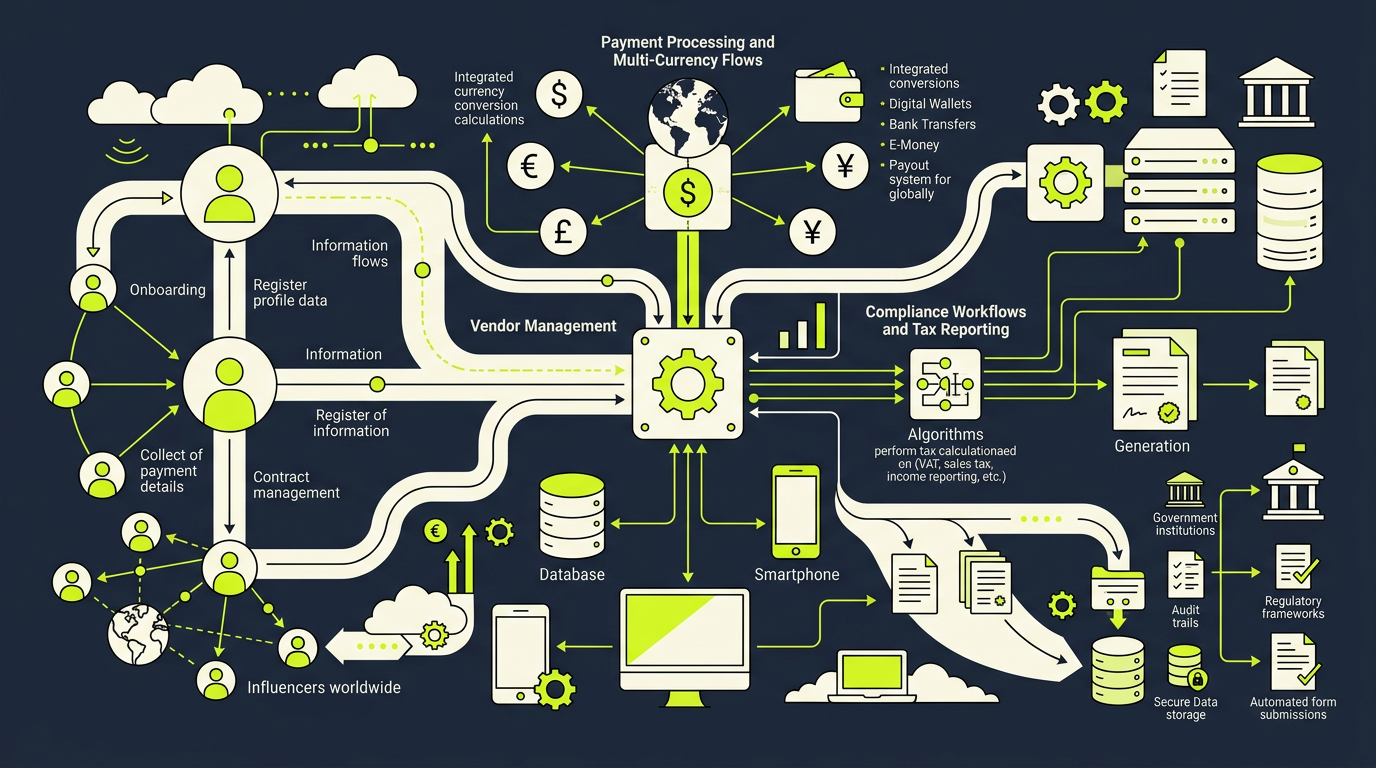
The most advanced and scalable model is the unified platform, an approach pioneered by Operations-First FinTech companies. This model treats payments and tax compliance not as two separate functions but as two sides of the same coin. A unified platform integrates global payouts, vendor management, and automated tax compliance into a single, cohesive operating system for your business.
In this model, the creator onboarding experience is a single, streamlined workflow. ) all in one go. The platform validates the information in real-time, ensuring compliance from the very first step. Because the payment and tax data reside in the same system, the data is inherently reconciled.
The act of paying a creator automatically generates the corresponding data needed for tax reporting.
The Power of a Single Source of Truth
A unified system eliminates the data silos and manual reconciliation work that plague fragmented approaches. There are no CSVs to export or import. Year-end reporting becomes a push-button process because the platform has tracked every payment to every creator and already has their validated tax information on file. This is the core principle behind building a 'Touchless Finance' function-automating the entire operational workflow, not just pieces of it.
A unified system eliminates the data silos and manual reconciliation work that plague fragmented approaches. There are no CSVs to export or import. Year-end reporting becomes a push-button process because the platform has tracked every payment to every creator and already has their validated tax information on file. This is the core principle behind building a 'Touchless Finance' function-automating the entire operational workflow, not just pieces of it.
Furthermore, these platforms are built for integration. A unified solution can sync data automatically with your existing accounting software, whether it's NetSuite, QuickBooks, Xero, or SAP. This ensures that your general ledger is always up to date, closing the loop on financial operations without manual intervention. Leading resources on the topic emphasize that the best time to automate early is before you feel overwhelmed, integrating it directly into your core campaign and financial setup.
Scaling Compliance Across Borders and Currencies
For global influencer networks, a unified platform is not just an efficiency gain; it's a strategic necessity. These systems are designed from the ground up to handle cross-border complexity. They manage currency conversion and payouts to over 150 countries in more than 135 local currencies, often with a predictable flat-fee per transaction model that is far more cost-effective than percentage-based fees.
This global-first approach extends to compliance. The platform can streamline global creator tax compliance by automatically identifying which W-8 form is required based on the creator's country and entity type, a nuance often missed in manual processes. Moreover, modern platforms support both fiat and crypto payouts, using stablecoins as a frictionless settlement layer for instant, low-cost global transfers-a critical capability for networks in the creator economy and ad tech. This is key to properly handling the entire tax lifecycle from TIN validation to year-end processing.
Side-by-Side Comparison: Which Model Fits Your Growth Stage?
Choosing the right model for creator tax reporting depends on your scale, resources, and growth ambitions. While a manual system may suffice for a brand paying five influencers, it becomes a liability for an ad network paying five thousand publishers. Let’s break down the comparison across key business dimensions.
Cost Analysis: Total Cost of Ownership
The manual approach has the lowest direct software cost but the highest hidden costs in terms of labor and risk. The hours spent on administrative tasks and correcting errors represent a significant, albeit hard to quantify, expense. A point solution for tax introduces a clear software subscription cost but reduces some of the labor costs; however, it doesn't eliminate the cost of reconciliation and managing a fragmented data environment.
A unified platform presents the most predictable and scalable cost structure. With a flat-fee per transaction model, costs are directly tied to business activity, making financial planning simple. By eliminating nearly all manual intervention in the payout-to-compliance lifecycle, the unified model offers the lowest total cost of ownership at scale. It transforms the finance function from a cost center focused on administration to a strategic enabler of growth, which is critical for platforms looking to boost publisher retention via payout automation.
Scalability and Risk Management
From a scalability perspective, the manual model is a dead end. It is inherently unscalable. The point solution model offers moderate scalability, as it solves one part of the problem, but the reconciliation bottleneck will eventually limit growth. As one guide on the topic suggests, the key is to automate influencer payments at scale by connecting systems and setting rules, a process that is natively handled in a unified environment.
The unified platform is the only model explicitly designed for hyper-growth. It's built to handle unlimited volume across borders without a corresponding increase in administrative headcount. In terms of risk, the manual approach is the highest-risk, relying on human perfection.
The point solution mitigates tax-specific risks but introduces data integrity risks. The unified platform offers the lowest risk profile by ensuring data consistency, leveraging enterprise-grade security, and automating compliance checks throughout the entire financial workflow, from onboarding to the final payment.