

For CFOs and finance leaders at creator marketplaces, scale is a double-edged sword. As your platform grows, so does the operational complexity of managing payouts to a global network of influencers, artists, and freelancers. The administrative tax of manual processes, particularly around tax compliance, can quickly erode margins and inhibit growth.
-based creators and W-8BEN for international individuals is not just inefficient-it's a direct bottleneck to onboarding speed and payout velocity.
In the competitive creator economy, the payout experience is a critical component of the product experience. Creators work across multiple platforms, and the one that provides the fastest, most frictionless payment experience often wins their loyalty. Slow, error-prone tax compliance is a primary source of that friction.
Shifting from a manual, reactive approach to an automated, proactive financial operating system is no longer a distant goal; it is the essential strategy for building a defensible, scalable marketplace.
- Unify Onboarding and Tax Form Collection
The first step toward touchless finance is to eliminate siloed, manual data collection. Your creator onboarding process should be a single, seamless workflow that includes tax form collection from the very beginning. Forcing a creator to complete their profile, then email a PDF of a W-9 or W-8BEN to your finance team, creates a poor experience and introduces unnecessary risk and delay. This fragmented process is a significant part of what contributes to the administrative burden that can undermine your margins.
The Self-Serve Creator Portal Advantage
A modern approach centers on a self-serve creator portal. This provides a single, branded environment where creators can enter their payment details, select their preferred payout method, and complete their tax information digitally. S.
S. individuals. This puts the creator in control of their own data, significantly reducing the likelihood of data entry errors by your internal team.
This portal becomes the single source of truth for all payee information, eliminating the chaos of managing data across spreadsheets, email inboxes, and payment gateways. By making the process intuitive and self-driven, you not only improve operational efficiency but also project a professional, modern image to your creator partners. This seamless onboarding is a powerful lever for creator retention before a single dollar is ever paid.
- Automate Tax Form Validation in Real-Time
Simply collecting a digital form is only half the battle. True automation requires a system that can validate the information provided in real-time to ensure compliance from day one. S. creators, this means performing an automated TIN (Taxpayer Identification Number) check against the IRS database the moment a W-9 is submitted.
A mismatch between the name and TIN can trigger backup withholding requirements, and discovering this at year-end creates a fire drill that damages creator relationships and consumes finance team resources.
Beyond Simple Form Collection to Proactive Verification
For your global creator base, the complexity increases. A robust platform doesn't just collect a W-8BEN; it helps the creator select the correct form from the start. It validates the form's fields to ensure they are filled out correctly to claim potential tax treaty benefits. Without this, your platform could be forced to withhold a flat 30% from payments to all international creators, putting them at a significant disadvantage and making your platform less attractive.
Proactive validation transforms tax compliance from a reactive, punitive function into a proactive, enabling one. It ensures correct withholding rates are established before the first payout, preventing payment failures and protecting the platform from compliance penalties. This level of diligence is a hallmark of sophisticated payout solutions that are built for high-volume, global operations.
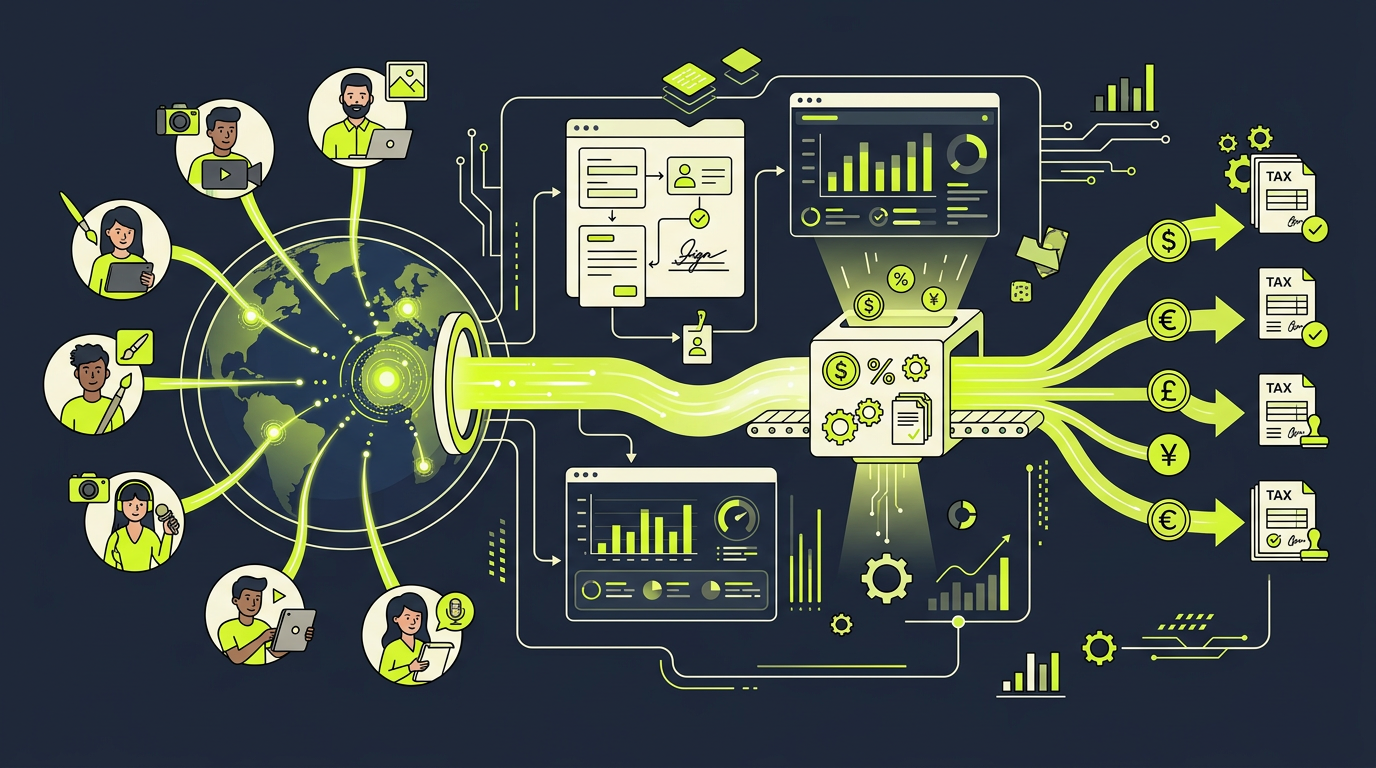
- Integrate Tax Status Directly into the Payment Workflow
Your tax compliance system and your payment engine cannot operate in separate universes. A creator's verified tax status is not static data to be stored in a folder; it is an active attribute that must inform every single transaction. In an automated system, a creator's validated Form W-9 or W-8BEN status is directly linked to their profile within the payout platform. This crucial link ensures that all compliance rules are automatically enforced at the point of payment.
Connecting Compliance to Disbursements for Flawless Execution
This integration means that when a finance manager initiates a bulk payout to thousands of creators, the system already knows who requires tax withholding and at what rate. There is no need for manual cross-referencing of spreadsheets or last-minute checks. This is fundamental to achieving operational scale and moving from manual processes to integrated platforms. This prevents a scenario where a payment is sent, only to discover later that tax should have been withheld, creating a messy and costly reconciliation problem.
Furthermore, this unified process creates an unbreakable audit trail. Every payment is automatically recorded with its corresponding tax treatment, and this data should be written back to your ERP in real-time. As noted in guidance on 1099 contractor payments, it is critical to use a platform that syncs data back to your general ledger, ensuring it remains constantly up to date. This approach accelerates the financial close and provides real-time visibility into your payout operations.
- Future-Proof Your Year-End Tax Reporting
For many finance teams at creator marketplaces, the fourth quarter is dominated by the looming dread of tax season. Manually aggregating a year's worth of payment data and attempting to match it to W-9 and W-8 forms is an enormous undertaking. It's a process that is famously prone to errors, which can lead to costly corrections and frustrated creators questioning the accuracy of their reported earnings.
Automating 1099-NEC and 1042-S Generation
A fully automated payout system solves this by design. Because it has meticulously tracked every payment and its associated tax status throughout the year, the platform can generate Forms 1099-NEC for U.S. creators and 1042-S for international creators with the click of a button. The system handles the aggregation of payment totals and the population of the required forms, ready for e-filing directly to the IRS. For businesses managing hundreds or thousands of contractors, automated systems provide an essential audit trail that connects every payment directly to the final tax report.
These forms can then be delivered electronically to creators through the same self-serve portal they used for onboarding. This creates a closed-loop, professional experience. With the IRS making significant changes to e-filing requirements and thresholds, such as the increased $2,000 reporting threshold for 1099-NECs starting with payments made in calendar year 2026, relying on a modern, compliant platform is more critical than ever.
It ensures you can adapt to regulatory shifts without overhauling your internal processes.
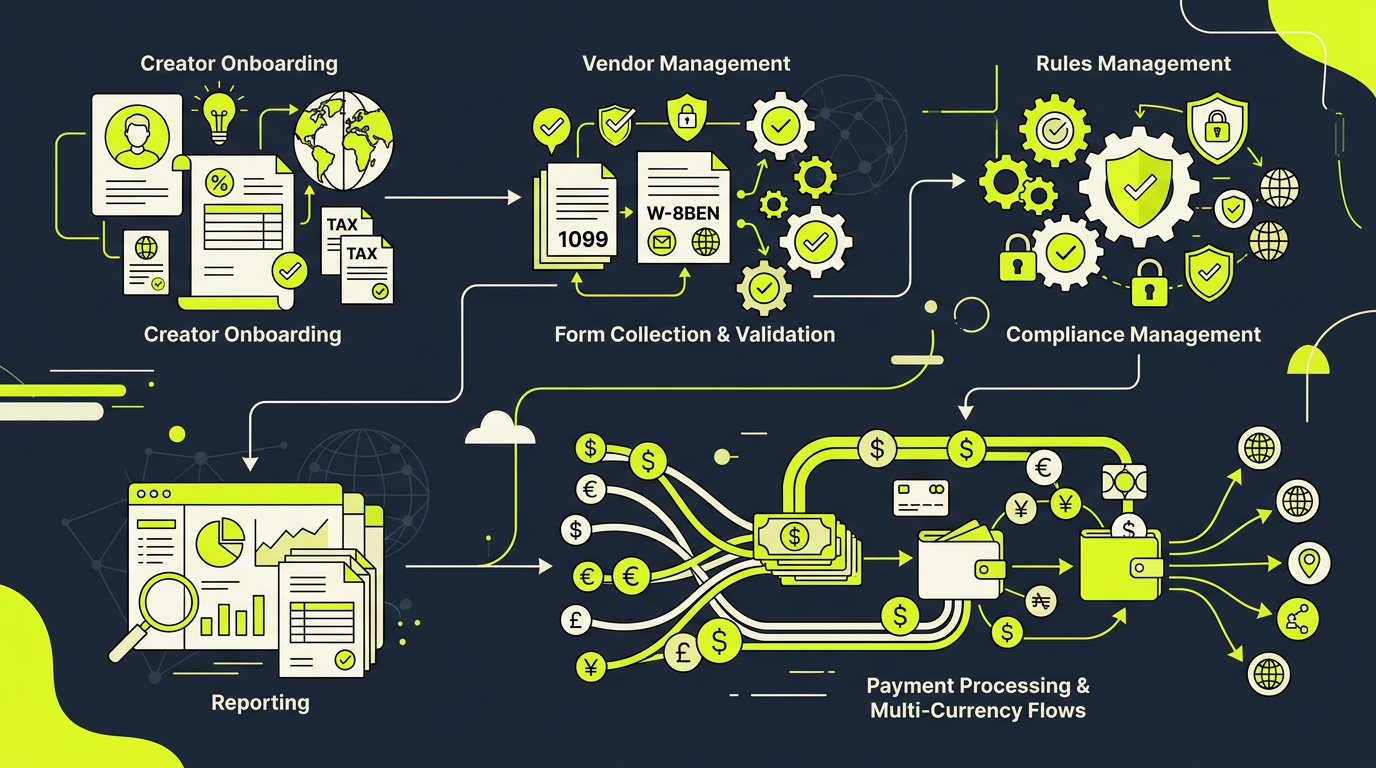
- Leverage Modern Settlement Layers for Global Reach
Paying creators across more than 150 countries presents significant challenges with traditional banking. Cross-border wire fees, slow settlement times, and currency conversion costs all add friction and reduce the net amount a creator receives. For a marketplace aiming to be the preferred platform, optimizing the speed and cost of global payments is a strategic necessity. This is where modern settlement technologies offer a compelling advantage.
Using Stablecoins as a Payout Utility
It is crucial to approach this from an 'Operations-First FinTech' perspective, viewing technology as a tool for financial optimization. Offering payouts in compliant stablecoins can function as a highly efficient and frictionless settlement layer. This is not about crypto speculation but about using a digital dollar as a utility to bypass the slow and expensive correspondent banking system.
For creators in countries with volatile local currencies or less developed financial infrastructure, receiving a stable, dollar-denominated asset can be a significant advantage.
By offering this as an option alongside traditional bank transfers, you empower creators with choice and can dramatically accelerate payment times. This capability transforms payouts from a slow, multi-day process into a near-instant transaction, a powerful feature when you need to modernize your payout operations. This speed and flexibility can become one of the most powerful creator retention levers your platform has.
Conclusion: From Administrative Burden to Strategic Advantage
For CFOs presiding over a growing global creator marketplace, the path to scale is paved with automation. Manually managing W-9 and W-8BEN tax compliance is a form of operational debt that compounds with every new creator you onboard. By unifying onboarding and tax collection, automating validation, integrating compliance with payments, streamlining year-end reporting, and leveraging modern settlement rails, you transform the finance function from a cost center into a strategic enabler.
Adopting a touchless finance model for creator payments is not merely about efficiency gains. It's about building a scalable, compliant, and resilient financial infrastructure that enhances your product offering. In an industry where speed and experience determine who wins the supply side, a best-in-class payout and tax compliance system is a definitive competitive advantage.