

In the competitive landscape of digital advertising, ad networks live and die by the quality and loyalty of their publishers. While metrics like CPMs and fill rates are crucial, the operational mechanics of how publishers get paid are often the unsung hero-or the silent villain-of retention. Publishers are, in essence, vendors.
When their payments are late, incorrect, or eroded by high fees, they don't just get frustrated; they redirect their valuable traffic to networks with more reliable and efficient payment systems. This churn isn't just a line item; it's a direct threat to inventory quality and advertiser satisfaction.
The problem is that many ad networks, especially those experiencing rapid growth, are running on payment infrastructure that wasn't built for global scale. Manual processes involving spreadsheets, multiple payment processors for different regions, and endless email chains for reconciliation create significant friction. This operational drag, what we call the "administrative tax," consumes finance and operations teams, pulling valuable engineering resources away from core ad tech innovation and into building bespoke payment plumbing.
Beyond CPMs: How Payment Terms Define Publisher Loyalty
Publishers have choices. net which requires approximately 100,000 monthly visitors, many high-quality, long-tail publishers fall below these thresholds, yet collectively represent significant inventory. For them, payment reliability and transparency are paramount.
Confusing fee structures, delayed NET-30 or NET-60 schedules, and high minimum payout thresholds (often $100 or more) can make a tangible impact on their own cash flow. When faced with a choice between a network with slightly higher CPMs but erratic payments and one with competitive rates and rock-solid, on-time payouts, the latter often wins.
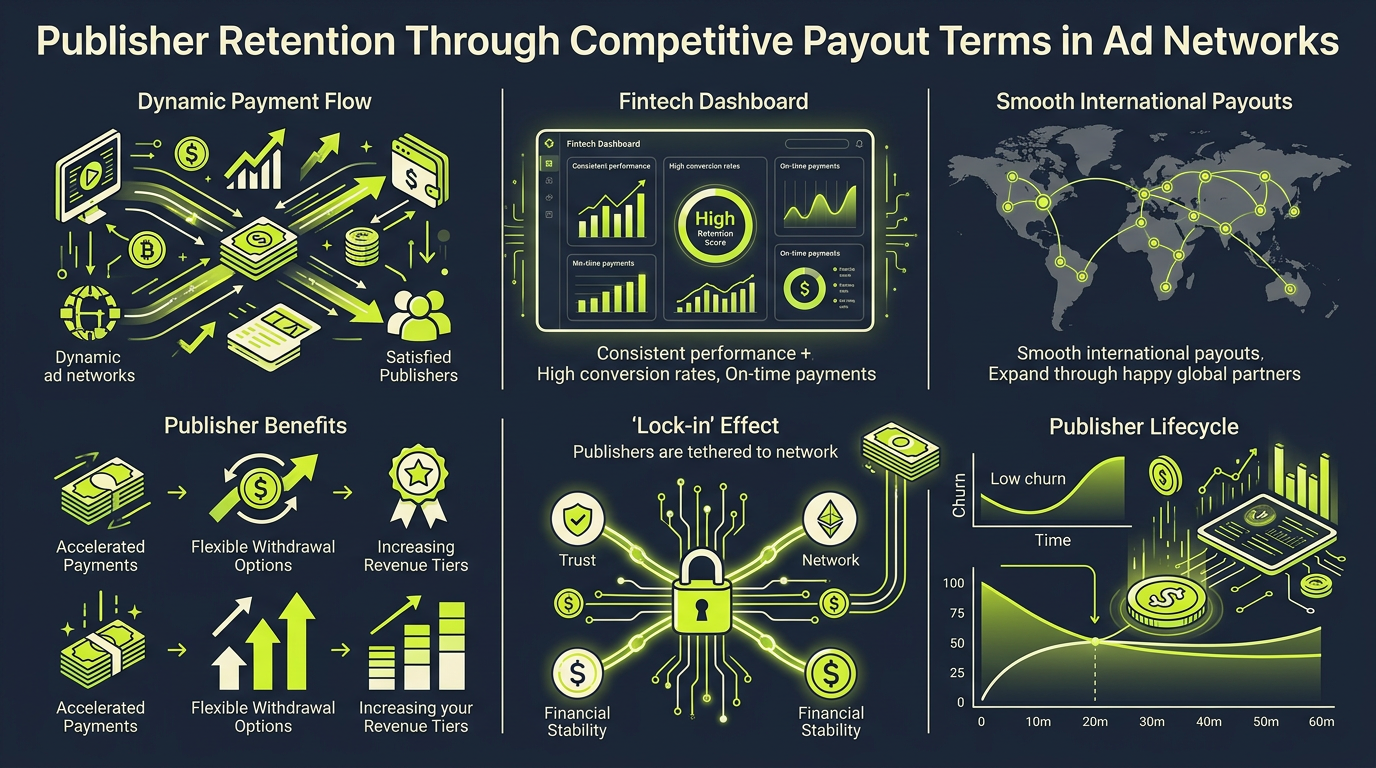
Effective management and optimization of ad inventory are critical for publishers to maximize revenue. This same principle applies to your own operations. Offering competitive payment terms is a strategic lever for attracting and retaining top-tier publisher talent. This includes not just the payment schedule but also the methods offered. Supporting local bank transfers in 150+ countries, PayPal, and even crypto stablecoins demonstrates a commitment to publisher convenience that builds lasting loyalty.
The Hidden Costs of Manual 'Payout Ops'
The 'cost' of manual payouts extends far beyond the hours your finance team spends matching CSVs from your ad server to payment files. It includes the high cost of cross-border transaction fees, which can eat into your margins and your publishers' earnings. It includes the risk of payment errors and rejections, which damage relationships and create more administrative work.
Furthermore, it involves the immense challenge of global tax and regulatory compliance, ensuring every W-9 and W-8BEN is collected, validated, and accounted for-a task that is nearly impossible to manage at scale without automation.
This manual complexity is a primary reason engineering teams get pulled into finance projects. When you decide to enter a new region, you suddenly face a new set of local payment rails and compliance rules, forcing a choice: divert your best engineers to build another integration or slow down your global expansion. This is the reconciliation black hole that many ad networks fall into, a problem that can be solved by adopting an operations-first fintech platform. This operational debt silently kills the scalability of otherwise fast-growing ad networks.
Manual Reconciliation vs. Automated Payouts: A Side-by-Side Comparison
For a Head of Publisher Relations, the difference between a manual and automated payout system is the difference between a reactive and proactive strategy. One is a constant fire drill of chasing down payment statuses and fielding publisher complaints. The other is a well-oiled machine that builds trust and allows your team to focus on strategic growth and relationship management, not on administrating payments. The transition from manual processes to automation can support programmatic payment best practices by streamlining financial workflows and improving transparency.
The Weakness of Spreadsheets in a Global Ad Network
A workflow built on spreadsheets is inherently fragile. Data is manually exported from one system, manipulated in Excel, and then manually uploaded to another. This process is ripe for human error, from simple copy-paste mistakes to incorrect formula calculations, leading to underpayments or overpayments.
There is no single source of truth, creating a nightmare for audits and financial reconciliation. When a publisher disputes a payment, the finance team must manually dig through multiple files and email chains to piece together the history, a process that can take days and severely damages trust.
Furthermore, this model doesn't scale. As your network grows from hundreds to thousands of publishers across dozens of countries, the complexity multiplies exponentially. The finance team becomes buried in administrative work, and the risk of a major compliance failure grows. It's a system that forces your most valuable team members to spend their time on low-value data entry instead of high-value analysis and strategy.
The Strength of a Unified Payout Platform
A unified payout automation platform acts as a central financial operating system for your network. Through direct integration with your ad-serving platform and your ERP (like NetSuite, QuickBooks, or Xero) via hundreds of pre-built connectors, it automates the entire payout lifecycle. Publisher earnings data flows in, payments are automatically calculated based on pre-set terms, and funds are disbursed through the publisher's chosen method, whether it's a local bank in Germany, PayPal in the US, or a USDT transfer.
This creates a single, auditable source of truth for every transaction. Publishers get access to their own branded portal where they can manage their payment information, download tax forms, and view their payment history 24/7, drastically reducing support tickets. Automating publisher payments is a widely accepted practice that ensures accuracy and efficiency. Your team is freed from manual reconciliation and can focus on optimizing publisher relationships and expanding your network's reach.
Building a Scalable Payout Infrastructure for Global Growth
The ambition of every ad network is to achieve global reach, tapping into traffic from every corner of the world. However, global scale brings global complexity. Each new country represents a new set of regulatory requirements, tax laws, and payment preferences. For networks reliant on manual systems, each new market means a new set of integrations and operational workflows-a painful, engineering-intensive process that hampers growth.

True scalability requires an infrastructure that is global by design. It means having one integration that unlocks access to numerous currencies and international payment rails. Instead of your engineers spending months building a connection to a local payment provider in Southeast Asia, they can remain focused on your core advertising technology, your competitive differentiator.
This is the promise of an operations-first approach: abstracting away the complexity of global payments to unleash your growth potential.
Expanding into New Markets Without Rebuilding Your Tech Stack
Imagine onboarding a new publisher in Japan or Brazil is as easy as onboarding one in the United States. With a unified payout platform, this becomes a reality. The platform handles the localization of payment methods, currency conversions, and fee calculations automatically. This allows your publisher relations team to confidently recruit from anywhere in the world, knowing that the payment experience will be seamless and professional, regardless of the publisher's location.
This model is built on a flat-fee per transaction basis, eliminating the punitive percentage-based fees charged by many traditional payment processors, especially on cross-border transactions. This cost predictability is crucial for financial planning and allows you to pass more of the earnings onto your publishers, further strengthening your competitive position. As publishers increasingly operate globally, providing them with a frictionless financial experience is a powerful retention tool. This is how you modernize your payout operations for the future.
Tax Compliance and KYC: From Global Headache to Automated Workflow
Global tax compliance is a non-negotiable, high-stakes challenge for ad networks. Manually collecting and validating W-9 forms for US publishers and W-8 series forms for international ones is a massive administrative burden. An automated platform digitizes this entire process.
During onboarding, publishers are guided through a simple digital workflow to submit the correct forms. The system automatically validates tax identification numbers (TINs) to ensure compliance and reduce the risk of IRS penalties.
This same automated approach applies to Know Your Customer (KYC) and Anti-Money Laundering (AML) checks, which are mandated in many jurisdictions. The platform can perform these checks against global watchlists automatically, providing an audit-ready trail for every publisher you work with. This moves compliance from a reactive, risky position to a proactive, automated, and secure part of your operational foundation, satisfying regulations like GDPR, PSD2, and FinCEN guidances.
The Future of Publisher Payments: Speed, Flexibility, and a Competitive Edge
The digital landscape is evolving rapidly, with the deprecation of cookies pushing a greater focus on privacy-centric models and first-party data strategies. As publishers adapt, their expectations for how they are compensated are also evolving. They are moving away from being passive recipients of funds to demanding the same level of speed and flexibility they see in consumer finance. Ad networks that fail to meet these expectations will be left behind.
The future of publisher payments is defined by optionality and control. This means offering a diversified range of payment methods, enhancing liquidity with faster payment options, and leveraging new technologies to reduce friction. By providing a superior payment experience, you are not just sending money; you are building a strategic partnership that helps your publishers grow their business, which in turn grows yours. Simply put, better payout operations directly contribute to higher publisher retention rates.
The Role of Crypto and Stablecoins in Frictionless Settlement
While still an emerging area, the use of crypto, specifically stablecoins like USDT and USDC, as a settlement layer offers a powerful new tool for global ad networks. For publishers in regions with volatile local currencies or underdeveloped banking infrastructure, receiving payments in a dollar-pegged stablecoin can be a . It provides stability and immediate access to funds without the delays and high fees often associated with correspondent banking systems.
From an operational perspective, leveraging a crypto payout option can dramatically simplify payments to a segment of your publisher base. The transaction is near-instantaneous and settles on a public ledger, providing ultimate transparency. com that offers both Fiat and Crypto payout capabilities, you can provide this option as part of a comprehensive suite of payment choices, catering to the needs of a diverse, global publisher base without adding operational complexity.
Offering Advanced Payments and Virtual Cards
Leading-edge ad networks are beginning to differentiate themselves by offering more than just standard payouts. With a robust financial platform, you can offer features like 'Advanced Payment,' which gives publishers the option to receive their earnings instantly for a small fee, rather than waiting for a NET-30 or NET-60 cycle. This provides valuable liquidity to publishers, helping them reinvest in their content and traffic acquisition faster.
Another powerful tool is the ability to issue virtual or prepaid cards. This allows you to pay publishers directly onto a card that they can use for online spending, such as paying for their own ad campaigns or hosting services. This creates a powerful, closed-loop ecosystem that enhances loyalty and provides another layer of value beyond a simple bank transfer. These capabilities transform your payout function from a cost center into a strategic tool for publisher engagement and retention.