

55 billion in 2026. Yet, the engine driving this growth has shifted. Brands are moving away from celebrity endorsements towards more authentic, performance-driven campaigns. This pivot has put nano and micro-influencers, who now comprise over 75% of Instagram's creator base and boast significantly higher engagement rates, at the center of modern marketing strategy.
But this strategic shift creates a massive operational challenge: How do you efficiently pay hundreds or thousands of individual creators scattered across the globe, each with unique payment preferences and tax requirements?
For finance and operations leaders, what begins as a promising ROI-driven strategy quickly devolves into a logistical nightmare. Manual data entry, complex cross-border fees, and fragmented compliance processes create a significant “administrative tax” on every campaign. This operational friction doesn't just drain resources; it actively caps your ability to scale.
The very processes meant to execute your strategy become the bottleneck preventing its success. The solution lies in shifting from manual administration to a 'Touchless Finance' model, transforming your payout function from a cost center into a strategic enabler of growth. This guide outlines the steps to build a scalable financial operating system for your creator partnerships.
Understanding the Hidden Costs of Manual Payout Processes
The allure of leveraging a large volume of micro-influencers is their collective impact and efficiency. However, the operational backend to support these campaigns often operates with profound inefficiency. The process typically involves spreadsheets, manual email chains for collecting payment details and tax forms, and individual wire transfers.
While this might be manageable for a dozen creators, it collapses when dealing with 200, 500, or 1,000+ individuals per campaign. The cost is not just the hours spent on data entry; it's the high error rates, compliance risks, and strained creator relationships.
Research highlights a critical issue: payment delays are rampant. A staggering 44% of influencers report experiencing late payments, a problem that can irreparably damage trust and lead them to decline future work. When your finance team is manually processing each payment, delays are inevitable. Furthermore, the lack of a centralized system means that crucial compliance documents like W-9s and W-8BENs are often missing or incorrectly filled out, exposing your business to significant tax and legal risks. This administrative burden is a direct threat to the scalability and profitability of your influencer programs.
A 4-Step Guide to Building a Scalable Influencer Payout Engine
To truly unlock the power of micro-influencer marketing, businesses must adopt an operations-first mindset. This means building a robust financial infrastructure before the operational strain becomes overwhelming. As strategic advisors often recommend, the key is to automate payments early in the process, integrating them into campaign setup rather than treating them as an afterthought. Follow these steps to implement a system that scales with your ambition.
Step 1: Centralize Onboarding for Global Tax and KYC Compliance
The first step towards scalable operations is creating a single, unified system for onboarding creators. Before a single dollar can be paid, you need to collect critical information: tax forms (W-9 for U.S. persons, W-8 series for non-U.S. persons) and Know Your Customer (KYC) identity verification. Attempting to manage this via email is a recipe for failure. It's disorganized, insecure, and creates massive downstream reconciliation problems.
Implementing a vendor portal solves this by providing-creators with a self-service environment to submit their information. The right platform will automate the process, intelligently guiding a user from any country to fill out the correct digital tax form. This not only ensures 100% compliance before payment but also creates an auditable, centralized database. By front-loading compliance, you eliminate the single biggest bottleneck in global payouts and create a foundation for truly Automating Creator Tax Reporting: 3 Core Strategies for Scale.
Step 2: Unify Payment Methods and Instructions
Creators are a diverse group with varying preferences for how they receive funds. One may prefer a direct deposit to a bank in Thailand, another wants PayPal in the UK, while a third may opt for a stablecoin like USDT for its speed and low fees. Manually managing these disparate payment instructions is untenable. Your finance team should not be responsible for collecting and validating dozens of different bank account formats, SWIFT/BIC codes, and crypto wallet addresses.
A global payout platform externalizes this complexity. During onboarding, creators select their desired country and payout method from a pre-vetted list. The platform handles the validation of their banking details or wallet address, ensuring the information is correct before it's even submitted. This self-service model empowers creators while freeing your team from the administrative burden of managing payment preferences, reducing the risk of payment failures due to incorrect data entry.
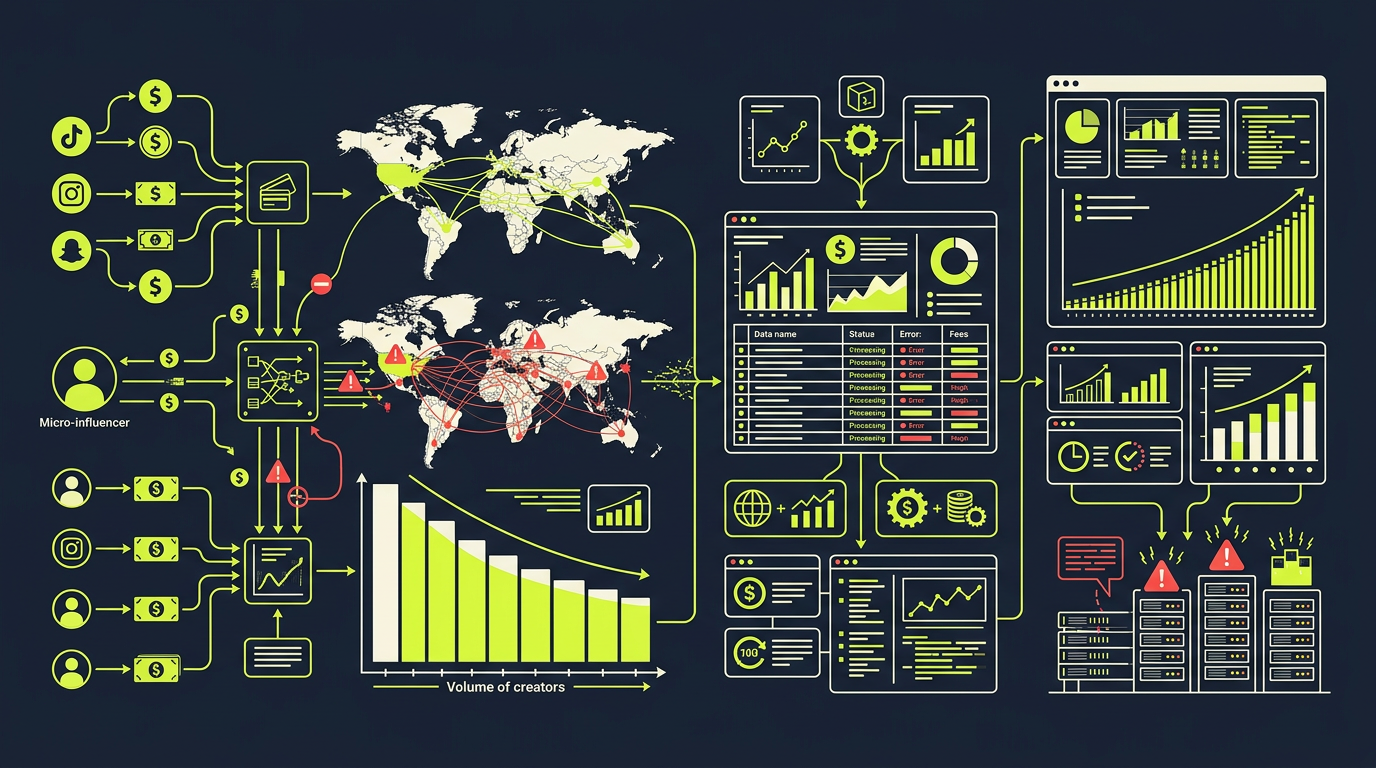
Step 3: Implement Mass Payment Automation and ERP Reconciliation
With onboarding and payment instructions centralized, you can move away from one-by-one transactions. The core of a scalable system is the ability to process hundreds or thousands of payments in a single batch. This is achieved by connecting your payout platform directly to your Enterprise Resource Planning (ERP) or accounting software, such as NetSuite, QuickBooks, or Xero. This integration is critical for maintaining a clean general ledger and ensuring seamless reconciliation.
The workflow becomes incredibly efficient. Your team can upload a single payment file with amounts owed, and the platform orchestrates the disbursement to every creator in their chosen method and currency. Once payments are completed, the platform sends the status of every transaction back to the ERP system, automatically marking bills as paid. This two-way data sync closes the loop, providing real-time visibility and eliminating endless hours of manual reconciliation. It's a foundational element for anyone asking How to Scale Creator Payouts Past $1M/Month.
Step 4: Optimize for Cross-Border Payments and Fees
Paying creators across 150+ countries introduces significant complexity in currency conversion and fees. Traditional banking systems and many payment providers rely on percentage-based fees that penalize larger payments and obscure the true cost of a transaction. For businesses focused on ROI, this lack of cost predictability is a major liability. The goal should be to find a payment infrastructure that offers transparent, flat-fee pricing per transaction, regardless of the amount.
This model provides cost certainty, allowing you to budget precisely for your payout operations. An advanced platform will also optimize the payment routing itself, leveraging local payment rails in different countries to avoid costly intermediary banks and lift fees associated with traditional SWIFT transfers. This ensures that a $100 payout results in the creator receiving as close to $100 as possible, building goodwill and making your program more attractive than competitors who pass on high fees to their partners.
From Transactional Payouts to a Strategic Financial Partnership
Once you have built a robust, automated payout system, you can elevate your relationship with creators from purely transactional to a true partnership. The data is clear: consistent, on-time payments build trust. Reliable systems reduce human error and ensure payments are sent on time, freeing up your team to focus on strategic initiatives rather than chasing down payment errors. This operational excellence becomes a competitive advantage in a crowded market.
An efficient back-office operation allows you to spend more time analyzing campaign performance and less time on administrative tasks. Given that brands earn an average of $5.78 for every $1 invested in influencer campaigns, any time not spent optimizing that return is a wasted opportunity. The conversation shifts from "Has this person been paid?" to "How can we deepen this partnership to drive even better results?" This is the essence of an operations-first approach to finance.
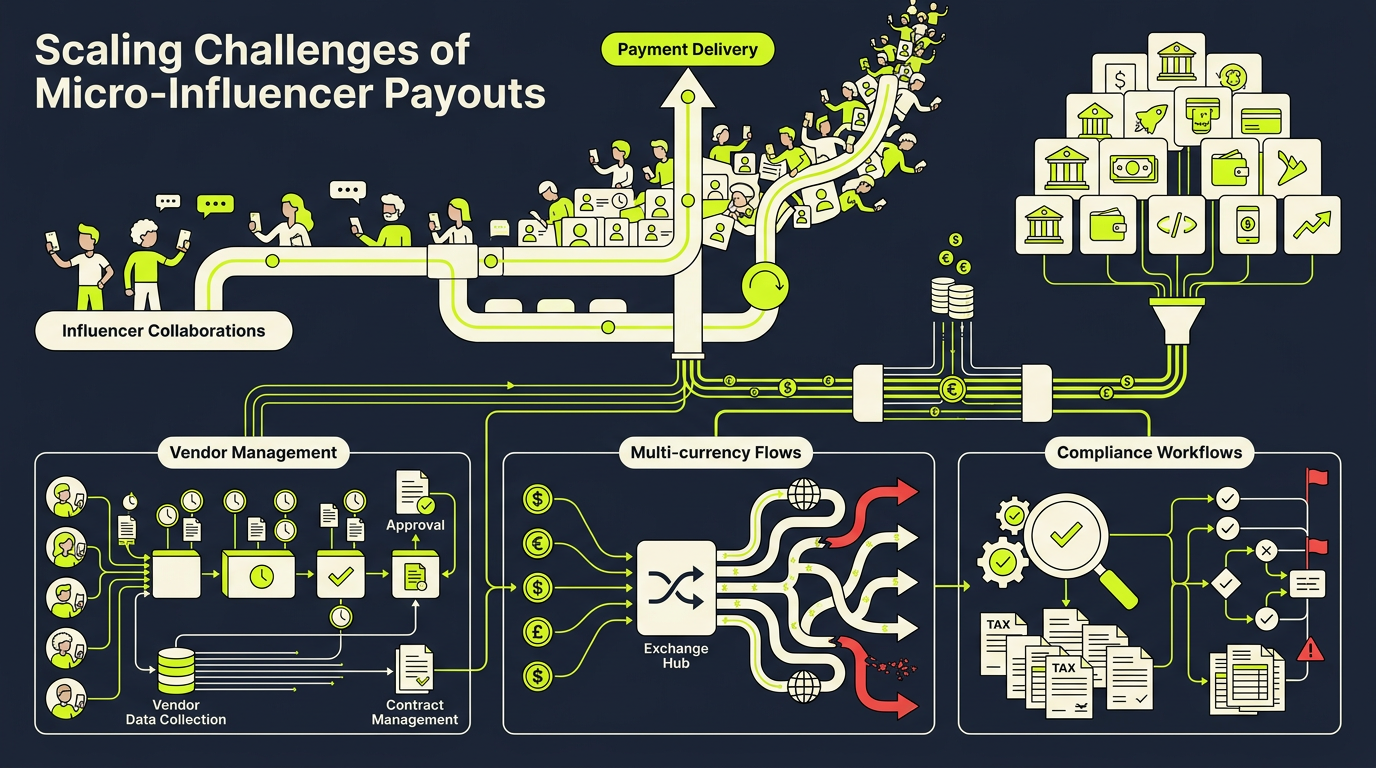
The Future of Creator Payouts: Liquidity and Flexibility
The next frontier of creator finance is about providing flexibility and liquidity. Many micro-influencers run their work like a small business and depend on timely cash flow. The old model of subjecting them to Net 30 or Net 60 payment terms is becoming obsolete and can strain relationships. Forward-thinking platforms recognize this and are building solutions to address it.
One such innovation is 'Advanced Payment,' which provides creators with instant liquidity on their approved invoices, effectively giving them an immediate payout while the paying company still adheres to its standard payment cycle. This is a powerful retention tool. Additionally, the adoption of stablecoins like USDT as a settlement layer offers a glimpse into the future. For creators in countries with volatile currencies or underdeveloped banking infrastructure, receiving a stable, dollar-pegged digital asset can be faster, cheaper, and more reliable than traditional banking. It highlights how platforms can serve as a complete financial operating system, addressing the nuanced needs of a global creator base and preventing payment disputes before they can even begin, as outlined in detailed guides for built-in influencer payment solutions.
By automating the entire payout lifecycle-from onboarding and compliance to multi-currency disbursement and reconciliation-you transform your finance function. It ceases to be a manual, reactive cost center and becomes a strategic, automated engine for growth. In the rapidly expanding creator economy, the brands that win will be those that build the most efficient and scalable operational foundation. This allows for better analytics and a focus on long-term partnerships, which are key differentiators in a market moving firmly towards ROI-driven strategies. As discussed in our detailed guide, this is a core component of successfully managing Marketplace Payouts at Scale.