

For high-growth digital companies in the creator economy, ad tech, and online marketplaces, scale is everything. Yet, the very act of paying a global network of vendors, affiliates, or creators often becomes the primary bottleneck to growth. Traditional payment methods, dominated by card networks and decades-old wire systems, impose a significant 'administrative tax' on finance and operations teams. This tax isn't just about money; it's paid in hours of manual data entry, compliance headaches, and delayed settlements.
The challenges of sending international payouts through legacy systems are numerous and complex. They include high cross-border fees, opaque foreign exchange (FX) rates, and fragmented compliance processes. Finance teams find themselves wrestling with disconnected systems for collecting tax forms, verifying vendor identities (KYC/KYB), and reconciling payments across multiple currencies and regions.
This operational friction prevents businesses from scaling efficiently, turning the finance department into a cost center overwhelmed by administrative tasks rather than a strategic partner driving growth.
The rapid growth of alternative payment methods signals a fundamental shift in the global payments landscape. This evolution is driven by digitalization and a demand for more efficient, transparent, and cost-effective ways to transact. Account-to-Account (A2A) payments are at the forefront of this movement, offering a direct path to 'Touchless Finance' by moving funds directly between bank accounts, bypassing the costly and slow-moving intermediaries that define legacy payment infrastructure.
What Are A2A Payouts and Why Do They Matter for Scale?
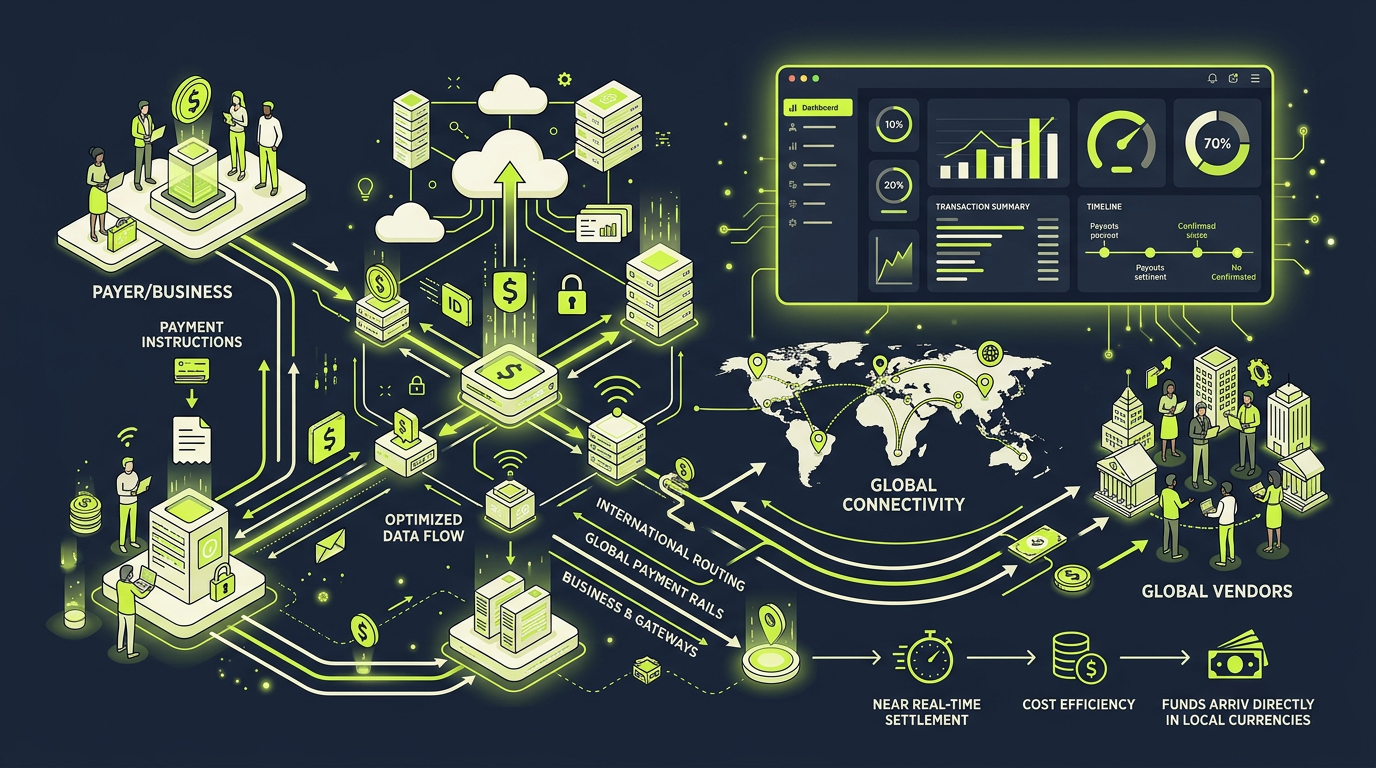
Account-to-Account (A2A) payments describe a process where funds are transferred directly from one bank account to another without relying on traditional card rails like Visa or Mastercard. This category includes modern real-time payment (RTP) networks, automated clearing house (ACH) transfers, and other bank-to-bank systems. Unlike card payments, which involve a long chain of intermediaries-issuing banks, acquiring banks, processors, and card networks-A2A simplifies the flow of money, resulting in greater speed, lower cost, and enhanced data transparency.
For businesses managing payouts to a large volume of global vendors, this is more than just a new payment method; it's a fundamentally different operating model. As finance leaders focus on optimizing liquidity and creating a connected treasury, A2A provides the programmable automation needed. By integrating directly with a company's Enterprise Resource Planning (ERP) system, an A2A payout platform can automate the entire workflow, from data ingestion and three-way matching to tax compliance and final settlement in over 150 countries.
This is what it means to build an operations-first financial infrastructure.
5 Ways A2A Payouts Optimize Global Vendor Operations
- Drastically Reduce Transaction Costs
Perhaps the most immediate benefit of shifting to A2A payouts is the significant cost reduction. Traditional card payments typically include percentage-based interchange and scheme fees, which erode margins, especially on high-volume or large-value transactions. Every time you pay a vendor via card rails, a portion of that payment is diverted to intermediaries. For a platform paying out millions to creators or affiliates, these fees accumulate into a substantial operational expense.
A2A payments fundamentally change this economic model. By removing the card networks, platforms can operate on a predictable, flat-fee per-transaction basis. This model is especially advantageous for businesses with a high number of global payees, as it eliminates the unpredictable nature of percentage-based fees. The cost savings can be redirected from operational overhead into core business growth, vendor incentives, or product development, directly impacting the bottom line. This addresses one of the core challenges of businesses sending international payouts, which is managing exorbitant and unpredictable costs.
- Accelerate Cross-Border Settlement Times
In a digital-first economy, waiting three to five business days for a SWIFT wire transfer to clear is an antiquated concept. Vendor and creator expectations have evolved; they demand faster access to their earnings. A2A payments leverage modern, real-time payment rails that are being adopted worldwide, from FedNow in the U.S. to single euro payments area (SEPA) in Europe and UPI in India. As a recent report on real-time payments notes, this expanding global infrastructure is fostering lower-cost, faster transactions across borders.
This acceleration from days to minutes-or even seconds-is a competitive advantage. It improves vendor satisfaction and retention, and features like 'Advanced Payment' can offer instant liquidity to key partners, strengthening the relationship. By connecting to local payment rails in over 150 countries, a unified payout platform can intelligently route payments through the most efficient channel available. This is a stark contrast to the opaque and slow-moving correspondent banking system that explains Why Your Global Vendor Payouts Settle in Days, Not Seconds.
- Centralize Compliance and Data Management
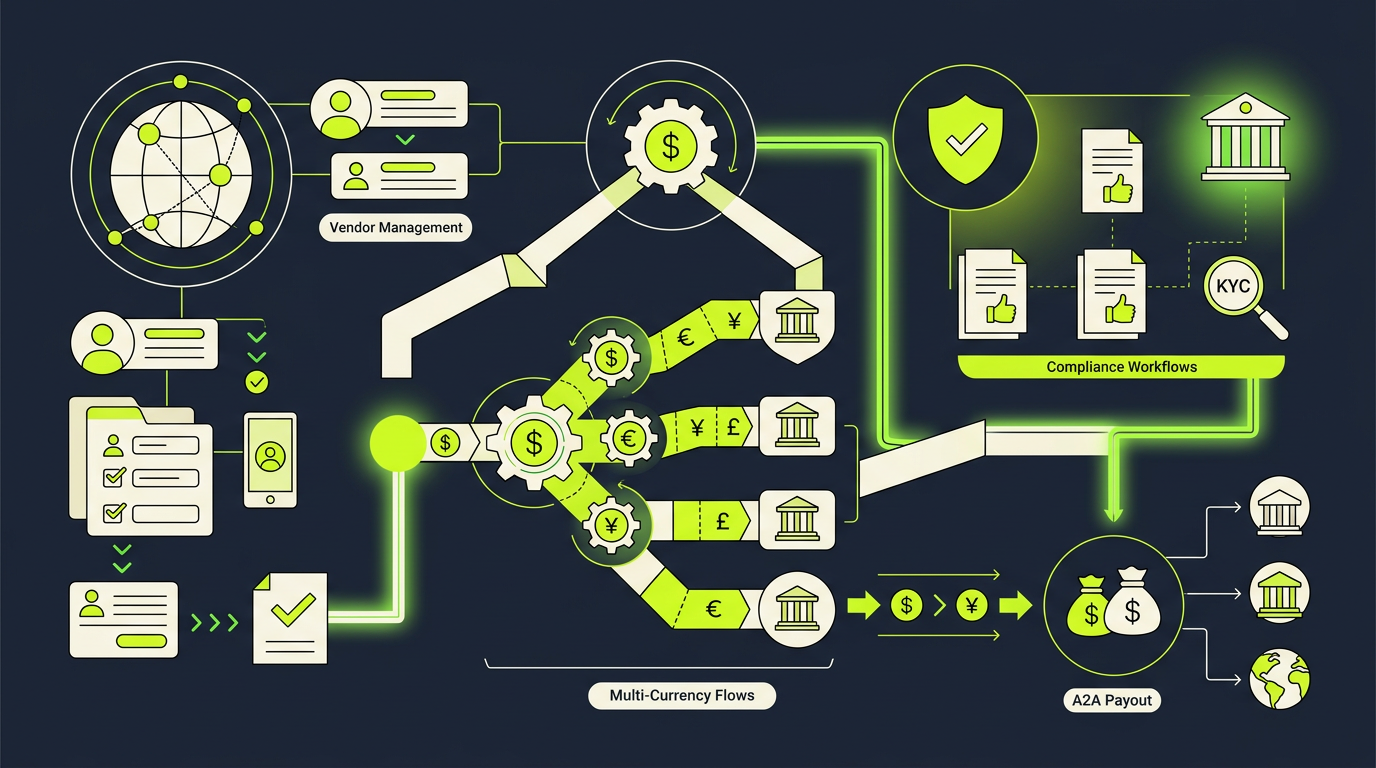
Managing global tax and regulatory compliance is a major source of administrative burden. Onboarding a single vendor from another country can require collecting a W-8BEN-E form, performing KYC/AML checks, and ensuring adherence to OFAC and other sanctions lists. Multiplying this process by hundreds or thousands of vendors creates a massive compliance challenge that manual processes cannot handle. This is the hidden administrative tax on scaling companies.
A2A payout automation platforms solve this by integrating compliance directly into the vendor onboarding workflow. A self-service vendor portal can programmatically collect and validate tax forms, trigger KYC/AML screening, and maintain a complete audit trail. As recommended in vendor payment best practices, configuring an ERP system to automatically generate payment instructions after validation is key. With integrations for systems like NetSuite, QuickBooks, and SAP, a unified payout platform ensures that payment data flows seamlessly from a verified vendor profile, dramatically reducing compliance risk and manual effort.
- Enhance Vendor Relationships with Transparency and Choice
Top-tier vendors, affiliates, and creators have choices. They will gravitate towards platforms that pay them reliably, quickly, and transparently. A common pain point with traditional payouts is the lack of visibility. Funds disappear into the black box of the banking system, and when a payment is delayed, the finance team must spend hours chasing down answers. This erodes trust and damages the business relationship.
An automated A2A payout system provides a centralized vendor portal where payees can self-manage their information, select their preferred payout method (including local bank transfer or even stablecoins like USDT), and track the status of their payments in real-time. This self-service capability reduces the support burden on the finance team and empowers vendors. While implementing A2A isn’t simply 'flipping a switch,' using a platform partner abstracts away the complexity of integrating payment rails and ensures a seamless experience for both the business and its payees.
- Future-Proof Your Financial Infrastructure
The global trend toward open banking and real-time payments is irreversible. Even major card networks are now launching their own A2A solutions to remain relevant, acknowledging the power of direct bank transfers. Building your payout operations on a forward-looking A2A framework ensures your business is prepared for the future of finance, not tethered to the past. This includes the ability to adapt to new payment rails and regulatory frameworks as they emerge.
This forward-looking approach also extends to incorporating new settlement layers. For true global reach, especially in emerging markets with less-developed banking infrastructure or volatile local currencies, stablecoins (like USDT) can serve as a highly efficient and low-cost payment rail. An advanced payout platform treats crypto as just another payment method, handling the complexities of conversion and settlement. This optionality between traditional and digital currency rails is one of the 4 Decisive Factors When Choosing Local Rails vs. SWIFT, providing ultimate flexibility for a global business.
Conclusion: A2A is the Engine for Touchless Finance
Shifting to Account-to-Account payouts is not merely a tactical decision to reduce fees. It is a strategic move towards building a resilient, automated, and scalable financial operating system. By eliminating manual workflows, centralizing compliance, and providing unparalleled speed and transparency, A2A empowers finance teams to shed their administrative burden.
Instead of chasing invoices and reconciling payments, they can focus on strategic initiatives that drive business growth and optimize capital allocation.
For any digital business paying a large number of stakeholders across the globe-be they ad networks, affiliate agencies, creator platforms, or marketplaces-A2A is the foundation of Touchless Finance. It transforms the payout function from a complex cost center into a streamlined, automated, and powerful engine for enabling scale. The future of global commerce is direct, digital, and connected, and A2A payments are the rails making it possible.