
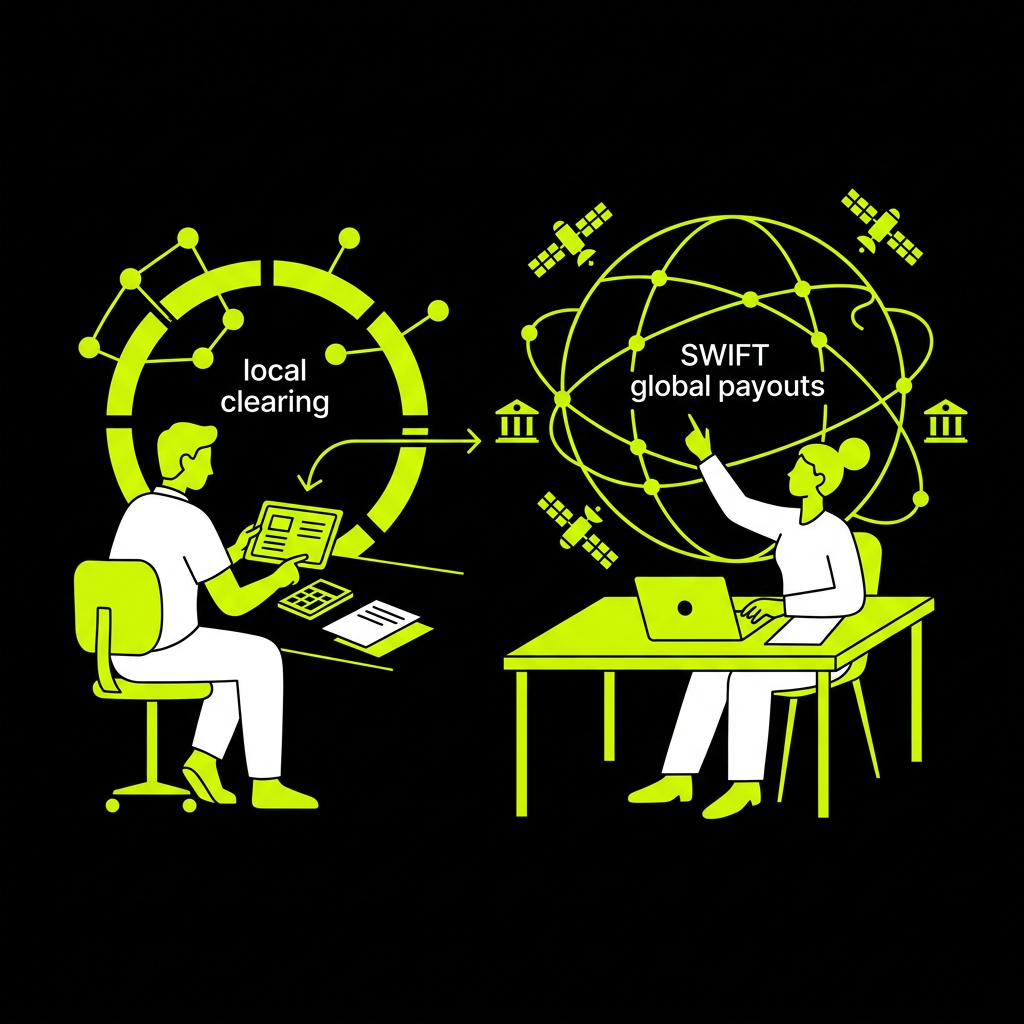
In the world of global business, the complexity of cross-border payments is no longer a niche concern-it's a primary operational hurdle. The era of regulatory "grey areas" is over. As noted in recent industry analysis, we have entered a period where real-time payment rails, once local novelties, are now global expectations.
For CFOs, Finance Directors, and Operations Managers at high-growth digital companies, the choice of payment infrastructure is a critical decision that directly impacts scalability, cost, and vendor satisfaction. Navigating this landscape requires a sophisticated understanding of the available rails.
The fundamental choice often boils down to two distinct paths: the long-established SWIFT network or modern systems built on local clearing networks. Each approach has profound implications for how efficiently a business can pay its global stakeholders, whether they be affiliates, influencers, freelancers, or marketplace vendors. The goal is to select a framework that not only transfers funds but intelligently navigates the evolving regulatory and technological environment. Understanding how each network operates is crucial, as each option has different speeds, costs, and data capabilities.
First, What is the SWIFT Network?
The Society for Worldwide Interbank Financial Telecommunication (SWIFT) is the traditional backbone of international finance. It's essential to understand that SWIFT itself is not a payment system; it does not move money. Rather, it is a vast and secure messaging network that financial institutions use to send and receive payment orders.
When a cross-border payment is initiated via SWIFT, a message travels through a chain of correspondent banks, each of which must process the instruction and pass it along.
This decades-old system provides immense global coverage, connecting thousands of financial institutions in nearly every country. Its ubiquity and standardized messaging formats have made it the default for high-value corporate transactions for years. However, its reliance on a chain of correspondent banks is also its primary operational drawback. While it enables international payments, the actual movement of funds happens through a network of correspondent banks, a multi-step process that introduces delays, potential for errors, and a lack of transparency into the final costs and settlement time.
And What Are Local Clearing Networks?
Local clearing networks, often called automated clearing houses (ACH) or local payment rails, are the domestic arteries of a country's financial system. These include well-known systems like ACH in the United States, BACS in the UK, and SEPA in the Eurozone. They were designed for high-volume, low-value domestic transfers and are typically faster and cheaper than traditional wire transfers within their respective countries.
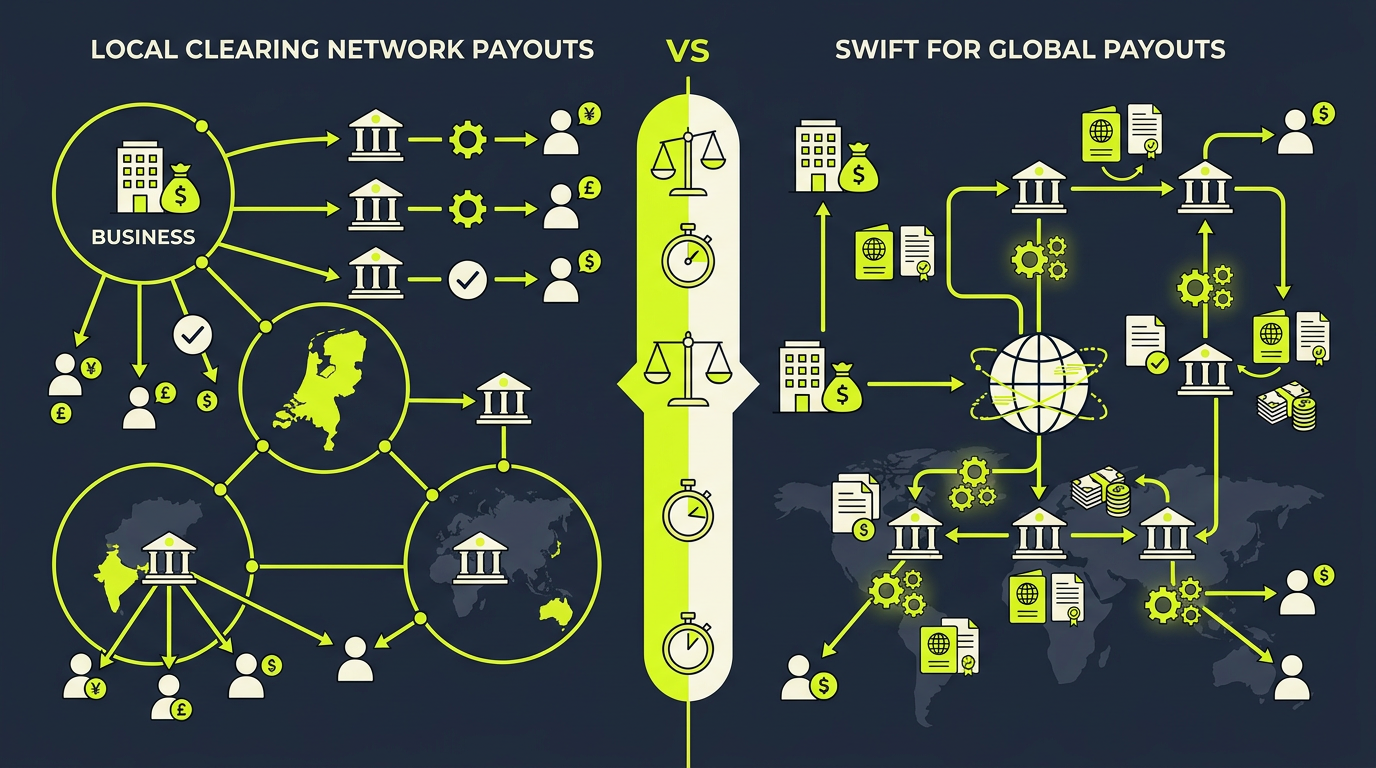
The innovation for global payouts comes from fintech platforms that have built infrastructure to connect these disparate local networks. Instead of sending a single payment through a long chain of international banks via SWIFT, a modern payout platform can fund a local account in a target country and then initiate a domestic payment directly on that country's local rails. Unlike SWIFT, which is a messaging layer, domestic payment networks actually move funds directly between local banking rails, significantly reducing the number of intermediaries involved in the transaction.
Furthermore, a new generation of real-time rails like Brazil's Pix, India's UPI, and the US's FedNow are becoming the standard. These systems operate 24/7/365 and offer instant or near-instant settlement, a stark contrast to the multi-day batch processing of traditional ACH and the even longer timeframe of SWIFT. An intelligent payout platform leverages these rails to offer the best possible speed and cost for each specific payment corridor.
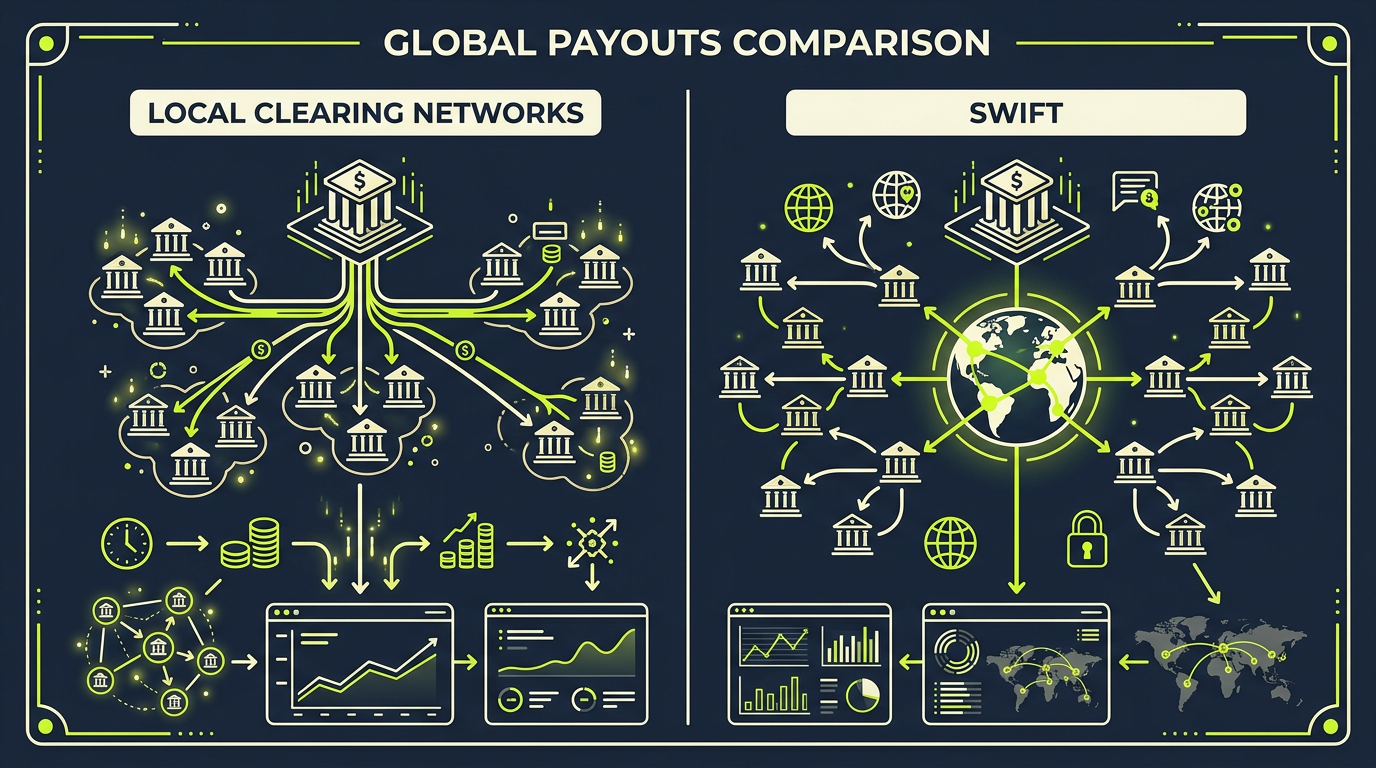
4 Key Factors for Evaluating Local Rails vs. SWIFT
- Speed and Finality of Settlement
The most palpable difference between SWIFT and local rails is the time to settlement. A SWIFT payment typically takes 2-5 business days to land in a recipient's account, and sometimes longer if it encounters an issue at an intermediary bank. This delay is a direct result of the correspondent banking chain, where each bank in the sequence must perform its own processing and compliance checks during its local business hours.
This latency creates friction for vendors and administrative burdens for finance teams tracking down lost or delayed payments.
Local payment rails, on the other hand, are built for speed. When a payout provider has a presence in the destination country, it can execute a domestic transfer that often settles within the same business day, or even instantly if leveraging real-time networks. This speed is a significant competitive advantage for businesses in the creator economy or ad tech space, where frequent and timely payments are key to retaining top talent and partners. If you've ever wondered Why Your Global Vendor Payouts Settle in Days, Not Seconds, the answer often lies in whether the payment is traversing the multi-hop SWIFT network or being intelligently routed onto local rails.
- Cost Structure and Fee Transparency
SWIFT's cost structure is notoriously opaque. Because a payment may pass through multiple intermediary banks before reaching its destination, each bank can deduct its own processing fee along the way. This often results in the recipient receiving less than the amount originally sent, a practice known as "lifting fees." The sending company has little to no visibility into these fees, making cost forecasting and reconciliation a significant challenge for finance departments.
This opaque structure is a key reason Your Cross-Border Payouts Have a 6% Administrative Tax in the form of hidden fees and administrative overhead. In contrast, platforms that leverage local rails can offer a much more predictable pricing model. By minimizing intermediaries, these providers can often extend a simple, flat-fee per transaction. This transparent model allows businesses to know the exact cost of each payout upfront, simplifying financial planning and eliminating the negative experience of a vendor receiving a partial payment.
- Data Richness and Reconciliation
Modern finance teams thrive on data for automated reconciliation. SWIFT's legacy messaging formats (like MT103) carry limited remittance information, often restricting data to a simple text field. This lack of structured data makes it incredibly difficult to automatically match incoming payments in an ERP system to the corresponding invoices or payment instructions, forcing manual intervention and creating costly administrative work.
Payout platforms built on API-driven local rails solve this problem. They can pass rich, structured data-such as invoice numbers, vendor IDs, and tax information-alongside the payment itself. This data flows directly into integrated ERP systems like NetSuite, QuickBooks, or SAP.
Papaya Global, with its centralized funding and global payout capabilities, uses this capability to enable "touchless finance," where payment-to-reconciliation workflows are fully automated, freeing up finance teams to focus on strategic initiatives rather than manual data entry and exception handling.
- Scalability and Modern Use Case Suitability
The suitability of each system often depends on the use case. SWIFT may still be a necessary option for very high-value, one-off transactions to esoteric countries where no direct local connections exist. However, for the high-volume, lower-value payouts characteristic of the modern digital economy, SWIFT presents a major bottleneck to scaling.
Platforms paying thousands of creators, affiliates, or marketplace vendors require an infrastructure that is built for mass payouts. Local clearing systems are designed for this exact purpose. While their national focus means they are often only a partial SWIFT alternative for global businesses on their own, they become incredibly powerful when connected by a unified payout platform. This is especially critical for platforms managing payments to a large base of vendors, such as affiliate networks aiming for Global Affiliate Payouts, Simplified and streamlined operations.
The Operations-First Approach: A Unified, Multi-Rail Strategy
The debate isn't about choosing one system to the exclusion of the other. The most advanced companies are adopting an intelligent, multi-rail payment framework. This approach treats SWIFT, local rails, and even stablecoins as a portfolio of options.
A financial operating system like Papaya Global sits on top of this fragmented landscape, acting as an intelligent routing engine. For each payment, the platform automatically selects the optimal rail based on the country, currency, transaction value, and desired speed.
This "Operations-First FinTech" model moves businesses beyond simply sending funds to dynamically optimizing their entire payout workflow. It orchestrates everything from vendor onboarding and tax compliance data collection (W-8/W-9) to the final settlement and reconciliation. By abstracting away the complexity of the underlying payment rails, a unified platform allows a business to connect its own systems via a single API and gain access to a global payment network spanning dozens of countries and currencies, without having to manage individual banking relationships or integrate with dozens of local systems.