

In a digital-first economy, your business operates at the speed of light, but your global payment operations are stuck in the past. High-growth companies, particularly ad networks, creator economy platforms, and global marketplaces, depend on a geographically diverse network of vendors, affiliates, and freelancers. Yet, the critical process of paying these partners is often bogged down by an archaic financial infrastructure that introduces delays, inflates costs, and creates a significant administrative burden.
This friction is more than an inconvenience; it's an operational tax on your ability to scale.
The traditional system of cross-border payments, reliant on correspondent banks and SWIFT messages, was not designed for the instant, high-volume, low-value transactions that define the modern internet economy. A wire transfer can take 3-5 business days to settle, crossing multiple intermediaries, each adding fees and potential for error. This model creates a fundamental disconnect between the real-time value your partners generate and the delayed compensation they receive, undermining relationships and hampering your competitive edge.
The Hidden Costs of Traditional Cross-Border Rails
Finance leaders often focus on the most visible expenses, but the true cost of outdated payout systems extends far beyond the number on an invoice. Direct costs are significant and often unpredictable. Wire transfer fees, currency conversion markups that lack transparency, and intermediary bank charges can erode a surprising portion of the original payment amount.
For businesses making hundreds or thousands of payments monthly, these variable, percentage-based fees accumulate into a major operational expense.
The indirect costs, however, are arguably more damaging. Delayed settlements tie up working capital and create uncertainty for both your finance team and your vendors. P. Morgan Global Research team has noted that in the current economic landscape, finance leaders are intensely focused on optimizing liquidity and building a more connected treasury.
When a payment is lost or delayed in the correspondent banking maze, your AP team spends valuable time tracking it down instead of focusing on strategic financial management. This operational drag frustrates vendors and damages the trust required to retain top global talent.
The Data Fragmentation and Reconciliation Nightmare
To serve a global vendor base, companies often resort to a patchwork of regional payment providers, each with its own system, fee structure, and reporting format. This approach creates data silos, making a unified view of global spend impossible without tedious manual work. At the end of each month, finance teams are left to piece together disparate spreadsheets, manually reconciling payments across different platforms and currencies, a process that is both error-prone and extraordinarily time-consuming.
A unified payment automation platform with deep ERP integration is the antidote to this fragmentation. By connecting directly with systems like NetSuite, QuickBooks, Xero, or SAP, a platform ensures that all payment data flows back into your core financial system automatically. This creates a single source of truth for global payouts, eliminating manual reconciliation and providing real-time visibility into your cash flow and vendor expenses.
The Unseen Hurdle of Global Compliance
Beyond the payment itself lies a complex web of global compliance obligations. Manually collecting and validating tax forms like W-8s and W-9s from hundreds of international vendors is a high-stakes, low-reward task. A single error can lead to tax penalties and audit risks. Furthermore, navigating Know Your Customer (KYC) and Anti-Money Laundering (AML) requirements across 150+ countries demands specialized expertise that most scaling companies lack in-house.
Modern payout platforms solve this by integrating compliance directly into the vendor onboarding workflow. A self-service vendor portal can guide each partner through the correct process, collecting and validating tax information digitally. This focus on Automating Creator Tax Reporting: 3 Core Strategies for Scale not only ensures compliance but also dramatically accelerates the time-to-first-payout for new vendors.
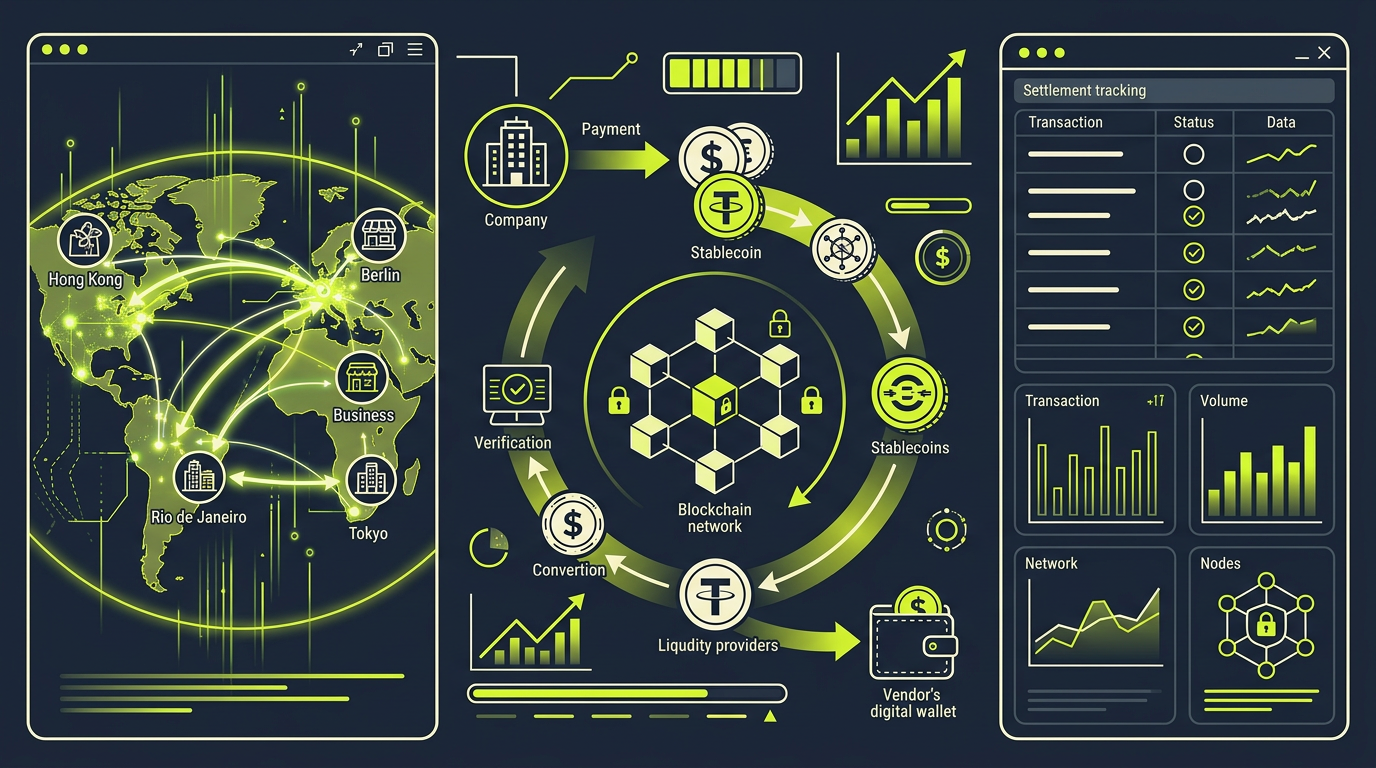
The Rise of Stablecoins as a Global Settlement Layer
Stablecoins are emerging as a powerful new payment rail, purpose-built for the digital age. S. Dollar. As noted in a recent Bain & Company report, stablecoins are beginning to trigger a “great rewiring of wholesale banking,” transforming liquidity and cross-border financial flows.
Their adoption is surging, with on-chain transaction volumes recently crossing $33 trillion, signaling their maturation from a niche concept to a cornerstone of modern finance.
The core advantage of stablecoins is their ability to leverage blockchain infrastructure for near-instant, low-cost value transfer, 24/7/365, without bank holidays or batch processing delays. Instead of a multi-day journey through correspondent banks, a stablecoin payment moves directly from sender to receiver in seconds, with transaction fees that are a fraction of a cent. For businesses paying global vendors, this means the ability to settle invoices instantly, anywhere in the world.
Beyond Payments: A treasury orchestration problem
Successfully leveraging stablecoins is more complex than simply sending a transaction. Businesses must manage different types of stablecoins (like USDT or USDC) across multiple blockchain networks. As one industry analysis points out, this is fundamentally a treasury orchestration problem, not just a payments problem. Your AP team shouldn't need a PhD in digital wallets and gas fees to pay an invoice.
This is where a financial operating system becomes critical. An advanced payout platform abstracts away all the underlying complexity. Your business funds its account in standard fiat currency. The platform’s treasury operations then handle the intricate process of ensuring the right stablecoin is on the right chain, in the right amount, to deliver a seamless payment to the vendor. Your team manages a simple payment instruction; the platform orchestrates the complicated multi-chain execution.
It's Not 'Crypto,' It's Just Better Payment Rails
A common misconception is that paying with stablecoins requires vendors to be cryptocurrency experts. The reality is that for the payee, it can be as simple as receiving dollars into a digital wallet, which can then be held, spent, or converted to their local currency. Using stablecoins for business operations is about utility, not speculation. The underlying technology is simply the means to a much more efficient end: faster, cheaper global money movement.
The goal is to provide optionality and efficiency. Many vendors, especially in the creator economy and tech sectors, prefer settlement in digital dollars due to the speed and portability it offers. For others, the platform can handle the final leg of conversion, delivering local currency to their bank account. The key is that the core cross-border settlement happens on these new, efficient rails, slashing the time and cost associated with the transaction.
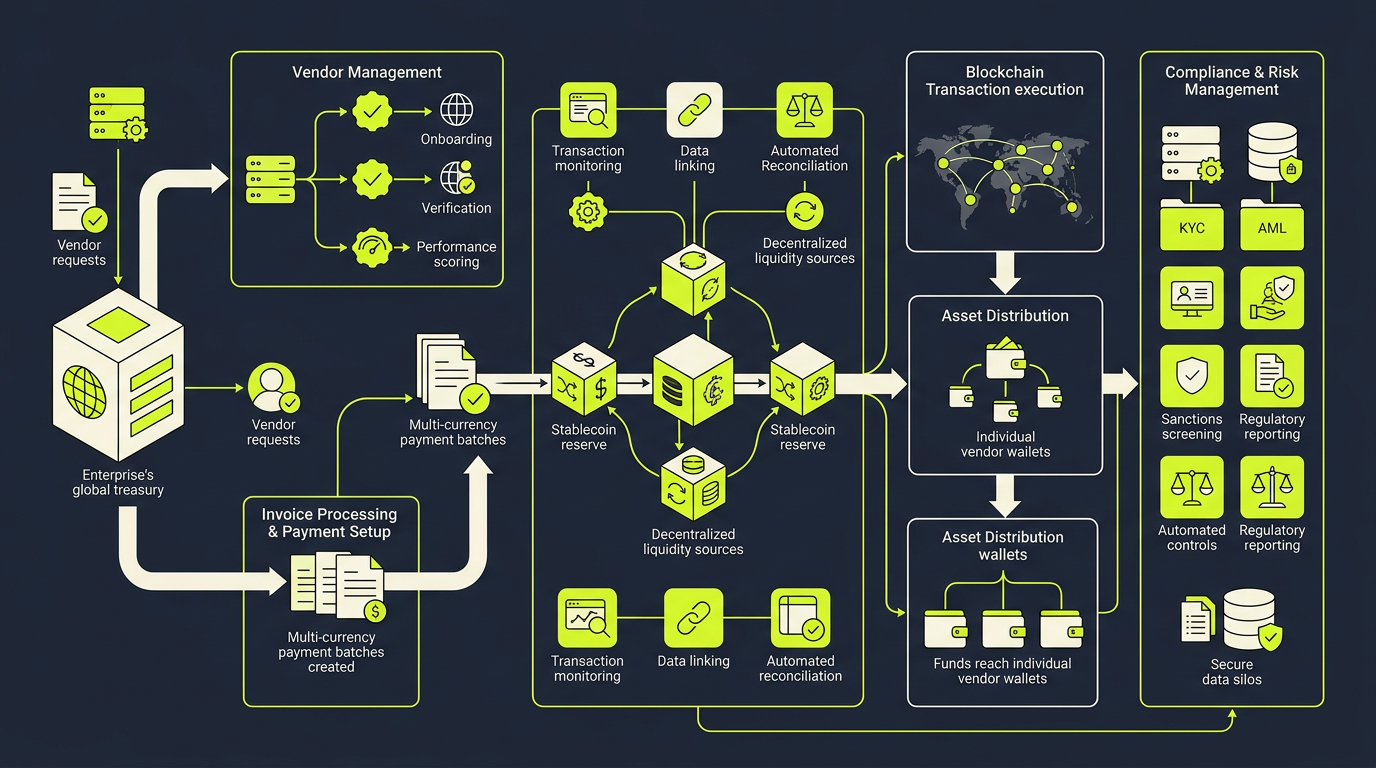
Building a 'Touchless Finance' Payout Operation
The ultimate goal for a scaling global business should be 'Touchless Finance'-a state where the entire payout lifecycle is automated, from vendor onboarding and invoice processing to multi-rail payment execution and reconciliation. This transforms the finance function from a reactive administrative center into a strategic, data-driven hub that supports business growth.
Achieving this requires a unified platform that combines several key components. It starts with a white-labeled vendor portal for seamless onboarding and data collection. Next is AP automation to ingest and approve invoices with minimal human intervention. The core is a smart payment engine that can disburse funds across both traditional (ACH, SEPA, wires) and digital (stablecoin) rails, optimizing for cost and speed with every payment. Finally, it must all sync back to your ERP.
The Strategic Advantage of Optimized Global Payouts
Viewing payments as a non-negotiable cost of doing business is an outdated mindset. As an analysis in Newsweek suggests, payment solutions can become a competitive advantage. By optimizing your payout operations, you do more than just lower costs; you build a strategic asset for your company. Instant or near-instant payments become a powerful tool for attracting and retaining the best global talent, whether they are freelance developers, performance marketing affiliates, or top-tier creators.
Features like Advanced Payment, which offers instant liquidity to vendors against their approved invoices, can be a . For a freelancer waiting on a critical payment, the option to receive funds immediately is a powerful incentive to prioritize your projects. This transforms your AP department from a cost center into a partner in vendor success and loyalty.
For platforms in the ad-tech, affiliate, and creator spaces, this operational excellence is non-negotiable for scale. Modernizing your payment infrastructure is a critical step in making global affiliate payouts simplified and scalable. A practical guide to stablecoin payments shows that this technology enables a new level of efficiency. Ultimately, the company that pays its global partners faster, cheaper, and more reliably will win. By moving settlement from a three-day ordeal to a three-second transaction, you are not just improving a process; you are building a more agile, resilient, and competitive global business.