

For today’s fastest-growing digital companies - ad networks, creator economy platforms, and online marketplaces - the world is their office and talent pool. This global-first model unlocks immense opportunity, but it also creates a significant operational bottleneck: paying hundreds or thousands of contractors, affiliates, and vendors across borders. Traditional payment rails, built for a different era, simply cannot keep up with the velocity and volume required.
This friction amounts to a hidden “administrative tax” on growth. Each international wire or ACH transfer is burdened by high cross-border fees, unpredictable settlement times, and costly currency conversions. Finance and operations teams spend countless hours on manual data entry, recipient support, and reconciling fragmented payment data from disparate systems.
This administrative drag diverts critical resources away from strategic initiatives and directly inhibits a company's ability to scale efficiently.
Enter stablecoins - not as a speculative investment, but as a transformative settlement utility. When integrated into a sophisticated payout automation platform, they provide a set of modern financial rails capable of closing the gap between your current, high-friction process and a future state of “touchless finance.” This isn’t about replacing your entire system overnight; it’s about strategically augmenting it with superior technology to eliminate the operational tax that holds you back.
Beyond Speculation: Stablecoins as a Financial Operating System
The conversation around digital assets is maturing rapidly. Once confined to capital markets, the stablecoin market has grown significantly, with an aggregate market capitalization reaching $317 billion as of early April 2026. This scale signifies a fundamental shift toward real-world utility. In 2025 alone, adjusted stablecoin transaction volumes grew to $10.9 trillion, beginning to rival the annual volume of major payment networks like Visa.
For CFOs and Operations Managers, this isn't abstract market data; it’s the validation of a new, hyper-efficient infrastructure for moving value. Stablecoins like USDC and USDT act as a digital representation of a fiat currency (like the US dollar) on a global, programmable ledger. This allows for near-instantaneous, low-cost transfer of dollar-denominated value to any recipient with a compatible wallet, anywhere in the world, without the delays and intermediaries of the traditional banking system.
From Capital Markets to Contractor Wallets
While early stablecoin use was dominated by trading activities, the most significant trend is the pivot to commercial payments. The volume of real-world stablecoin payments doubled in 2025 to $400 billion, showcasing a clear demand for more efficient payment rails. This growth is driven by businesses seeking a tangible solution to the high costs and slow speeds of legacy systems.
The cost savings are dramatic and immediate. A conventional cross-border SWIFT payment can cost anywhere from $40 to $80 per transaction, including intermediary bank fees and FX spreads, and take 3-5 business days to settle. In stark contrast, a stablecoin payout can cost less than a dollar and settles in a matter of seconds. For a company processing thousands of international contractor payments monthly, this efficiency gain translates directly to the bottom line and improves vendor satisfaction.
Why Flat-Fee Models Trump Percentage-Based Fees
As payout volume scales, the economic model of your payment provider becomes critically important. Many solutions charge a percentage of the transaction value, which can become prohibitively expensive for businesses disbursing millions of dollars. A 1% fee on a $5 million monthly payout volume amounts to a $50,000 operational cost, a figure that directly penalizes growth.
An “Operations-First FinTech” platform utilizes a flat-fee per-transaction model. This approach provides complete cost predictability, regardless of the transaction size or total volume. For finance leaders, this transparency is essential for accurate forecasting and budgeting. It ensures that your payout infrastructure is a scalable asset that supports growth, not a variable cost that erodes margins as you succeed.
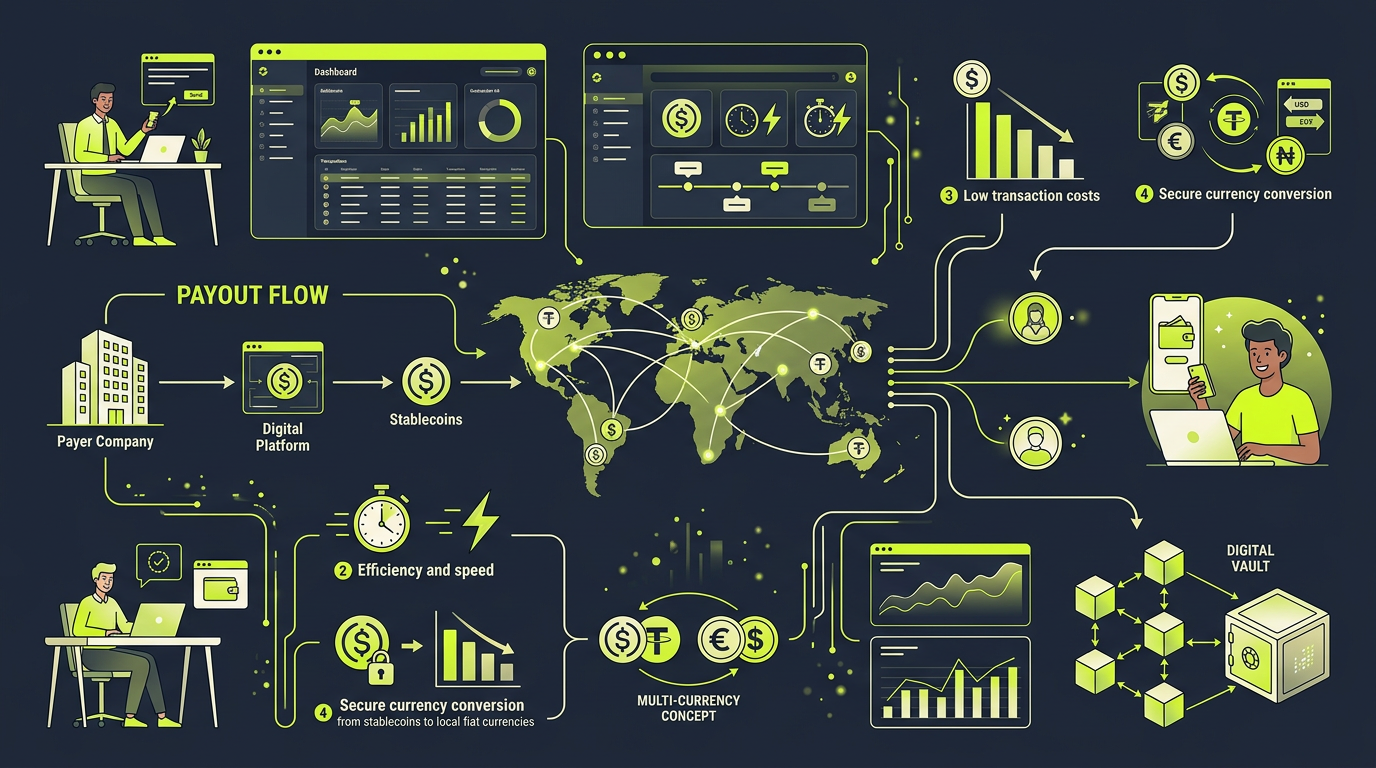
The Operational Upgrade: Integrating Stablecoin Rails into Your AP Workflow
Adopting stablecoin payouts isn't about adding another disconnected tool to your finance stack. The true value is unlocked when these new rails are seamlessly integrated into a unified global payment automation platform. The goal is to create a single operating system for all disbursements, whether fiat or crypto, thereby eliminating the complexity and data silos that plague manual accounts payable processes.
This unified approach allows a business to onboard a vendor in any of 150+ countries, validate their identity and tax information, and give them the option to be paid in their local currency via traditional banking or in a stablecoin like USDC. The entire process, from data ingestion to final settlement, is managed within one system, providing unparalleled visibility and control over your entire payout function.
Unifying Fiat and Crypto Payouts in a Single Ledger
One of the greatest challenges for finance teams is managing reconciliation. When you use one system for domestic ACH, another for international wires, and a third for crypto payouts, you create fragmented data trails that are nearly impossible to reconcile efficiently. This manual consolidation process is a significant source of errors and wasted hours.
A true payout automation platform solves this by design. With over 600+ ERP integrations, including NetSuite, QuickBooks, Xero, and SAP, all payout data-fiat and crypto-is posted back to your general ledger from a single source. This creates a unified and immutable audit trail, transforming reconciliation from a multi-day ordeal into an automated, error-free background process.
Automating Global Tax & Vendor Compliance
Paying international contractors isn't just a logistical challenge; it's a major compliance undertaking. Your organization is responsible for collecting the correct tax forms (like W-8 BEN/W-8 BEN-E for foreign contractors and W-9s for US persons), performing necessary KYC/AML checks, and screening against sanction lists. Managing this manually across a large, distributed workforce is untenable and exposes the business to significant regulatory risk.
Modern payout platforms embed compliance directly into the vendor onboarding workflow. This process can be fully automated. The system intelligently collects the right information and documentation based on the contractor's location and entity type, ensuring you remain compliant without manual intervention. As regulators provide clearer frameworks, such as Europe’s MiCA regulations, compliant platforms manage these obligations seamlessly.
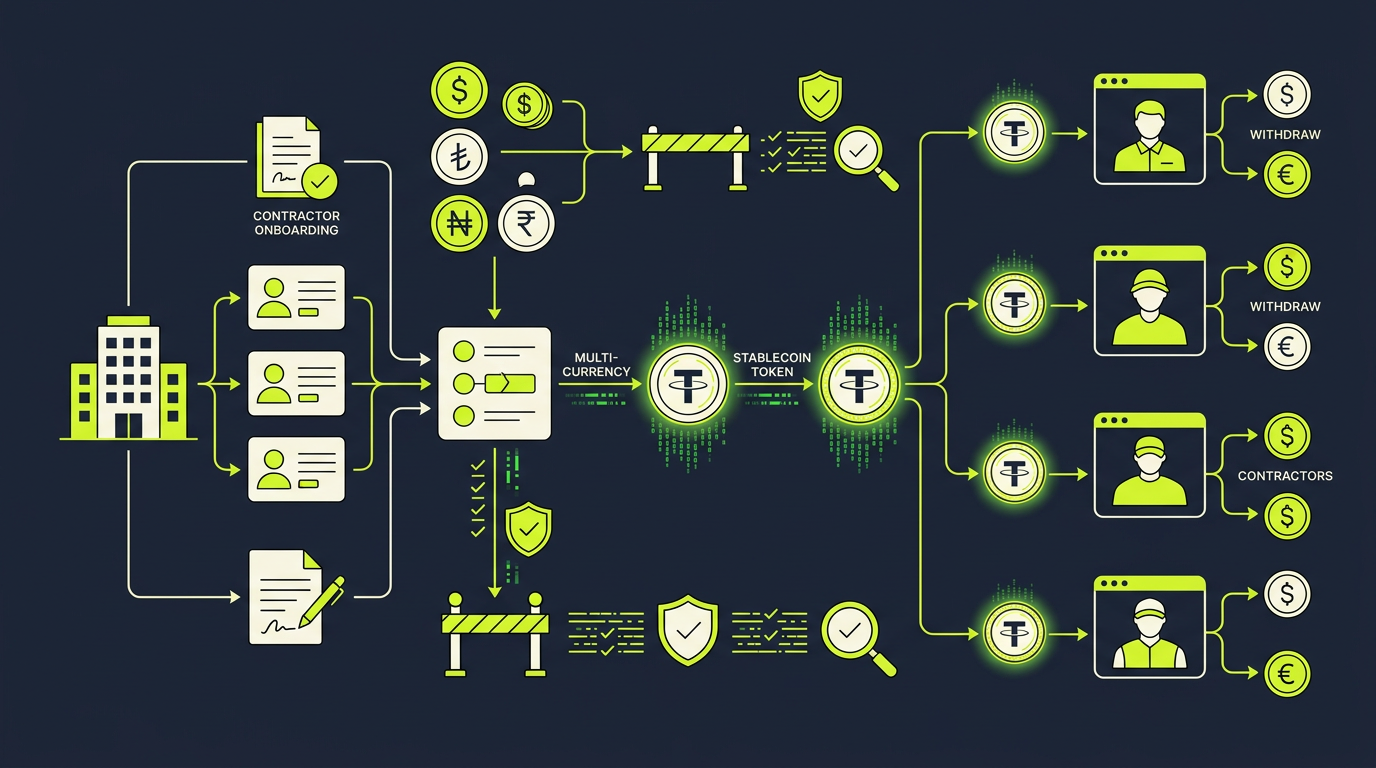
Building a Touchless Finance Function for the Creator Economy
For platforms in the creator economy, ad tech, and online marketplaces, the ability to pay contributors quickly, reliably, and efficiently is a core business function and a key competitive differentiator. A “touchless finance” operating model, where payouts are executed automatically and without manual intervention, frees up your team to focus on growing the business.
This is achieved through a combination of powerful automation and self-service capabilities. A robust Vendor Management Suite, including a white-labeled portal, empowers your global contractors to onboard themselves, upload their payment and tax details, and choose their preferred payout method. This self-service approach drastically reduces the administrative burden on your operations team and provides a superior experience for your payees.
The Strategic Advantage of Payout Choice
In a competitive global market for talent, offering flexibility in how people get paid is a powerful retention tool. Stablecoin payouts have become especially useful for teams paying contractors, creators, and vendors across borders. For a contractor in a country with a volatile local currency or high inflation, receiving payment in a USD-backed stablecoin provides a level of financial stability and control that a local currency transfer cannot.
By offering payout optionality within a single platform-135+ fiat currencies alongside major stablecoins-you cater to the diverse needs and preferences of a global workforce. This demonstrates that you are a forward-thinking partner committed to providing them with the best possible payment experience, which in turn fosters loyalty and makes your platform more attractive to top-tier talent.
Instant Liquidity and Advanced Payments
The near-instant settlement of stablecoins unlocks new possibilities beyond basic payouts. It serves as the foundation for innovative financial products that provide even greater value to your vendor network. One such innovation is “Advanced Payment,” a feature that offers instant liquidity to creators and contractors against their confirmed earnings.
Instead of waiting for a standard net-30 or net-60 payment cycle, a vendor can opt to receive their funds immediately, managed entirely through the payout platform. This is a for freelancers and small businesses who rely on consistent cash flow. For your company, offering this service requires no additional capital or risk, yet it serves as a powerful tool for building stronger, more resilient relationships with your most valuable partners.