

The affiliate marketing industry is no longer a niche channel; it's a significant engine for digital commerce, with the global market valued between $17 and $18.5 billion in 2025. For finance leaders at rapidly growing affiliate networks, this scale presents a dual-edged sword. While revenue soars, the operational complexity of managing global payouts balloons, introducing an 'administrative tax' that silently erodes margins and stifles the very growth you're trying to manage.
Manual wires, percentage-based payment processors, and disjointed systems for tracking and remittance create a cascade of challenges. These include high transaction fees, painful multi-currency reconciliation, and the constant risk of compliance missteps. The finance team, buried in spreadsheets and manual data entry, becomes a bottleneck rather than a strategic partner to the business. This operational drag is not just an inconvenience-it's a direct threat to scalability and profitability.
Deconstructing the Hidden Costs in Your Payout Stack
For a CFO, true cost analysis goes beyond the line items on an invoice. The genuine cost of affiliate payouts is hidden in lost efficiency, margin leakage from fees, and the strategic handicap of a slow, manual finance function. As the global cross-border payment market is projected to grow from $397.37 billion in 2026 to over $727.74 billion by 2034, these hidden costs will only become more pronounced for networks operating on a global scale.
Margin Erosion from Cross-Border & FX Fees
Traditional payment processors and banks often rely on percentage-based fees and opaque foreign exchange rates. When paying out hundreds or thousands of affiliates across 150+ countries, these small percentages compound into a significant drain on revenue. A 1-2% fee per transaction can equate to tens or hundreds of thousands of dollars in lost margin annually, directly impacting your bottom line and ability to offer competitive commission structures.
The alternative is a transparent, flat-fee-per-transaction model. This approach decouples your operating costs from your revenue growth, allowing you to scale payouts without scaling costs proportionally. Proactive financial management involves choosing partners who provide rate transparency and minimize unnecessary currency conversions, a key strategy for any business managing global disbursements.
This predictable cost structure transforms payouts from a variable expense into a fixed operational cost, simplifying forecasting and financial planning.
The Operational Drag of Manual Reconciliation and Clawbacks
The process of reconciling payout data from an affiliate tracking platform (like Everflow or TUNE) with payment confirmations and your ERP is a notorious time sink. Discrepancies, failed payments, and currency fluctuations turn what should be a straightforward process into a multi-day ordeal for your finance team. This is more than lost time; it’s a critical business risk. Without a single source of truth, creating an accurate, audit-ready financial picture is nearly impossible.
This manual drag is amplified when managing clawbacks. When a sale is reversed or a lead is found to be fraudulent, your team must manually identify the affiliate, calculate the correct deduction, and ensure it's applied to a future payout-all while documenting the change for audit purposes. The process is error-prone, lacks a clear audit trail, and creates friction with valuable affiliate partners.
Global Compliance: The Unseen Operational Risk
Operating globally means navigating a labyrinth of tax and compliance regulations. Onboarding a new affiliate requires more than just a name and payment details; it involves collecting and validating the correct tax documentation (W-9 for US persons, W-8 series for non-US) to ensure proper reporting and withholding. Failure to do so exposes the network to significant financial penalties and legal risk.
Manually managing this for a global base of thousands of affiliates is untenable. It necessitates a system that can automate the collection, digital validation, and renewal of these forms. Furthermore, robust compliance requires maintaining secure and organized financial records. This includes keeping transaction data and KYC documents in a way that is prepared for audits and regulatory reviews, ensuring data integrity and accessibility.
The Integration-First Blueprint: A Touchless Finance Operation
The solution lies in creating a unified financial operating system-one that connects your affiliate tracking platform, your payment provider, and your ERP into a seamless, automated workflow. This 'integration-first' approach eliminates manual data entry, provides a single source of truth for all payout-related data, and transforms your finance team from data clerks into strategic analysts. The goal is 'Touchless Finance,' where operations run without constant manual intervention.
Step 1: Unify Your Stack with Universal Connectors
The process begins by connecting your core affiliate tracking platform-be it CAKE, Everflow, TUNE, or a custom in-house system-to a central payout automation hub. This achieves connectivity via Universal Connectors and a robust API, which ingest approved commission data in real-time. Instead of manually exporting CSVs and uploading them to a bank portal, the data flows automatically, creating payable invoices ready for execution.
This single point of integration removes the primary source of reconciliation errors and operational bottlenecks.
This integration serves as the bedrock for automation. Once commission data is synced, the platform can automatically trigger the next steps in the workflow, from tax compliance checks to the final disbursement. This eradicates the need for the finance team to act as intermediaries between disparate systems, freeing them to focus on higher-value activities like cash flow management and financial analysis.
Step 2: Automate the Affiliate Clawback Workflow
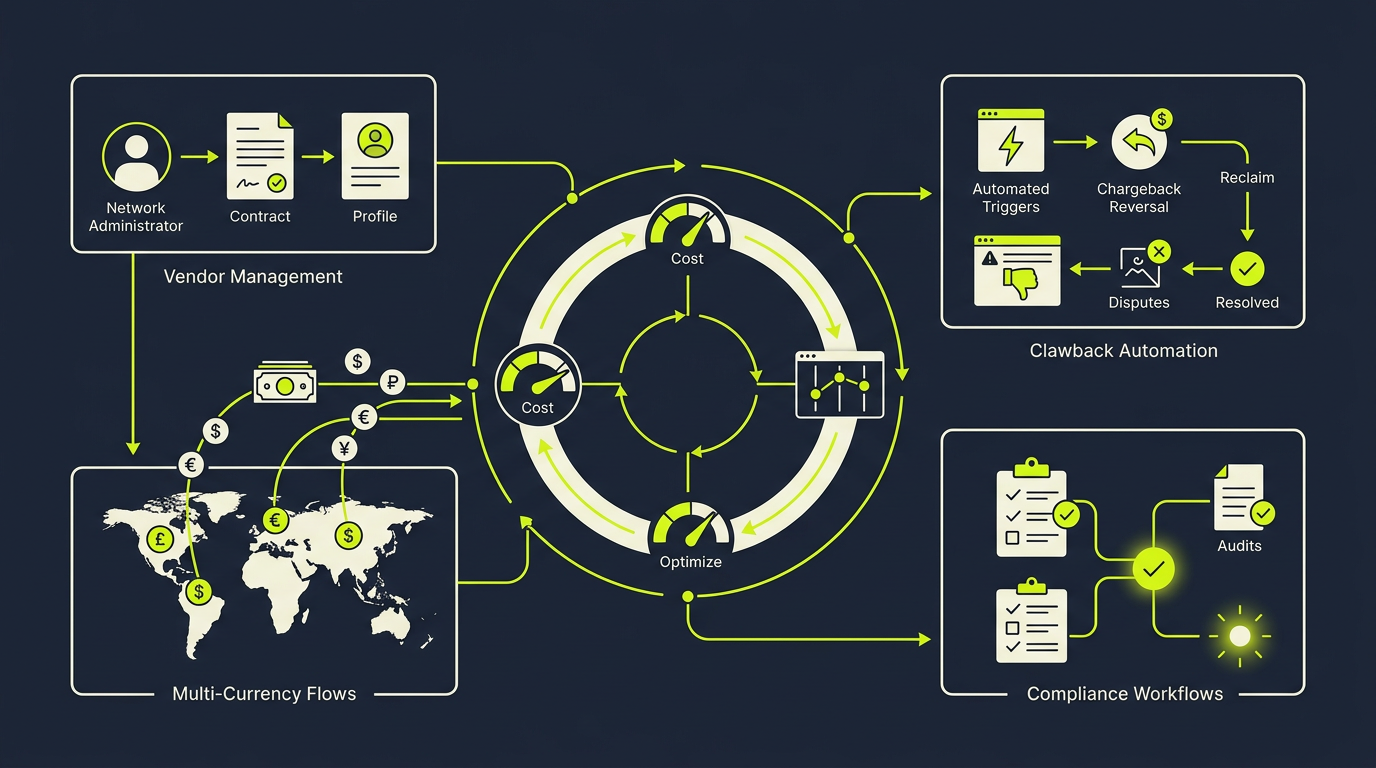
With an integrated system, managing clawbacks transitions from a manual headache to an automated, auditable process. When a transaction is reversed or flagged in your tracking platform, that data is passed to the payout platform. Instead of requiring manual intervention, the system can automatically generate a negative invoice or debit against the affiliate's account.
This debit is then applied against their next approved commission payout. The entire workflow is documented, providing a clear audit trail for both internal review and the affiliate. The affiliate sees the deduction transparently in their vendor portal, along with the corresponding reversal ID from the tracking platform. This removes ambiguity and builds trust, turning a potential point of conflict into a clear, automated business process.
Step 3: From Data to Disbursement to Reconciliation
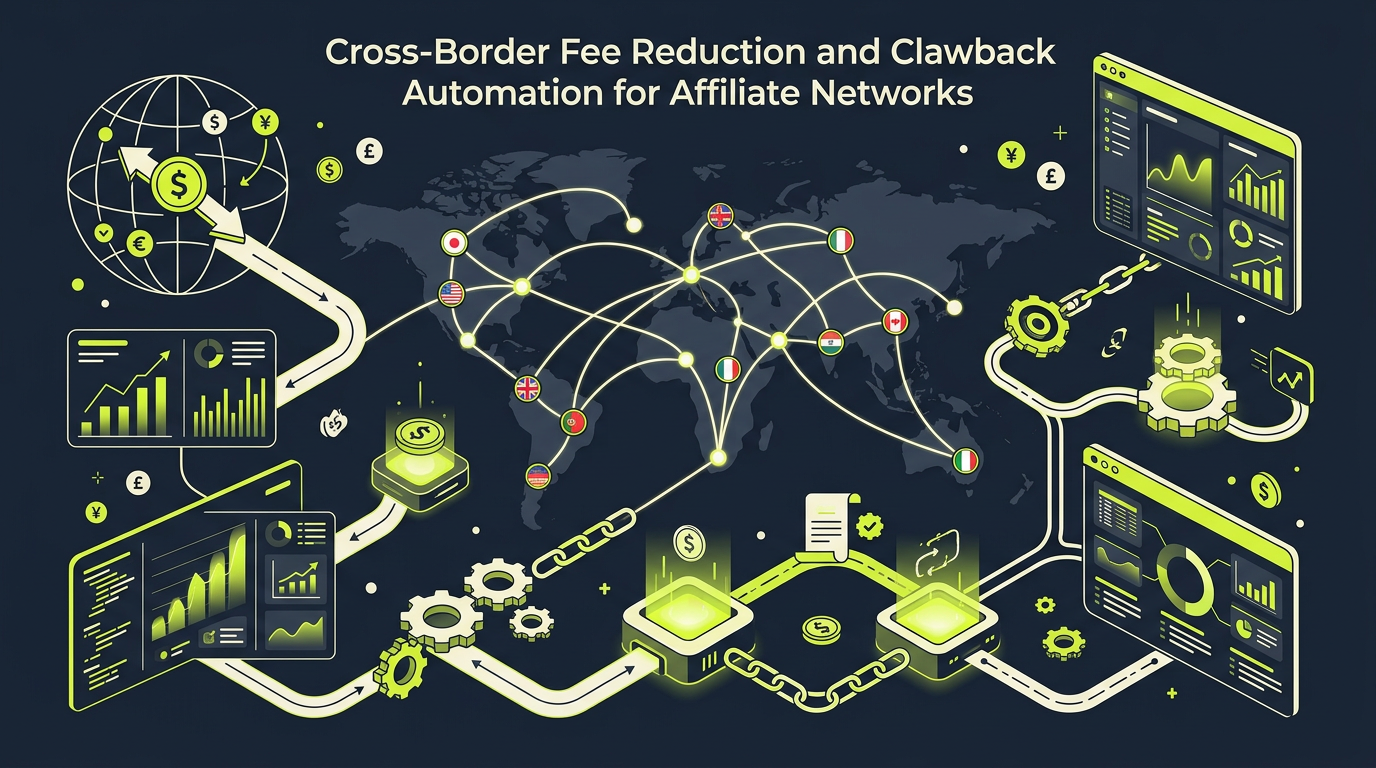
The touchless workflow culminates in payment execution and reconciliation. With approved commissions and affiliate data synchronized, the system automates critical pre-payment checks, including tax form validation (W-9/W-8) and AML screening. Once cleared, payments are executed across 150+ countries and 135+ currencies, optimizing for the best payment rail-be it local bank transfer, instant payment, virtual card, or even crypto stablecoins.
Crucially, the loop is closed when the payout platform writes the reconciled data back to your ERP. With over 600+ available ERP integrations, including NetSuite, QuickBooks, Xero, and SAP, this final step provides a fully reconciled journal entry for every single transaction. This eliminates the multi-day reconciliation nightmare and gives the CFO an accurate, real-time view of cash flow and liabilities.
Strategic Gains Beyond Simple Cost Reduction
While fee reduction and operational efficiency are compelling benefits, a modern payout infrastructure delivers strategic advantages that directly contribute to top-line growth. It reframes the finance function from a cost center to a competitive differentiator, enabling the network to attract and retain top-tier affiliates who view payment terms as a primary factor in choosing a partner.
Using Payout Speed as a Competitive Recruitiment Tool
In the competitive world of affiliate marketing, the speed and reliability of payments are paramount. Top affiliates will gravitate towards networks that offer flexible, fast, and transparent payouts. Automating your payout stack allows you to move from slow Net-30 or Net-60 cycles to daily or weekly payments. This predictability and speed become a powerful marketing tool for your partner acquisition team.
In the competitive world of affiliate marketing, the speed and reliability of payments are paramount. Top affiliates will gravitate towards networks that offer flexible, fast, and transparent payouts. Automating your payout stack allows you to move from slow Net-30 or Net-60 cycles to daily or weekly payments.
This predictability and speed become a powerful marketing tool for your partner acquisition team. Payout satisfaction is directly linked to loyalty. Furthermore, by providing affiliates with a self-service vendor portal to manage their information, track payments, and choose their preferred payout method, you reduce the support burden on your operations team and deliver a superior partner experience.
Unlocking Global Scale with Multi-Rail and Crypto Payouts
True global expansion requires a payment infrastructure that can adapt to local preferences and banking realities. A multi-rail strategy is essential, as the optimal way to pay a creator in Europe (SEPA) is different from paying one in Southeast Asia (digital wallets) or the US (ACH). Attempting to manage these different rails through separate providers creates a fragmented and costly system. A unified platform should intelligently optimize payout routes by region to ensure reliability and speed.
For certain corridors, using stablecoins like USDT as a settlement layer offers a frictionless and near-instant payment rail, bypassing correspondent banking delays and fees. This isn't about crypto speculation; it's about utility. For affiliates in regions with volatile local currencies or underdeveloped banking systems, a stablecoin payout is a lifeline, offering stability and immediate access to funds. Providing this option demonstrates a network's commitment to serving its global partners and can be a significant differentiator from competitors who struggle with reducing cross-border payment fees through traditional means.
By shifting the mindset from managing costs to enabling growth, finance leaders can build a payout operation that is not only efficient and compliant but also a core component of the company's competitive strategy. This strategic approach to finance is what it means to be an Operations-First FinTech.