

Your company just closed a significant funding round. According to recent data, North America saw over $250 billion in venture funding in 2025, a 20% year-over-year increase. This capital isn't for celebrating-it's for executing a high-growth strategy that likely involves global expansion.
You're scaling your team, acquiring customers, and partnering with a global network of vendors, creators, affiliates, or freelancers. But with this global scale comes a silent, creeping cost: the operational drag of multi-currency disbursements.
Every dollar paid out to a global stakeholder comes with an 'administrative tax'-time spent on manual data entry, currency conversions, compliance checks, and payment reconciliations. This is the friction that grinds scalable operations to a halt. While your team is focused on growth strategies like new product introductions and strategic partnerships, your finance and operations teams are getting bogged down in manual work that an automated system should handle.
High-growth startups don't need a simple payment processor; they need a financial operating system.
The Scaling Paradox: When Growth Overwhelms Your Financial Stack
The very tools that helped you manage finances in the early stages often become the primary bottlenecks to scale. Startups that raise significant capital do so to invest in growth, not to hire armies of finance clerks to manage an increasingly complex web of global payments. This scaling paradox occurs when your operational capabilities can no longer keep pace with your company's growth trajectory, turning a strategic advantage into a liability.
The Disconnect Between Your ERP and Global Reality
Your ERP system-whether NetSuite, QuickBooks, SAP, or another platform-is your financial system of record. It's the source of truth for what you owe. However, it was never designed to be a global payout engine. An ERP can generate a bill, but it can't efficiently execute a payment to a freelancer in Southeast Asia, an ad network in Europe, and a supplier in India, all in their local currencies.
This creates a fundamental disconnect. Finance teams are forced to manually export payment data from the ERP, reformat it in spreadsheets, and upload it to multiple banking portals or payment gateways. This process is not only slow and prone to error, but it also creates data silos. The payment status, transaction fees, and final settlement details rarely make it back into the ERP without another round of manual reconciliation, leaving your financial records perpetually out of sync.
Why Your Finance Team Becomes a Bottleneck
When your processes rely on manual intervention, your finance team's capacity becomes the limiting factor for your company's growth. ' inquiries, and manually onboarding new vendors. This is the administrative tax in its most tangible form, preventing skilled finance professionals from focusing on strategic work like cash flow optimization and financial planning.
This bottleneck has real-world consequences. Delayed payments damage relationships with your most valuable partners-the creators, affiliates, and vendors who power your growth. In the creator economy or affiliate marketing space, payment speed and reliability are competitive differentiators. If your operations can't keep up, you risk losing top talent to platforms with a more streamlined financial infrastructure.
The Touchless Finance Model: Unifying Data for Seamless Disbursement
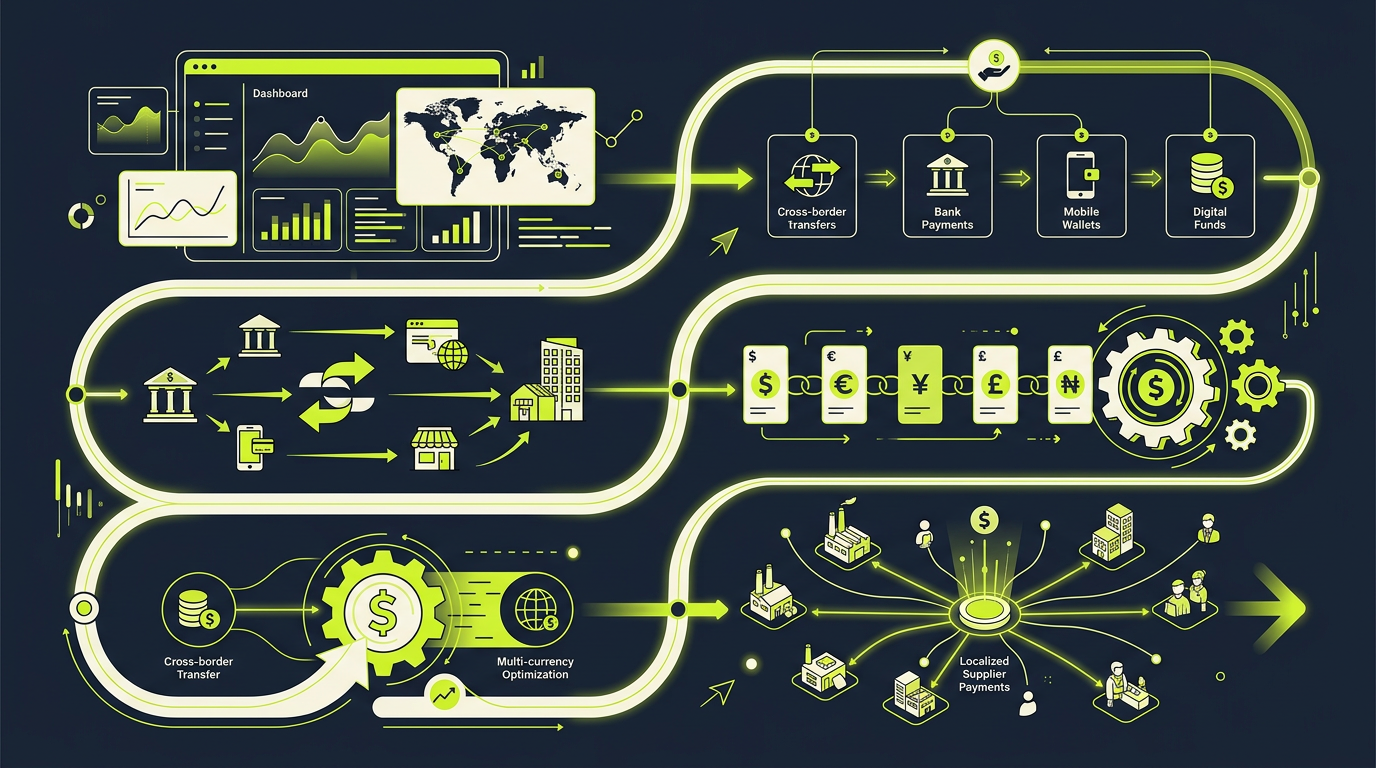
To escape the scaling paradox, companies must adopt a 'Touchless Finance' model. This approach focuses on building a unified financial operating system that connects disparate systems and automates the flow of data from ingestion to final settlement. It’s about creating an infrastructure where payments are an automated outcome of business activity, not a manual task.
Integrating Your System of Record (e.g., NetSuite) with a Payout OS
The foundation of a touchless model is a seamless, two-way integration between your ERP and a global payout platform. Payouts.com acts as an orchestration layer, sitting on top of your existing NetSuite or QuickBooks instance. When a bill is approved in your ERP, the data is automatically pushed to the payout platform, triggering a series of automated workflows for validation, compliance screening, and disbursement.
Once the payment is processed across the chosen rails-whether local or SWIFT-the final settlement status, including any transaction fees, is automatically reconciled back to the ERP. This closes the loop, providing a single, consolidated view of your financial state without manual data entry. With pre-built ERP integrations, this 'plug-and-play' capability eliminates the need for lengthy and expensive custom development projects.
The Role of Universal Connectors
In many high-growth businesses like ad networks and creator platforms, payment data doesn't originate in an ERP. It comes from proprietary tracking systems, affiliate networks, or performance marketing platforms. Payouts.com's Universal Connectors are designed to ingest data from any source via API. This allows you to centralize payment management from across the business, creating a single, unified workflow.
This unified approach allows a business to centralize payment management to reduce friction. Rather than juggling multiple data sources and payment systems, you have one operating system to manage all disbursements. This is crucial for achieving true operational scale and providing a consistent, reliable payment experience for all external stakeholders, a key component of building a scalable infrastructure for Marketplace Payouts at Scale.
Executing a Multi-Currency Strategy without the Fee Drag
A global payout strategy is about more than just moving money; it's about moving it efficiently and cost-effectively. As transaction volumes grow, fee structures that seemed reasonable at an early stage can quickly become a significant drain on your bottom line. Optimizing your fee structure and payment routing is a critical component of financial maturity.
Moving Beyond Percentage Fees to a Flat-Fee Model
Many payment processors charge a percentage of the transaction value. This model penalizes growth-the more you pay out to your global partners, the higher your fees become. For a company disbursing millions of dollars a month, a 1-2% fee represents a substantial and unnecessary cost. This is why a core component of a modern payout strategy is to find a provider that offers predictable, transparent pricing.
Payouts.com was built on a flat-fee per transaction model. This means your costs remain predictable and manageable as you scale. You pay a fixed fee for each payout, regardless of its size. This aligns your costs with your operational activity, not your revenue or payout volume, allowing you to retain more of your capital for reinvestment into growth. This predictable cost structure is essential for accurate financial forecasting and budgeting in a high-growth environment.
Local Rails vs. SWIFT: Choosing the Right Path for Your Payees
Not all payment paths are created equal. For decades, the SWIFT network was the standard for international transfers, but it is often slow, opaque, and laden with high correspondent banking fees. Modern payout platforms leverage local payment rails-like ACH in the US, SEPA in Europe, or FPS in the UK-to deliver funds faster and more cost-effectively. This is a crucial element of a comprehensive guide to global payout solutions.
The right platform should offer dynamic payment routing, allowing you to choose the optimal path for each transaction based on speed, cost, and payee location. Offering payouts across 150+ countries and 135+ currencies requires this level of flexibility. By intelligently routing payments, you can dramatically reduce transaction costs and settlement times, directly improving your partner relationships. Understanding the nuances between these options is key, as highlighted in the discussion around 4 Decisive Factors When Choosing Local Rails vs. SWIFT.

From Tax Compliance to Payee Experience: The Last Mile of Operations
A truly 'touchless' financial operation doesn't stop at payment execution. It extends to the entire payee lifecycle, from onboarding and tax compliance to providing a world-class, self-service experience. This 'last mile' of operations is often where manual processes persist, creating friction and compliance risk.
Automating W-8/W-9 Collection at Scale
Global tax compliance is a non-negotiable aspect of paying international partners. Manually collecting and validating IRS forms like the W-8 and W-9 series is a time-intensive and error-prone process that exposes your business to significant compliance risk. Withholdings, year-end reporting, and regulatory scrutiny all hinge on having accurate and up-to-date documentation for every payee.
A modern payout platform embeds this process directly into the onboarding workflow. Payouts.com’s self-service vendor portal guides each payee through a digital form collection process, automatically validating the data to ensure accuracy. This means that hours spent on W-8s could be seconds, freeing up your team while creating a seamless experience for your partners. It transforms compliance from a reactive, year-end fire drill into a proactive, automated function.
Offering Flexibility: Fiat, Crypto, and Instant Liquidity
The best global partners demand flexibility. A one-size-fits-all approach to payouts is no longer sufficient. Leading platforms offer a range of payout options to meet the diverse needs of a global payee base. This is a core tenet of modern multi-currency payment processing best practices. This includes disbursement to bank accounts, virtual cards, and increasingly, stablecoins like USDT.
At Payouts.com, we view crypto not as a speculative asset, but as a utility-a frictionless settlement layer for sending funds quickly and cheaply across borders, especially in regions with underdeveloped banking infrastructure. Beyond method, it's also about timing. Features like 'Advanced Payment' provide instant liquidity to vendors and creators, allowing them to access their earnings before standard net-30 or net-60 payment cycles. For platforms in the creator economy or ad tech, providing this kind of financial flexibility is a powerful tool for attracting and retaining top-tier talent as part of a global, unified payments solution like the one described by Stripe Payments.
Ultimately, your investment capital was raised to build and scale your business. It was not intended to fund manual, inefficient financial operations. By architecting a touchless finance stack that unifies your ERP, automates workflows, and optimizes global disbursements, you can reclaim your team’s time and focus on what truly matters: growth.