

The mandate for "finance transformation" has become a constant refrain in corporate boardrooms. CFOs are under immense pressure to digitize, automate, and leverage AI to build more resilient and efficient finance functions. Yet, many leaders are discovering a frustrating paradox: despite significant investment in new technologies, their teams remain buried in manual workflows.
The promise of a strategic, data-driven finance organization is consistently undermined by the reality of operational friction.
This dissonance arises from a fundamental misunderstanding of what transformation requires. Bolting on new software-a point solution for AP, another for expense management, a third for treasury-is not transformation; it's diversification of complexity. True transformation is not about acquiring more disparate tools but about architecting a single, cohesive financial operating system.
This article compares the common point solution approach with a unified platform strategy, offering a roadmap for CFOs to achieve a truly "touchless" finance function.
The Allure and Disappointment of Patchwork Digitalization
The modern CFO's role has expanded dramatically, moving beyond traditional financial stewardship to include technology strategy and operational transformation. This expanded mandate coincides with significant economic uncertainty. While many CFOs anticipate revenue growth, a recent survey highlights a key challenge: converting top-line gains into bottom-line profit. This gap is often a direct result of operational inefficiencies-the 'administrative tax' that silently erodes margins.
In response, many finance leaders adopt new technologies like AI-powered invoice processing, big data analytics, and cloud computing. These tools are powerful in their own right, but when implemented as a patchwork of disconnected solutions, they fail to solve the core problem. Instead of creating a seamless flow of data, they create more silos.
Finance teams find themselves managing a brittle web of integrations, manually reconciling data between systems and plugging gaps with spreadsheets-the very work automation was meant to eliminate.
Comparison: Point Solutions vs. A Unified Financial Operating System
The path to touchless finance presents a critical strategic choice for every CFO. Do you continue to address individual pain points with specialized point solutions, or do you invest in a foundational, unified platform that re-architects the entire payment lifecycle? The former offers quick wins for specific symptoms, while the latter provides a cure for the underlying disease of operational fragmentation.
The Point Solution Patchwork: A Symptom-First Approach
The most common approach to digitalization involves acquiring best-in-class tools for specific problems. An Accounts Payable automation tool is a classic example. These systems use AI and optical character recognition (OCR) to extract data from invoices, accelerate approval workflows, and reduce manual data entry. As noted in The CFO's Guide to Digital Innovation in Financial Operations, benchmarks for touchless invoice processing can be high, showing the power of focused automation.
However, this solves only one piece of the puzzle. Once an invoice is approved, the finance team must still export that payment obligation, upload it to a separate payment provider or bank portal, manage currency conversions for international vendors, and then manually reconcile the payment back in the ERP. This workflow is riddled with manual handoffs, creating new opportunities for errors and delays. It's a classic case of local optimization creating global inefficiency.
The Hidden Costs of a Fragmented Tech Stack
The costs of this fragmentation are both explicit and implicit. Maintaining API connections between an AP tool, the ERP (like NetSuite or QuickBooks), and various payment gateways requires dedicated IT resources. When one system updates, integrations can break, causing payment runs to fail and forcing teams back to manual processes.
Finance professionals end up spending their time managing technology instead of analyzing financial data, battling the very unstructured communications that automation was supposed to resolve.
More importantly, a fragmented stack creates significant compliance and strategic blind spots. A point solution for AP typically doesn't handle the critical, upfront work of global tax compliance (collecting and validating W-8/W-9 forms) or automated KYC/AML checks for payees. This remains a high-risk, manual process. With increasingly complex compliance challenges on the horizon, from new tax laws to data privacy regulations, these gaps represent a major liability for scaling companies.
The Unified Platform: An Operations-First Approach
The alternative is an operations-first approach built on a unified platform. This model treats payout operations not as a series of discrete tasks but as one continuous, end-to-end workflow. It's a financial operating system designed to eliminate manual handoffs entirely. Data flows seamlessly from initial vendor onboarding through compliance, invoice processing, multi-currency disbursement, and final ERP reconciliation without human intervention.
From Data Ingestion to Final Settlement in One System
In a unified model, a new vendor, affiliate, or freelancer onboards through a self-service portal that is part of the core platform. The system automatically guides them to submit the correct tax forms and payment information, validating the data in real-time. This single action populates a global payee database that serves as the foundation for all future activities. This approach transforms financial operations by automating invoice handling from receipt to payment, as highlighted by guides on AI's role in boosting efficiency.
When it's time to pay, invoices are processed, approved, and scheduled for disbursement across 150+ countries and 135+ currencies-including fiat and crypto options like stablecoins-all within the same environment. There are no CSV files to export or upload. The platform handles all FX conversions, payment routing, and settlement, then automatically syncs fully reconciled data back to the company's ERP through pre-built integrations with over 600 systems like NetSuite, SAP, and Xero.
This creates a single, immutable source of truth for all payout-related activity.
Embedding Compliance and Security Across the Workflow
A unified system fundamentally changes the posture towards risk and compliance. Instead of being a separate, manual step, compliance is woven directly into the operational fabric. Because the platform captures and validates tax and identity information at onboarding, it can proactively enforce compliance rules throughout the payment lifecycle. This is crucial for businesses making mass global payouts and need to automate KYC/AML for global mass payouts.
This integrated approach is particularly vital as CFOs at the largest companies increase their focus on geopolitical and macroeconomic risks. A unified view of global payment flows provides the transparency needed to navigate shifting regulatory regimes and trade dynamics. It turns complex requirements like global tax reporting and adherence to frameworks like PSD2 from a resource-draining burden into a highly automated and scalable function, freeing the finance team to focus on strategic risk management.
A Pragmatic Roadmap to Touchless Finance
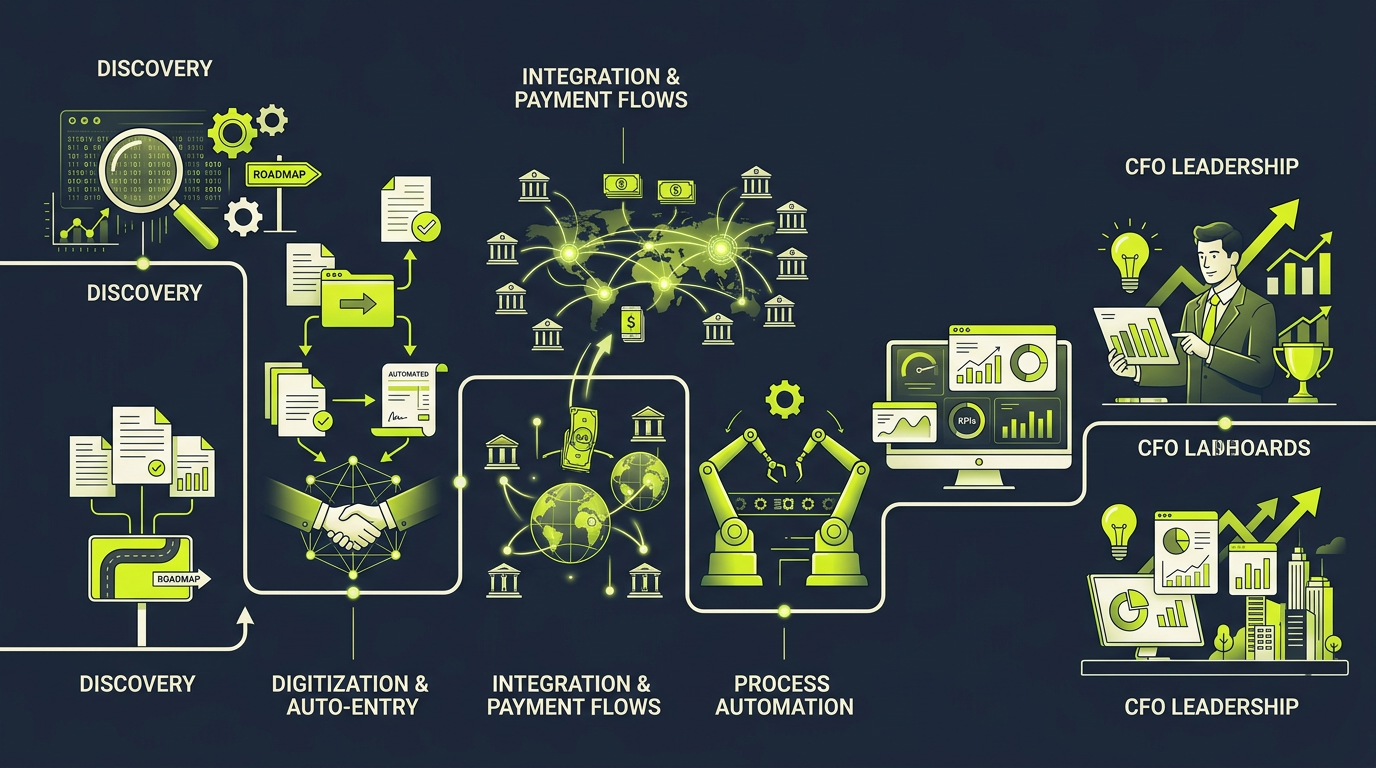
Transitioning to a unified model doesn't require a chaotic "rip and replace" of all existing systems overnight. It can be a phased journey that systematically eliminates manual work and builds a foundation for strategic growth. For CFOs, the roadmap should focus on consolidating data, automating core processes, and finally, optimizing treasury operations.
Stage 1: Centralize Global Stakeholder Data
The first and most critical step is to get out of spreadsheets and shared inboxes. Implement a unified Vendor Management portal to serve as the single point of entry for all global payees, whether they are traditional suppliers, freelance creators, or affiliate partners. This initial stage is about data integrity.
The focus should be on creating a clean, validated, and comprehensive database of every entity you pay. This involves capturing correct legal names, payment details for various methods, and, most importantly, collecting and validating tax identity information (like W-9s and the W-8 series) from the very beginning. This clean data layer is the bedrock upon which all future automation is built.
Stage 2: Automate the Payout and Compliance Lifecycle
With a centralized data foundation, the next stage is to connect it to the complete accounts payable and payment execution workflow. This involves automating the entire lifecycle, from invoice submission and internal approvals to the final disbursement. This is where organizations realize massive efficiency gains and move beyond the constraints of simple AP and AR automation toward a truly holistic system.
This stage automates the complex, multi-step process of paying thousands of stakeholders globally. The system should handle payments across all desired methods, from traditional bank transfers and virtual cards to crypto stablecoins, all managed from a single dashboard and funded through a single account. By choosing a platform with a flat-fee per transaction model, CFOs can create a predictable cost structure that scales efficiently, avoiding the margin erosion common with percentage-based payment fees.
Stage 3: Optimize Global Treasury and Liquidity
Once payout operations are automated and data is unified, the CFO's role can fully transition from reactive processor to strategic leader. With a real-time, global view of cash flow and payment obligations, the finance team can begin to strategically manage treasury functions, optimize currency holdings to minimize FX exposure, and forecast cash needs with precision.
This advanced stage also unlocks new strategic capabilities. For example, a unified platform's data can be used to offer 'Advanced Payment' options, providing instant liquidity to key suppliers or creators, thereby strengthening the entire ecosystem. Moreover, it allows businesses to leverage modern settlement layers like stablecoins to bypass the slow and costly correspondent banking system for international payments. It also enables sophisticated tools like virtual cards for better spend control, as outlined in The CFO’s Framework for Global Vendor Payments with Virtual Cards.
Ultimately, true finance transformation is not defined by the number of AI tools in your tech stack, but by the degree of operational autonomy your business achieves. The choice CFOs face is between treating the recurring symptoms of fragmentation with a patchwork of point solutions, or curing the underlying condition with a unified financial operating system. For today’s scaling digital businesses-from ad networks and creator platforms to global marketplaces-an operations-first approach is the only sustainable path to converting ambitious growth projections into tangible, bottom-line results, overcoming the key challenges facing CFOs today.