

For Chief Financial Officers at high-growth companies, scaling cross-border payments is a significant operational challenge. As your network of international vendors, freelancers, and affiliates expands, so does the complexity. Manual payment runs, high transaction fees, and the constant threat of fraud create an 'administrative tax' that burdens finance teams and hinders growth.
0 Billion in 2025, and its continued growth underscores the urgency for efficient solutions.
Virtual cards have emerged as a powerful tool in the modern finance stack, offering a layer of security and control that traditional payment methods lack. By generating unique card numbers for specific transactions, businesses can mitigate risk and gain unprecedented visibility into spending. The virtual cards market is projected to reach USD 15.14 trillion by 2031, driven by the adoption of AP automation and the need for enhanced security.
However, deploying virtual cards is not a panacea for the complexities of global B2B payments. They are a crucial component, but true operational excellence requires a holistic strategy. This framework outlines five key considerations for CFOs looking to leverage virtual cards as part of an integrated, automated payout ecosystem-an approach that enables 'touchless finance' and supports sustainable global scaling.
- Enhance Security and Mitigate Fraud Risk
The primary driver for adopting virtual cards is security. Traditional corporate cards, with their static numbers, expose companies to significant risk if compromised. A single data breach at a third-party vendor can spiral into a major financial liability. incidents like the recent breach affecting customers of a Texas state vendor highlight the persistent threat in the supply chain. Virtual cards fundamentally change this dynamic by decentralizing risk.
The Power of Single-Use Credentials
The most secure iteration of this technology is the single-use virtual card. These disposable credentials can be locked to a specific vendor, a precise transaction amount, and a limited timeframe. Once the payment is executed, the card number becomes obsolete, rendering it useless to fraudsters.
03% CAGR through 2031 as enterprises focus on fraud control.
This granular control is impossible with physical cards or traditional bank transfers. It effectively creates a secure payment environment for every individual transaction, minimizing the surface area for attack. For finance leaders, this means a tangible reduction in payment fraud, fewer chargebacks, and less time spent on security audits and incident response.
Reducing Exposure from Data Breaches
When you pay a vendor with a physical card, you are trusting their security infrastructure to protect your financial data indefinitely. In an era of constant cyber threats, this is a significant gamble. By using a virtual card, the actual corporate account details are never exposed to the vendor.
The virtual number acts as a proxy, shielding the underlying funding source. If the vendor's system is ever breached, the compromised data is limited to a single-use number, protecting the business from cascading financial impact.
- Achieve Granular Control Over Global Spend
Beyond security, virtual cards provide an unparalleled level of spend control, which is critical for any organization scaling internationally. CFOs need visibility into where capital is being deployed in real-time. Virtual cards transform procurement and vendor payments from a reactive, opaque process into a proactive, data-driven function. They allow finance teams to enforce policy automatically, rather than policing it manually after the fact.
Implementing Dynamic Spend Controls
Modern virtual card platforms allow for the creation of cards with specific, enforceable rules. For instance, a card issued to an ad network for a marketing campaign can be restricted to that specific merchant category and capped at the approved budget. It can also be time-limited to the campaign's duration. This empowers department heads and budget owners to manage their vendors directly while finance maintains ultimate control and oversight from a central platform.
These controls prevent out-of-policy spending and eliminate budget overruns before they happen. This is a fundamental shift from the traditional model of reviewing expense reports and vendor invoices weeks or months after the spend has occurred. It moves the point of control from post-mortem analysis to pre-transaction authorization, embedding compliance directly into the workflow.
Streamlining Project and Departmental Budgeting
Issuing unique virtual cards for different projects, campaigns, or departments creates an automatic audit trail. Every transaction is instantly categorized and linked to its business purpose. This rich data stream is invaluable for financial planning and analysis. As noted in industry analysis, such granular data supports better budgeting, forecasting, and even vendor negotiations.
Imagine closing the books at the end of the month where all vendor payments are already categorized by project code, general ledger account, and department. This eliminates days of manual work for the accounting team. This level of data fidelity, captured at the point of transaction, is a cornerstone of building a highly efficient, automated finance function.

- Simplify Cross-Border Transaction Reconciliation
Reconciliation is a major pain point in B2B international payments. When you send a wire transfer in one currency and it's received in another, the final amount rarely matches the invoice perfectly. As a Ramp guide on the topic explains, reconciliation becomes complex when FX conversion, partial payments, and intermediary bank fees alter the received amount. This forces finance teams into a time-consuming investigative process, matching payments to invoices across different systems.
How Virtual Cards Embed Rich Data
Virtual cards help solve this problem by carrying structured data with each transaction. When a virtual card is generated, it can be tagged with critical metadata such as an invoice number, purchase order number, vendor ID, or project code. This data travels with the payment throughout the entire lifecycle.
When integrated with an ERP or accounting system, this allows for automatic, real-time reconciliation. The payment transaction, complete with all its metadata, flows directly into the general ledger, where it can be matched against the corresponding invoice automatically. This capability dramatically reduces the manual effort required for month-end close and provides a clearer, more accurate view of the company's financial position.
- Acknowledge the Operational Limitations
While the benefits are clear, CFOs must also be pragmatic about the limitations of a virtual-card-only strategy, especially in a global context. Relying solely on virtual cards can create new operational bottlenecks and may not be a viable solution for every vendor in your supply chain. A successful global payment strategy requires flexibility and multiple payment options.
Addressing Vendor Acceptance and Onboarding
The most significant limitation is vendor acceptance. While card payments are common, not all businesses globally are equipped or willing to accept them, particularly for large B2B invoices where processing fees can be substantial. Forcing a vendor to accept a payment method that is inconvenient or costly for them can strain the relationship. Furthermore, the process of collecting payment details must be efficient and secure, which requires a robust system for Vendor Onboarding That Scales.
An effective global payout platform must offer multiple payment rails. This includes local bank transfers (like ACH and SEPA), international wire transfers, and even crypto stablecoins for vendors who prefer them. The choice of payment method should reside with the vendor, managed through a sophisticated portal that is part of a larger payout automation system.
This Operations-First approach ensures a frictionless experience for your partners, which is crucial for retaining top talent and reliable suppliers in a competitive market.
Navigating Regulatory and Tax Compliance
Making a cross-border payment is more than just moving money; it involves strict regulatory and tax obligations. Every payment must comply with the rules of both the sender's and recipient's countries, covering areas like KYC (Know Your Customer) and anti-money laundering (AML) regulations. Virtual cards do not inherently solve these compliance challenges.
Your payment process must include automated systems for collecting and validating tax forms like W-8s and W-9s and screening vendors against global watchlists. Integrating this into the payment workflow is non-negotiable for global businesses. This is precisely why leaders must How to Automate Global Tax Compliance for Seamless Vendor Payouts, ensuring every transaction is fully compliant without creating manual bottlenecks.
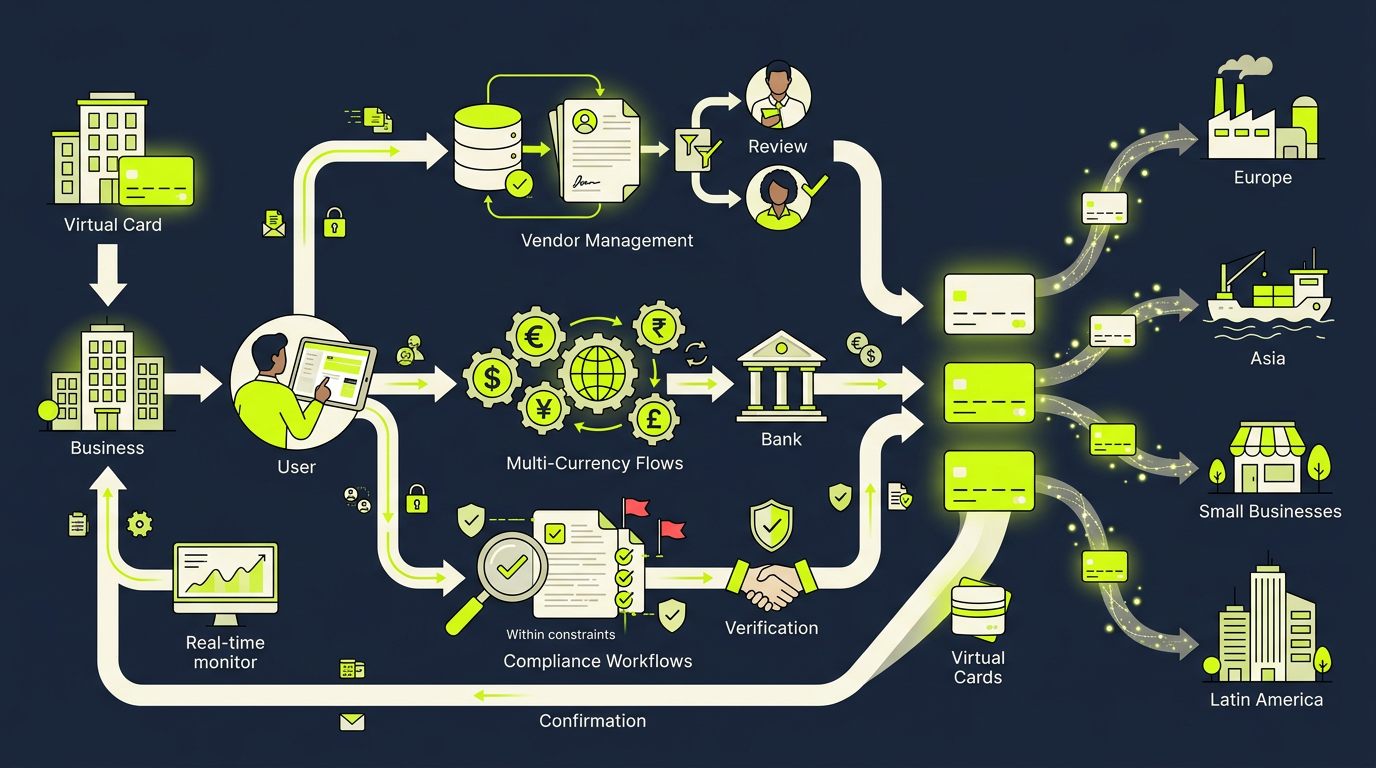
- Integrate Virtual Cards into a Unified Payouts Platform
The ultimate goal for a scaling finance team is to achieve 'touchless finance,' where payments are managed through an automated, intelligent, and unified system. Using a standalone virtual card provider can create yet another data silo, undermining the goal of a single source of truth for all payables. The true power of virtual cards is unlocked when they are a native feature within a comprehensive global payout platform.
Building a Holistic B2B payment automation Strategy
A holistic approach, as described in guides on B2B payment automation, involves integrating various functions into one workflow. This includes vendor onboarding, tax compliance, invoice processing, multi-rail payments (including virtual cards), and ERP reconciliation. This creates a closed-loop system that eliminates manual data entry and reduces the risk of errors.
By using a single platform like Payouts.com, which offers over 600+ ERP integrations with systems like NetSuite, QuickBooks, and SAP, finance teams can manage all outbound payments from one central dashboard. This approach acknowledges that Why Virtual Cards Alone Won't Solve Global B2B Payments. They are a tool, and their effectiveness is magnified when part of a complete financial operating system that automates the entire payment lifecycle.
Ultimately, virtual cards are a strategic asset for any CFO focused on security and control. However, to truly build a scalable, global payment operation, they must be viewed as one component of a broader automation strategy. By embedding them within a unified platform that handles compliance, multi-rail payments, and ERP integration, finance leaders can eliminate the administrative tax of manual work and position their companies for efficient global growth.