

For finance and operations leaders at high-growth global companies, the landscape of digital payments is undergoing a seismic shift. Once a niche topic, the use of stablecoins for cross-border B2B payouts is now a critical operational consideration. With the fiat-backed stablecoin supply soaring to approximately $238 billion as of August 2025, policymakers have moved decisively to establish clear regulatory frameworks.
The passage of the Gridlock, Evasion, and Nefarious Activities Interdiction for Unlawful Systems (GENIUS) Act and the ongoing progress of the Digital Asset Market Clarity Act (CLARITY Act) are not just abstract policy developments; they are foundational changes that will define the future of global payment operations.
This new era of regulation is not a barrier but an enabler for businesses scaling globally. It transforms stablecoins from a volatile frontier into a predictable, compliant, and efficient settlement utility. For Operations-First FinTech platforms and the companies they serve - from ad networks and creator economy platforms to global marketplaces - these rules provide the certainty needed to leverage digital assets for faster, more transparent, and cost-effective payouts.
This framework outlines the five key operational impacts of this regulatory evolution and provides a blueprint for CFOs and Operations Managers to build a resilient and future-proofed payout infrastructure.
- Demystifying the New Regulatory Landscape
From Ambiguity to Architecture
For years, the primary obstacle to institutional adoption of digital assets for payments was regulatory ambiguity. Operating in a gray area created unacceptable risks for businesses overseeing large-scale payouts to vendors, affiliates, or creators. The GENIUS Act, in particular, has been a watershed moment. It replaces a confusing patchwork of state-level money transmitter laws and federal guidance with a coherent national standard. By doing so, it ushers in an era of legal clarity, defining who can issue a payment stablecoin and the requirements for how it must be backed.
This clarity is paramount for any organization's treasury and finance functions. It provides a legal foundation for using dollar-backed stablecoins as a legitimate payment instrument, much like traditional electronic funds. The law’s goal is to facilitate innovation while mitigating risks to users and the financial system.
For a CFO or Finance Director, this means that a significant source of counterparty risk-the potential for an issuer to be shut down or for assets to be deemed non-compliant-is drastically reduced, making it possible to integrate stablecoin rails into strategic financial planning.
The GENIUS Act vs. The CLARITY Act
It's crucial for operational leaders to understand the distinct roles of these two key pieces of legislation. The GENIUS Act is laser-focused on providing regulatory clarity specifically for payment stablecoins. It lays out the rules for issuance, backing, and oversight by either federal or state regulators, ensuring that every dollar-backed stablecoin is, in fact, backed by equivalent assets.
The CLARITY Act complements this by providing a broader regulatory structure for all other non-stablecoin crypto assets. While the token taxonomy is only interpretive guidance, the SEC is expected to issue a more in-depth, formal rulemaking in the coming months that will further clarify the regulatory treatment of digital assets. While the CLARITY Act is still progressing through the Senate-having passed the House in July 2025 and advanced out of the Senate Agriculture Committee in January 2026-its close relationship with the already-enacted GENIUS Act signals a comprehensive approach to integrating digital assets safely into the U.S. financial system. For businesses, this means a more predictable environment for a wider range of digital asset activities beyond just payments.

- How Defined Issuer Roles Mitigate Operational Risk
Establishing Trust Through Regulation
Prior to the GENIUS Act, any entity could theoretically launch a stablecoin, with varying degrees of transparency and backing. This created significant diligence burdens for businesses looking to use them for payouts. The new legislation establishes strict criteria for who may issue a stablecoin, effectively creating a list of trusted, regulated entities. This might include registered banks or non-bank firms that secure a regulatory exemption.
This development is a cornerstone for building operational trust. When paying hundreds or thousands of international vendors, the stability and reliability of the payment rail are non-negotiable. By ensuring that stablecoin issuers are held to high prudential standards, the law allows companies to treat these instruments as reliable cash equivalents. This structured approach is designed to foster development and innovation in U.S. dollar-backed stablecoins while protecting users and the broader financial system from systemic risk.
The End of Unbacked Asset Risk in Payouts
A key provision within the new regulatory framework is the mandate for 1:1 asset backing with high-quality liquid assets. This eliminates the risk of using algorithmic or thinly-backed stablecoins for operational purposes, which proved catastrophic in the past. For a business’s treasury, this is a critical safeguard. It ensures that the digital dollars used for payouts are fully collateralized and redeemable on demand.
This shift fundamentally repositions stablecoins as a pure settlement utility rather than a speculative asset. When an ad network processes millions in payments to global publishers, it cannot afford to take on asset risk. The regulatory requirement for full backing means the value of the payment is preserved from the moment it leaves the business’s account to the moment it arrives in the vendor’s wallet.
This stability is the bedrock upon which efficient, large-scale global payout systems can be built.
- The Impact on Global Payout Operations
Stablecoins as a Frictionless Settlement Layer
With a solid regulatory foundation, businesses can now more confidently leverage stablecoins to solve long-standing challenges in cross-border payments. Traditional payment rails are often slow, expensive, and opaque, especially when dealing with a high volume of payments to numerous countries. The administrative tax on scaling companies that rely on manual wire transfers and fragmented systems is significant, often eroding margins and slowing growth.
Regulated stablecoins offer a powerful alternative. As a near-instant, 24/7/365 settlement layer, they can bypass the correspondent banking system, reducing settlement times from days to seconds and often at a fraction of the cost. For platforms paying creators, affiliates, or freelancers across 150+ countries, this is a competitive advantage. It improves vendor satisfaction and cash flow, creating a more loyal and engaged network of global partners as discussed in our Crypto Payouts in 2026: A Post-MiCA Operational Guide.
Integrating Digital and Fiat Rails for Global Reach
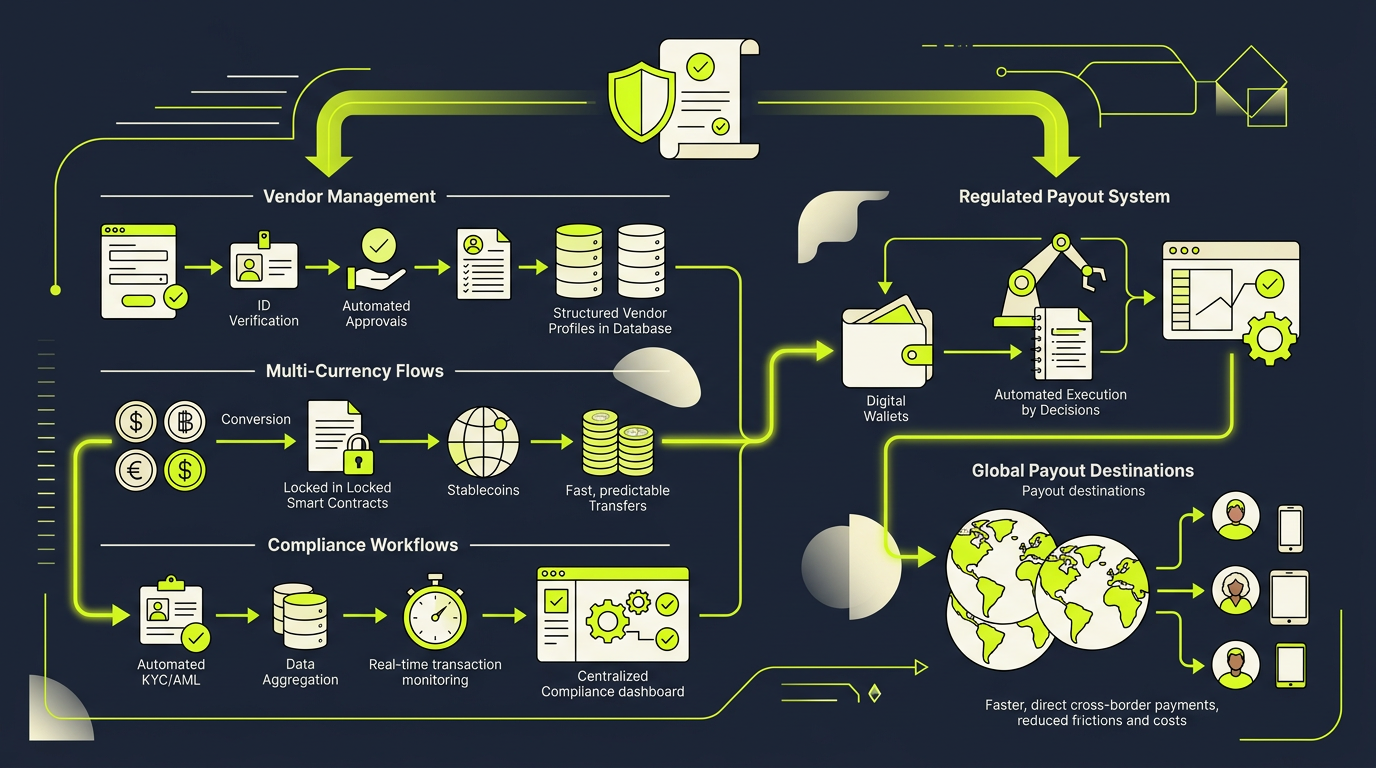
The future of global payouts is not a binary choice between fiat and crypto; it's about having a unified infrastructure that supports both. Not every vendor will want to be paid in stablecoins, and not every jurisdiction has the same level of digital asset adoption. The most resilient payout strategy involves a platform that can cater to the preferences of each individual recipient, whether they prefer a local bank deposit in their native currency or a stablecoin payment to a digital wallet.
This is where an Operations-First FinTech platform becomes essential. By providing a single point of integration for both traditional and digital payment rails, it abstracts away the complexity for the paying business. The platform intelligently routes payments through the most efficient rail, manages currency conversion, and provides a seamless experience for both the sender and the receiver, simplifying the entire process of Global Affiliate Payouts, Simplified.
- Unifying ERPs and Digital Assets
Closing the Reconciliation Gap
One of the most significant operational challenges for finance teams is reconciliation. When payout data is fragmented across multiple systems-ad networks, affiliate platforms, payment processors, and the core ERP-the manual effort required to close the books is immense. The addition of a new payment rail, even one as efficient as stablecoins, threatens to exacerbate this problem if not managed within a unified system.
The new regulations, by design, facilitate further integration of a regulated digital asset market with traditional financial markets. This regulatory convergence makes it more critical than ever to have a financial operating system that can speak to all parts of the business. An effective payout platform must not only execute payments but also ensure that every transaction, whether fiat or digital, is automatically synced with the company’s financial records.
A Single Source of Truth for Global Payments
This is where deep ERP integration becomes a defining feature. A platform with over 600+ integrations into systems like NetSuite, QuickBooks, Xero, and SAP provides a single source of truth for all payment activities. When a payment run is initiated for thousands of global vendors, the data flows seamlessly from the ERP to the payout platform and back again upon completion.
This removes the “administrative tax” of manual data entry and reconciliation, freeing up the finance team to focus on strategic activities. Whether a payment is made in Euros via SEPA, USD via ACH, or in USDC on a public blockchain, the transaction details are standardized and synchronized with the general ledger. This unified view is essential for operational control, financial visibility, and scalable growth.
- Navigating the New Compliance Burden
The Hidden 'Administrative Tax' of Regulation
While regulatory clarity is a net positive, it is accompanied by new compliance obligations. The GENIUS Act and related guidance from the Treasury Department bring stablecoin transactions fully under the purview of the Bank Secrecy Act (BSA), requiring robust Anti-Money Laundering (AML) and sanctions screening processes. The public input solicited by Treasury on these rules indicates a focus on ensuring digital asset transactions are held to the same compliance standards as traditional finance.
For a scaling business, building and maintaining this compliance infrastructure in-house is a significant undertaking. It requires expertise in global regulations, continuous monitoring of sanctions lists, and the technical capability to screen every transaction. This represents another form of administrative tax-a compliance burden that can divert resources from core business activities and slow down the very payment processes you’re trying to accelerate.
Automating Global Compliance from End-to-End
The most effective way to manage this new complexity is to automate it. A comprehensive payout automation platform embeds compliance into the workflow. This starts with vendor onboarding, where W-8/W-9 tax forms are collected digitally and validated automatically. It includes robust Know Your Customer (KYC) and Know Your Business (KYB) checks, ensuring that every payee is a legitimate and verified entity.
Crucially, the platform performs AML and sanctions screening on every single transaction before it is processed, regardless of the payment method. This end-to-end automation insulates the business from compliance risk. It ensures that even when paying thousands of recipients in stablecoins, every payment adheres to the latest regulations without requiring manual intervention from the finance or operations team.
The Interplay of Banking and Digital Assets
The CLARITY Act goes a step further by seeking to provide regulatory clarity for digital asset markets. This represents a period where regulators are thinking deeply about the intersection of banking and digital assets and the potential risks involved. This underscores the importance of working with financial partners who are not just technologically capable but also regulatory-savvy.
For a business, this means choosing a payout partner that understands both worlds. The partner must have the compliance frameworks and banking relationships to securely manage fiat currencies while also possessing the technical expertise to handle digital assets. This dual capability is a hallmark of an Operations-First FinTech platform, which serves as a durable bridge between the traditional financial system and the emerging, regulated digital economy.