

The world of digital assets has matured. Once a frontier for speculative investment, cryptocurrency is now a functional component of the global financial system. With a worldwide user base now exceeding 560 million people, up from 420 million in 2023, the question is no longer about adoption but about integration.
As of 2026, the regulatory landscape is solidifying, with 68 countries having enacted or proposed specific legislation to bring structure to the market-a 62% increase in just two years. This transition from debate to enforcement signals a new era for businesses that leverage crypto for operations.
At the forefront of this global regulatory shift is the European Union's Markets in Crypto-Assets (MiCA) regulation. MiCA is not merely another compliance hurdle; it's a foundational framework designed to standardize the ground rules for crypto-asset service providers (CASPs) and token issuers. For high-growth companies paying hundreds or thousands of stakeholders globally-from affiliate networks and creator platforms to AI agencies and marketplaces-MiCA represents a critical inflection point.
It forces a decision between outdated, risky payout methods and a future built on compliant, scalable financial infrastructure.
This article compares two operational models for managing global crypto payouts: the ad-hoc, pre-MiCA approach versus the unified, post-MiCA strategy. We will explore how leveraging a compliance-first platform not only mitigates risk but also unlocks a significant competitive advantage by removing the 'administrative tax' that hampers scaling businesses. The focus is shifting from simply making payments to architecting a resilient financial operating system.
The Old Model: Unregulated Crypto Payouts and Hidden Risks
In the earlier days of crypto adoption, the appeal for businesses was undeniable: a seemingly frictionless, fast, and low-cost way to send money across borders, bypassing traditional banking rails. Many companies turned to stablecoins to pay international freelancers, affiliates, and vendors, seeking to avoid high wire fees and slow settlement times. This approach, while innovative, was conducted in a regulatory vacuum, creating significant and often misunderstood operational and financial risks.
This 'wild west' environment meant that the entire compliance burden-from Anti-Money Laundering (AML) checks to sanctions screening-fell squarely on the shoulders of the paying business. Companies were often using consumer-grade exchanges or non-custodial wallets ill-suited for enterprise-scale operations, exposing them to security breaches, frozen funds, and counterparty risk with little to no recourse. The ambiguity created a fragile system where a single regulatory crackdown or exchange failure could jeopardize the entire payout process.
Operational Drag: The True Cost of Manual Reconciliation
Beyond the direct compliance risks, the ad-hoc model was plagued by operational inefficiency. Finance teams were left to manually reconcile crypto transactions with their existing Enterprise Resource Planning (ERP) systems like NetSuite, SAP, or QuickBooks. This process was a resource-draining exercise in spreadsheet management, prone to human error and lacking real-time visibility.
Every payout required manual tracking, verification, and journal entries, creating a significant delay in closing the books.
Furthermore, this model offered no integrated solution for global tax compliance. Onboarding a new vendor or creator and collecting the correct tax documentation, such as W-9 forms for US persons or W-8BEN forms for non-US individuals, remained a completely separate and manual workflow. The lack of a unified system meant data was fragmented across different platforms, increasing the risk of non-compliance and making audits a daunting, time-consuming affair.
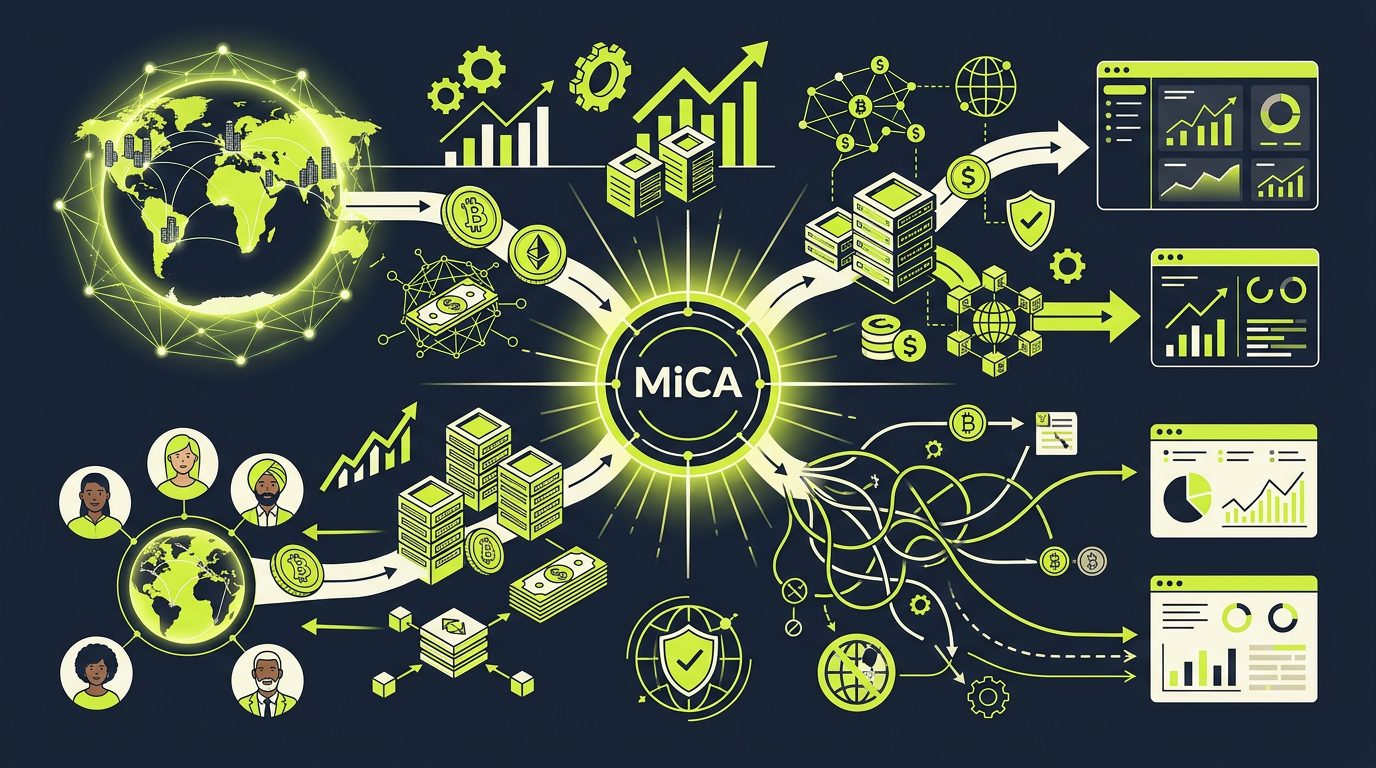
The New Framework: Operating Payouts in a MiCA-Regulated World
The implementation of MiCA transforms the landscape by establishing clear, harmonized rules across the EU. Under MiCA, businesses providing crypto-related services are defined as CASPs and must adhere to stringent licensing, governance, and capital requirements akin to traditional financial institutions. This regulatory clarity is not designed to stifle the use of crypto for payments; it is designed to make it safe, reliable, and scalable for legitimate business operations.
This shift is monumental for companies scaling their global payouts. It professionalizes the ecosystem, moving operations away from risky, unregulated exchanges toward licensed partners who provide institutional-grade security and compliance. For CFOs and Operations Managers, this means crypto can finally be treated as a predictable settlement utility rather than a speculative asset. a strong compliance framework has become a necessity for any serious player in the space, fostering a more stable environment for growth.
Stablecoins as a Legitimate Settlement Utility
MiCA provides specific classifications for stablecoins, distinguishing between Asset-Referenced Tokens (ARTs) and E-Money Tokens (EMTs). This formal recognition and regulation provide the certainty that businesses need to use stablecoins like USDT or USDC as a core settlement layer for cross-border payments. By mandating reserve, governance, and reporting standards, MiCA ensures that these instruments are truly stable and redeemable, mitigating the de-pegging risks that previously worried finance departments.
With this regulatory backing, stablecoins become a powerful tool within a diversified payment strategy. They offer the speed and cost-efficiency benefits of digital assets while operating within a framework of trust and transparency. For businesses paying a global network of creators or affiliates, this means they can offer payees the choice of receiving funds in fiat or crypto, with the confidence that the underlying crypto rails are robust, compliant, and integrated into a proper financial operating system.
Comparing Approaches: The Ad-Hoc Method vs. a Unified Payout Platform
The arrival of comprehensive regulation like MiCA sharpens the contrast between two fundamentally different ways of managing global business payouts. The choice a company makes directly impacts its ability to scale, manage risk, and control operational costs. On one side is the legacy ad-hoc approach, and on the other is a modern, unified platform designed for the new era of compliant finance.
Side-by-Side: Manual Processes vs. Automated Infrastructure
The ad-hoc model is characterized by fragmentation. A finance team might use one service for ACH transfers in the US, another for SEPA in Europe, and a series of crypto exchanges to handle payments elsewhere. Each platform has its own onboarding process, fee structure, and reporting system.
Managing payees, collecting tax forms, and reconciling payments across these disconnected silos is a manual, error-prone process that creates an enormous administrative tax on the business. Misclassifying a token can lead to significant penalties and operational freezes, a risk that grows with every new payout destination.
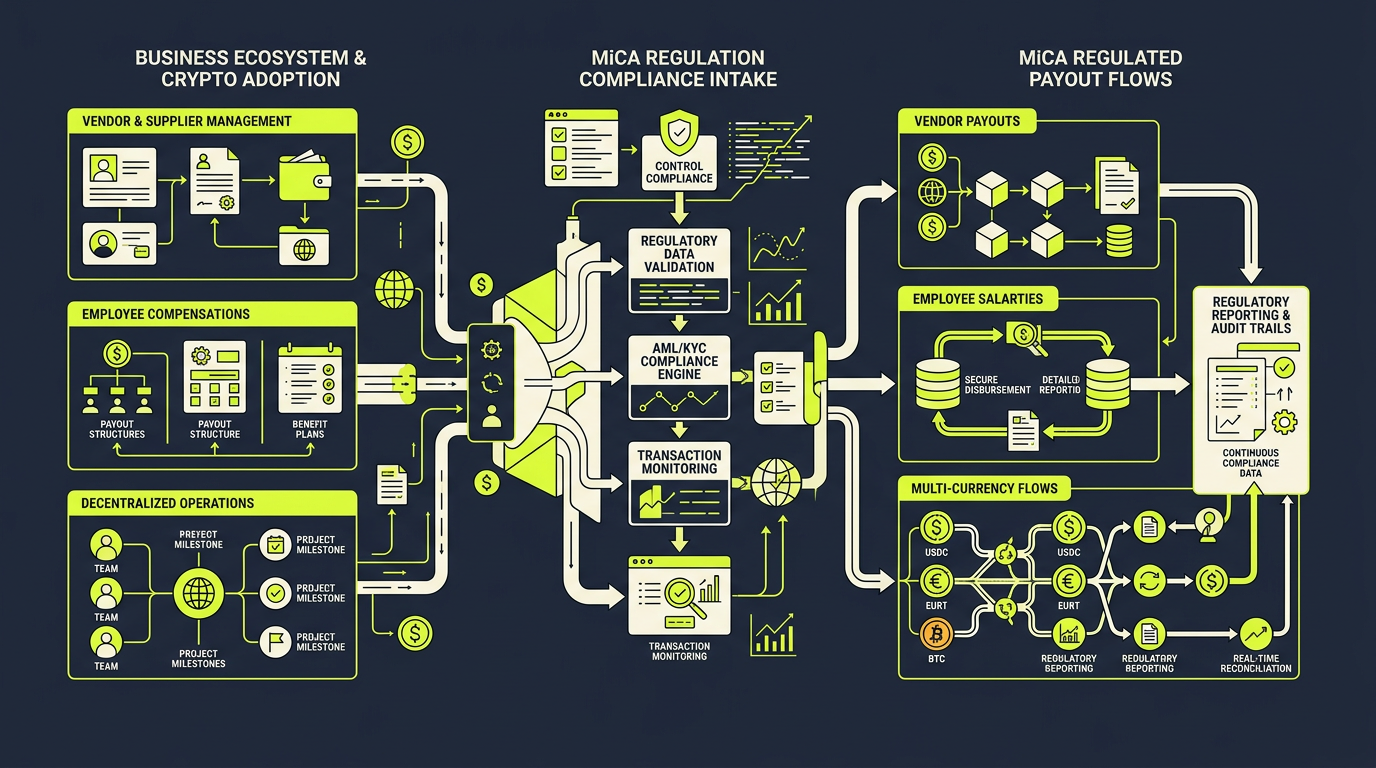
In contrast, a unified payout platform consolidates all payment flows-both fiat and crypto-into a single financial operating system. Rather than juggling multiple vendors, businesses can manage payees, execute payments across 150+ countries, and automate compliance through one central hub. This model embeds compliance into the workflow, automatically handling KYC/AML checks and collecting the correct W-8/W-9 tax forms during vendor onboarding.
The platform's ability to integrate with over 600 ERPs, including NetSuite, QuickBooks, and Xero, eliminates manual reconciliation entirely.
Cost Structure: Unpredictable Fees vs. a Flat-Fee Model
The fragmented, multi-vendor approach often involves a complex and opaque fee structure. Businesses are hit with percentage-based transaction fees, foreign exchange markups, and hidden charges from intermediary banks or exchanges. This makes forecasting costs nearly impossible and erodes margins, especially as payment volumes grow. For a business processing thousands of small payments, these percentage-based fees can become a significant and uncontrolled expense.
A unified platform built for scale operates on a more predictable model. For instance, a platform utilizing a flat-fee-per-transaction structure provides transparency and complete cost clarity, allowing finance teams to forecast expenses accurately and protect their margins. Whether a payment is $100 or $10,000, the fee remains the same, creating an economic model that encourages growth rather than penalizing it.
This is especially crucial for platforms in the creator economy or affiliate marketing, where success is defined by scaling the number of payees.
The Strategic Advantage of a Compliance-First Payout Infrastructure
In the regulated environment of 2026, compliance is no longer a reactive checklist item; it is a proactive strategy and a source of competitive advantage. Businesses that demonstrate a robust, compliant payout process are better positioned to attract and retain high-value vendors, creators, and partners. This operational excellence signals stability and trustworthiness, which are paramount in a global talent market.
Adopting a unified platform is a strategic move to future-proof financial operations. The regulatory landscape will continue to evolve, with frameworks like MiCA creating a blueprint for other jurisdictions, including the US. Businesses that build their payout infrastructure on a flexible, API-driven platform are equipped to adapt to these changes seamlessly.
This agility is critical for long-term, sustainable growth, as firms may need to adapt their business models to align with new regulatory expectations.
Building Trust and Unlocking Global Scale
For an affiliate network or creator platform, the payout experience is a core part of the user experience. Delayed payments, high fees, or complex onboarding processes create friction and erode trust. By automating the entire process, from KYC to payment settlement, a unified platform provides a superior experience for payees.
They can choose their preferred payout method (local bank transfer, prepaid card, or crypto), track payments in real-time, and access their funds quickly. This is how platforms achieve global affiliate payouts.
Ultimately, the transition to regulated digital assets is about enabling global commerce at scale. Manual workflows are the single biggest bottleneck preventing high-growth companies from expanding their operations efficiently. By removing this 'administrative tax,' automation platforms free up internal resources to focus on core business growth instead of financial administration.
For any business with global ambitions, it's essential to understand how to prepare payout infrastructure for emerging trends by building on a solid foundation.