

The global cross-border payments market is vast and expanding, projected to swell from $190 trillion in 2023 to nearly $300 trillion by 2033. For high-growth digital companies, this landscape represents immense opportunity, but also significant operational friction. Traditional payment rails, with their multi-day settlement times, opaque fees, and manual reconciliation processes, impose an "administrative tax" that directly inhibits scaling.
This friction is particularly acute for businesses managing payouts to a global network of affiliates, creators, vendors, and freelancers.
As finance leaders seek to build more resilient and efficient operations, a powerful new settlement layer is gaining traction. Stablecoins, digital assets pegged 1:1 to reserve currencies like the US dollar, have evolved beyond a niche instrument into a utility-grade tool for global commerce. 5 trillion, successfully surpassing the transaction volume of the United States Automated Clearing House (ACH) network.
This isn't about speculation; it's about operational efficiency.
However, adopting this technology isn't about simply swapping fiat for crypto. It's about integrating it into a cohesive financial operating system that automates compliance, reconciliation, and treasury management. For CFOs and Operations Managers, the question is no longer if stablecoins can be used for B2B payments, but how to leverage them strategically to build a competitive advantage.
This article explores five critical ways stablecoin settlement is redefining AP operations for globally-minded companies.
- Eradicate Cross-Border Fees and FX Volatility
The single greatest pain point in traditional cross-border payments is cost. When a business pays an international vendor, the funds pass through a network of correspondent banks, each levying its own fee. On top of this, poor exchange rates with hidden markups can erode a significant percentage of the payment's value. This model creates financial uncertainty and strains vendor relationships, as payees often receive less than anticipated.
Stablecoins fundamentally redesign this workflow. By using a dollar-pegged digital asset like USDC or USDT, payments are sent directly on a blockchain network from a sender to a receiver. This peer-to-peer model bypasses the costly intermediary banks, collapsing the transaction chain into a single, efficient step. The result is a dramatic reduction in transactional costs, replacing percentage-based wire and FX fees with a predictable, low network fee.
When integrated into a payout automation platform that operates on a flat-fee per transaction model, the savings are amplified. This combination provides complete cost certainty for the payer, regardless of the payment's size or its destination. Finance teams can budget with precision, eliminating the variable costs that complicate global AP and ensuring vendors receive their full, expected payment value every time.
- Achieve Near-Instant Settlement, 24/7/365
In a digital, always-on economy, legacy financial infrastructure remains stubbornly tied to business hours and banking holidays. ACH, SEPA, and wire transfers often take 2-5 business days to settle, creating cash flow ambiguity for both the payer and payee. This delay is an operational bottleneck, preventing businesses from implementing just-in-time payment strategies and forcing vendors to wait for critical working capital.
Blockchain networks operate continuously, 24/7/365. As noted in industry analysis, stablecoin settlement is confirmed in seconds to minutes, depending on the underlying chain. This capability transforms accounts payable from a batch-processed, delayed function into a real-time, strategic operation. Payments can be initiated and finalized on a Friday evening, a weekend, or a holiday with the same speed and efficiency as on a Tuesday morning.
For businesses in the creator economy, ad tech, and online marketplaces, this speed is a . It improves partner satisfaction and retention by providing rapid, reliable access to earnings. Operationally, it allows finance teams to close books faster, manage liquidity more effectively, and eliminate the frustrating and time-consuming task of tracking payments lost in the correspondent banking system.
- Simplify Treasury Operations and Global Liquidity
Managing a global business often requires maintaining separate bank accounts in multiple jurisdictions to hold various currencies (EUR, GBP, JPY, etc.). This practice is not only administratively complex but also inefficient from a capital perspective, as it fragments liquidity across numerous accounts. Rebalancing these funds is slow and incurs FX conversion costs, making it difficult to maintain an agile and responsive treasury function.
A modern approach centralizes liquidity using a primary stablecoin as the core settlement asset within a financial operating system. A company can hold its working capital in a single, dollar-denominated digital currency, while a payout platform handles the complexities of off-ramping into 135+ local currencies or paying out directly in crypto. This abstracts away the need for pre-funding foreign accounts and managing fluctuating FX rates, offering a single source of truth for global liquidity.
From Fragmented Balances to a Unified Ledger
By centralizing treasury, finance teams gain a real-time, consolidated view of their payment capacity. This model is perfectly suited for modern financial platforms built to connect and automate data flow across your entire financial stack. Through integrations with various ERPs including NetSuite, QuickBooks, and Xero, the platform ensures that every stablecoin payment is automatically reconciled against your general ledger, just like any fiat transaction.
This unified approach streamlines financial reporting and forecasting. Instead of wrestling with data from dozens of bank portals, CFOs can monitor global cash flow from a single dashboard. This operational simplification allows treasury teams to shift their focus from manual data aggregation to strategic capital allocation and risk management, leveraging a more flexible and liquid treasury position.
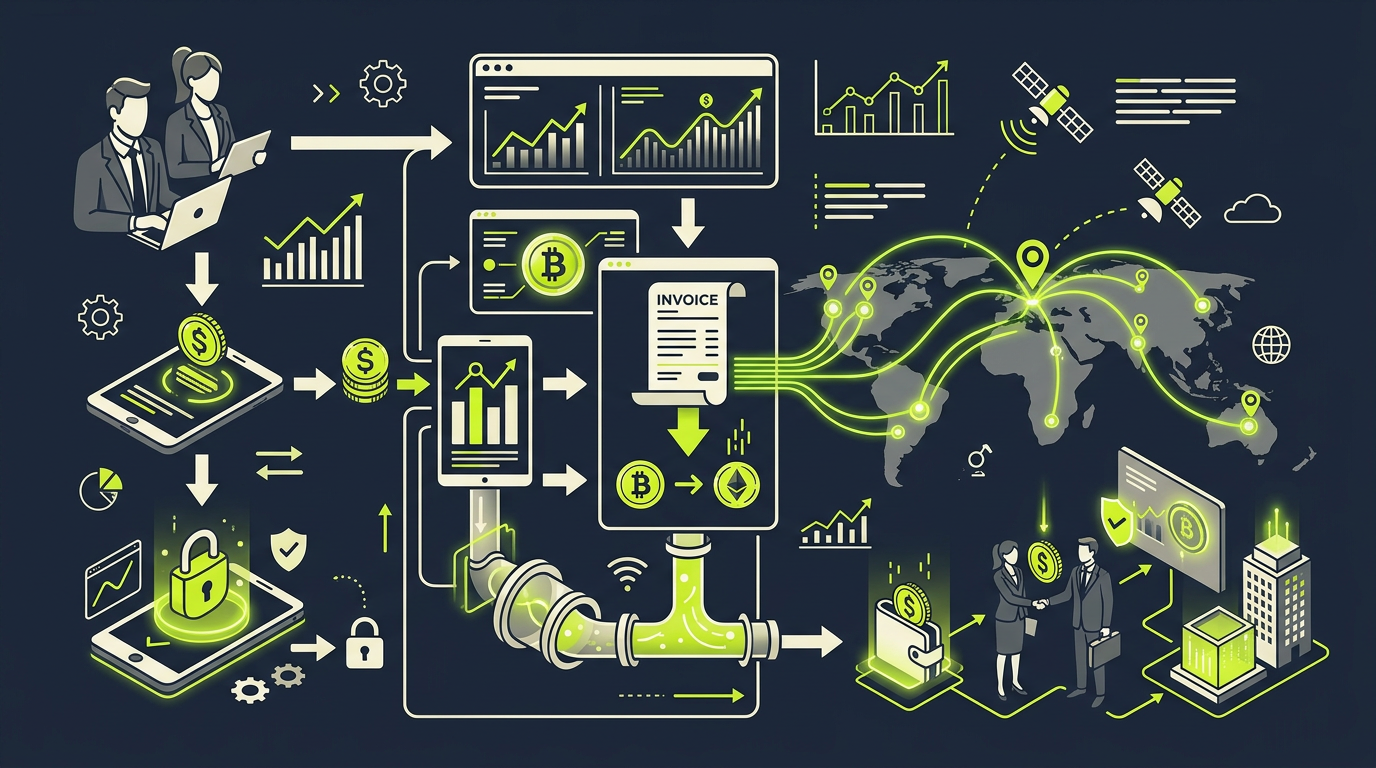
Enabling Advanced Payment Models and Vendor Liquidity
The instant and programmatic nature of stablecoins unlocks innovative financial products that are impossible with traditional payment rails. One such innovation is "Advanced Payment," a feature that provides instant liquidity to vendors and creators. Instead of waiting on standard 30- or 60-day net terms, your partners can opt to receive their payments instantly, improving their cash flow and strengthening their relationship with your platform.
This capability transforms your AP department from a cost center into a strategic enabler of your ecosystem's success. For ad networks paying affiliates or creator platforms paying influencers, offering instant pay can be a powerful competitive differentiator. It’s a prime example of how modern payment infrastructure, as a component of a holistic platform, can provide tools for both optimization and growth. The discussion around this topic is expanding, with some platforms even exploring new forms of invoicing like Unified Money Addresses that simplify the user experience, as detailed in guides on the next evolution in global payments.
- Automate Compliance and Reduce Counterparty Risk
A common misconception frames cryptocurrency payments as unregulated and inherently risky. The reality for institutional-grade B2B payments is the opposite. When executed through a compliant payout platform, stablecoin transactions on public blockchains offer a higher degree of transparency and automated oversight than traditional, opaque banking networks. The key is not the asset itself, but the operational wrapper that ensures compliance.
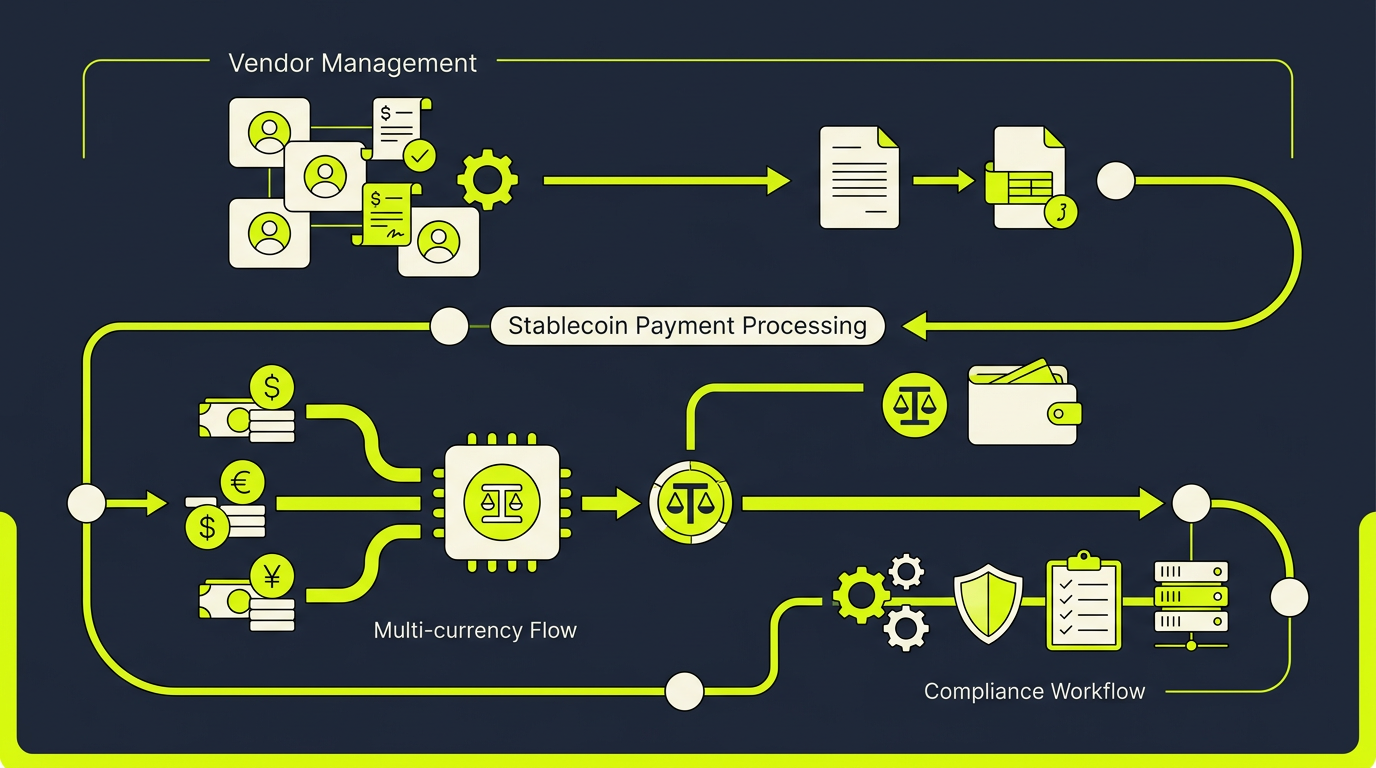
The entire lifecycle of a payment can be embedded with compliance checks. Authoritative guides on practical stablecoin payments emphasize the importance of compliance automation. This begins with robust vendor onboarding, a process that should be streamlined while collecting necessary Know Your Business (KYB) and Know Your Customer (KYC) documentation. For US payees, this includes an automated W-9 collection and validation process; for non-US payees, it involves a guided W-8 form series collection to determine tax withholding status.
Integrating KYB/KYC and Transaction Monitoring
A compliant workflow for B2B stablecoin payments involves several non-negotiable steps. Both the sending entity and the receiving counterparty must undergo rigorous identity verification. Furthermore, a critical component of on-chain compliance is wallet screening.
According to institutional best practices, both the sending and receiving addresses must be screened using Know Your Transaction (KYT) chain analysis tools before and after the payment is sent. This process checks for any links to sanctioned addresses or illicit activities, providing a powerful layer of risk mitigation.
Integrating these checks into a single automated workflow is crucial for scaling. Modern fintech platforms provide the infrastructure to How to Automate Global Tax Compliance for Seamless Vendor Payouts, ensuring that every payment, whether fiat or crypto, meets strict regulatory standards under frameworks from FinCEN, FATF, and others. This removes the burden of manual compliance from finance teams and creates an auditable, transparent record of all payment activities.
The Importance of a Regulated Partner
Ultimately, the security and compliance of stablecoin invoicing rests on the partner you choose. An "Operations-First FinTech" platform acts as a regulatory shield, abstracting away the immense complexity of global compliance. This extends beyond KYC and KYT to include comprehensive tax compliance. The work required for any finance team is detailed in breakdowns on B2B stablecoin payments and how businesses settle, covering everything from counterparty verification to the proper accounting treatment.
By leveraging a unified vendor management portal, vendor data collection is simplified and standardized. The process of Vendor Onboarding That Scales becomes an automated, digital-first experience. This ensures that your organization remains compliant even as it scales to thousands or tens of thousands of global payees, creating a robust framework that satisfies both internal auditors and external regulators.
- Future-Proof Your AP for AI and Programmatic Commerce
The landscape of digital business is evolving towards greater automation, with AI agents and programmatic systems beginning to execute commercial tasks independently. This emerging machine-to-machine (M2M) economy demands a payment infrastructure that is as agile and autonomous as the technology driving it. Traditional payment methods, with their manual inputs and settlement delays, are fundamentally incompatible with this high-frequency, programmatic future.
Recent innovations, such as the launch of the MainUSD stablecoin issued by Brale for AI-native agent workflows, signal a clear trend. These systems will require payment rails that are programmatic, instant, and capable of handling high volumes of low-value transactions efficiently. Stablecoins are uniquely suited for this role, providing a programmable, API-drivable settlement layer that can operate without human intervention.
For forward-thinking companies, particularly in sectors like ad tech, AI influencer agencies, and large-scale marketplaces, preparing for this shift is a strategic imperative. Adopting a financial operating system that supports both traditional and blockchain-based payment rails ensures your business is ready for the next wave of digital commerce. The underlying process involves sending the stablecoin on-chain, where settlement is confirmed in seconds, providing the speed needed for automated workflows.
Conclusion: Your Next Step Towards Touchless Finance
Settling vendor invoices with stablecoins is no longer a theoretical concept; it is a practical tool for achieving significant operational efficiencies. From drastically reducing transaction costs and enabling real-time settlement to simplifying global treasury and automating compliance, stablecoins address the core frictions that hinder growth. They provide the speed, efficiency, and programmability required for the next generation of digital commerce.
However, the true value is unlocked not by the stablecoin itself, but by the financial operating system that orchestrates its use. A unified platform provides the crucial layer of automation, compliance, and integration that makes stablecoin payments scalable, secure, and simple to manage. By embedding this capability within a comprehensive vendor management and payout automation suite, businesses can move closer to the ideal of "Touchless Finance," freeing up strategic resources to focus on growth instead of manual administration.
Exploring these capabilities is the first step towards building a truly global, automated financial operation.