

For global-first companies, the pace of expansion is often dictated by the friction of its financial infrastructure. As businesses hire top talent across continents, they inevitably collide with a legacy payment system built for a different era. The traditional correspondent banking model, with its multi-day settlement times and opaque fees, acts as an invisible 'administrative tax' on any organization attempting to scale a global network of contractors, affiliates, or creators.
This operational drag isn’t just an inconvenience; it’s a direct inhibitor of growth. Every hour a finance team spends manually reconciling cross-border payments or fielding inquiries about a delayed wire transfer is an hour not spent on strategic financial planning. Simultaneously, top-tier global talent has grown to expect near-instant, reliable compensation. The companies that can deliver this are the ones that win.
Fortunately, a significant shift is underway. With a market capitalization that has moved past $300 billion, stablecoins have transitioned from a niche concept to a mature settlement layer for global business-to-business payments. This isn't about speculative trading; it's about leveraging a superior technology rail to achieve operational excellence. For CFOs and Operations Managers, understanding this utility is now critical for maintaining a competitive edge.
The New Scale-Up Challenge: Payment Rails That Can't Keep Up
The challenge for modern digital companies-from ad networks to AI influencer agencies-is that their business models are global by default, while their payment infrastructure is not. The process of moving money across borders via traditional rails involves a complex chain of intermediary banks, each adding delays, costs, and potential for error. This is a primary reason why your global vendor payouts settle in days, not seconds.
Limitations of Correspondent Banking
When a company initiates a SWIFT payment, it embarks on a multi-day journey through the correspondent banking system. This network, while reliable for large corporate transactions, is profoundly inefficient for the high-volume, smaller-value payments typical of contractor or affiliate payouts. Each bank in the chain can deduct its own processing fee, meaning the amount received by the contractor can be unpredictably less than the amount sent.
This lack of transparency and predictability creates significant operational burdens. Finance teams must contend with fluctuating currency conversion rates, high cross-border fees, and a constant stream of inquiries from payees about the status of their funds. The manual effort required to manage these issues represents a significant administrative cost that scales directly with the company's growth.
The Talent Market Doesn't Wait for SWIFT
In the competitive global talent market, payment speed and reliability are powerful differentiators. A freelancer in Southeast Asia or a creator in Latin America is less concerned with the underlying technology than with the outcome: receiving the full, expected value of their work on time. Platforms that subject them to three-day-plus settlement times and surprise fees risk damaging their reputation and losing access to premier talent.
For marketplaces and creator economy platforms that depend on a large, engaged base of international vendors, slow and expensive payouts are a direct threat to their business model. In these industries, operational efficiency is not just an internal goal-it is a core part of the user experience. This is why forward-thinking companies are exploring payment rails that match the instant, on-demand nature of the digital economy.
Stablecoins as a Financial Operating System Upgrade
Viewing stablecoins as a pure utility-a financial operating system upgrade-is the key to understanding their impact on global payouts. At their core, stablecoins like USDC and USDT are simply digital dollars that operate on modern, efficient blockchain rails. This allows them to bypass the slow and fragmented correspondent banking system entirely, offering a direct path for value transfer from payer to payee.
The scale of this new infrastructure is staggering. In 2025 alone, stablecoin settlement volume reached $33 trillion, surpassing the throughput of traditional payment giants. This isn't a future trend; it's a parallel financial system operating at a massive scale today. For businesses, tapping into these rails means transforming a complex, multi-day process into a simple, automated action.
From Hours to Milliseconds: The Speed Advantage
The most profound difference is settlement finality. Instead of waiting days for a wire transfer to clear through multiple banks, a stablecoin transaction achieves finality in the time it takes for the underlying blockchain to confirm a block. This can be as fast as 400 milliseconds on networks like Solana or under two seconds on TRON, representing a fundamental paradigm shift in payment speed.
This isn't just a theoretical benefit for small-scale transfers. Institutional adoption is already proving its viability at scale. Visa’s stablecoin settlement program, for example, hit a $4.5 billion annualized run rate by January 2026. This demonstrates that these new rails are robust enough to handle enterprise-level volume, providing CFOs with a proven alternative for global treasury operations.

Cost Efficiency Beyond Lower Transaction Fees
While blockchain transaction fees are typically lower than wire fees, the true cost savings come from eliminating hidden charges. A traditional cross-border payment is subject to FX conversion markups and intermediary bank fees, often obscuring the total cost of the transaction. In contrast, a stablecoin payment is a point-to-point transfer of a dollar-denominated asset, removing these variables entirely.
Platforms like Payouts.com extend this efficiency with a transparent, flat-fee-per-transaction model. This predictable pricing, as opposed to percentage-based fees, allows businesses to forecast their payment costs accurately, regardless of volume or destination. As noted by industry experts, the goal is to enable stablecoin global payouts without changing your process, removing the operational overhead of managing individual transfers and complex fee structures.
Automating Compliance and Operations for Global Payouts
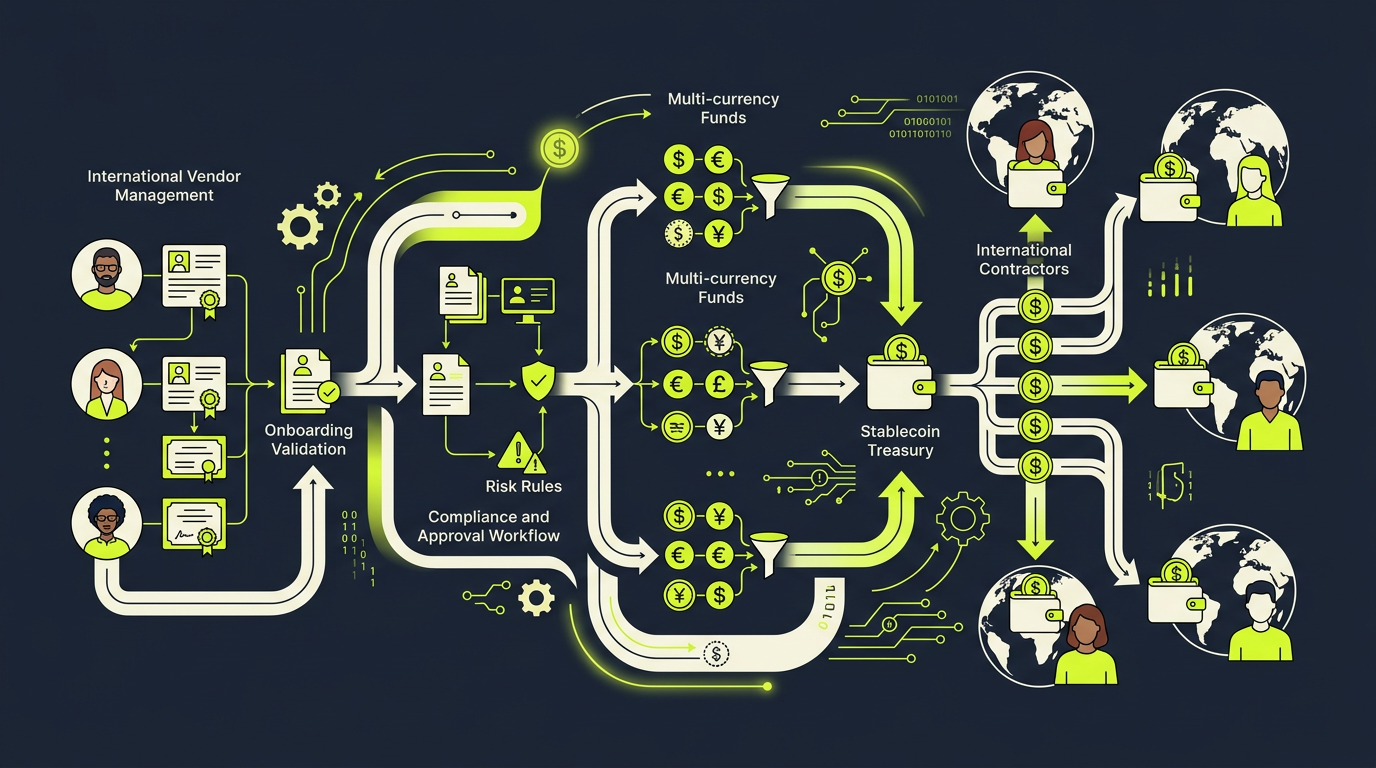
The payment itself is only the final step in a complex workflow. An Operations-First FinTech approach recognizes that true efficiency comes from automating the entire process, from vendor onboarding and tax compliance to data ingestion and ERP reconciliation. Simply offering a stablecoin payout option without this integrated framework merely shifts the manual burden from one area to another.
A unified platform acts as a financial operating system, orchestrating every component of the payout process. This ensures that speed and cost-efficiency at the settlement layer are matched by automation and compliance at the operational layer, delivering a "Touchless Finance" experience.
Integrating Payouts, Tax, and Reporting
Managing global tax compliance is one of the most significant challenges of paying an international workforce. An automated system handles the collection and validation of W-8/W-9 forms, ensuring that every contractor is correctly classified and that the business remains compliant with IRS regulations. This eliminates a major source of administrative overhead and legal risk.
Furthermore, with existing financial software is non-negotiable. With over 600 ERP integrations, including NetSuite, QuickBooks, Xero, and SAP, a connected platform ensures that all payout data is automatically reconciled. As platforms like Mural Pay automate invoice reconciliation and regulatory checks, the finance team is freed from manual data entry and can operate from a single source of truth.
Vendor Management in a Hybrid Fiat-Crypto World
While the benefits of stablecoin settlement are clear, forcing all payees onto a single rail is not a viable strategy. The key to successful global payout operations is optionality. A best-in-class Vendor Management Suite provides contractors with a self-service portal where they can choose their preferred payout method and manage their own information.
Within a unified payout platform, a vendor in the Philippines can opt for a local bank transfer in PHP, while a developer in Argentina might prefer to receive USDC. The business initiates a single payment instruction from its end, and the platform handles the complexity of routing funds through the optimal rail for each recipient-whether it's local bank networks in over 150 countries or stablecoin settlement. For a more detailed analysis, our Contractor Compliance & Payments in 2026 offers key insights.
The Strategic Outlook: Where Stablecoin Payouts Go From Here
The rapid adoption of stablecoins for payments is not a temporary phenomenon but a structural shift in how global finance operates. A Bain & Company report suggests that these digital assets are poised to rewire wholesale banking, moving from niche tools to essential strategic assets. Market growth projections underscore this trend, with forecasts suggesting the value of issued stablecoins could reach $2 trillion by 2028.
For finance and operations leaders, this means that strategies built around legacy payment systems will soon become unsustainable. The conversation is shifting from if a business should use digital currency rails to how it can integrate them for maximum operational advantage and compliance.
The Rise of Regulated Digital Assets
As the market matures, so does the regulatory landscape. Frameworks like Europe's MiCA (Markets in Crypto-Assets) are providing clarity and reducing risk for businesses that utilize digital assets. This regulatory certainty is crucial, as it allows companies to build long-term strategies around stablecoin payouts with confidence. It transforms the discussion from risk mitigation to strategic implementation.
Platforms that prioritize compliance are essential in this environment. As pointed out by experts at Rise, adhering to varied international rules is non-negotiable. An effective payout partner must embed compliance automation-including KYC/KYB checks and transaction monitoring-directly into the payment flow, ensuring adherence to global standards like those set by FinCEN and the FATF.
Beyond Simple Payouts: New Financial Products
As the rails for instant, global value transfer become standardized, they unlock new opportunities to support the financial health of contractors. One of the most powerful innovations is Advanced Payment, which offers instant liquidity to vendors against their approved invoices. Instead of waiting weeks or months for payment terms to clear, a contractor can access their earnings immediately.
This capability transforms the vendor relationship from purely transactional to a genuine partnership. For an affiliate agency or marketplace, offering instant pay can be a powerful tool for attracting and retaining the highest-performing partners. It creates a sticky ecosystem where vendors are deeply integrated into the platform’s financial operations, fostering loyalty and driving mutual growth.
Ultimately, the move toward modern payment rails is about creating a more inclusive and efficient financial system for global business. Whether through traditional bank transfers optimized via account-to-account payout solutions or through the speed of stablecoins, the goal is to remove friction. For scaling companies, eliminating the administrative tax of manual payouts is no longer just an operational goal-it's a strategic imperative for winning in the global market.