

# W-8 vs. W-9: 7 Critical Rules to Avoid the IRS Audit Trap with Global Contractors
For a high-growth influencer agency or global marketplace, scale is the dream, but administrative complexity is the tax that can kill it. When you transition from paying twenty local freelancers to two thousand international creators, your treasury department suddenly becomes a localized branch of the IRS. One of the most frequent-and dangerous-points of failure in this scaling process is the mishandling of IRS Forms W-8 and W-9.
Choosing the wrong form isn't just a minor clerical error; it’s a compliance liability that can lead to massive back-tax exposure and penalties. If you fail to collect a W-8 from a foreign contractor, the IRS may hold you liable for up to 30% of the total payments made. As we move toward 2026, the scrutiny on digital platforms is only intensifying. To keep your margins intact and your operations "touchless," you must master the nuances of global tax documentation.
Below are the 7 critical rules every CFO and Operations Manager needs to know about the W-8 vs. W-9 showdown.
## 1. The Fundamental Distinction: Tax Residency is Everything
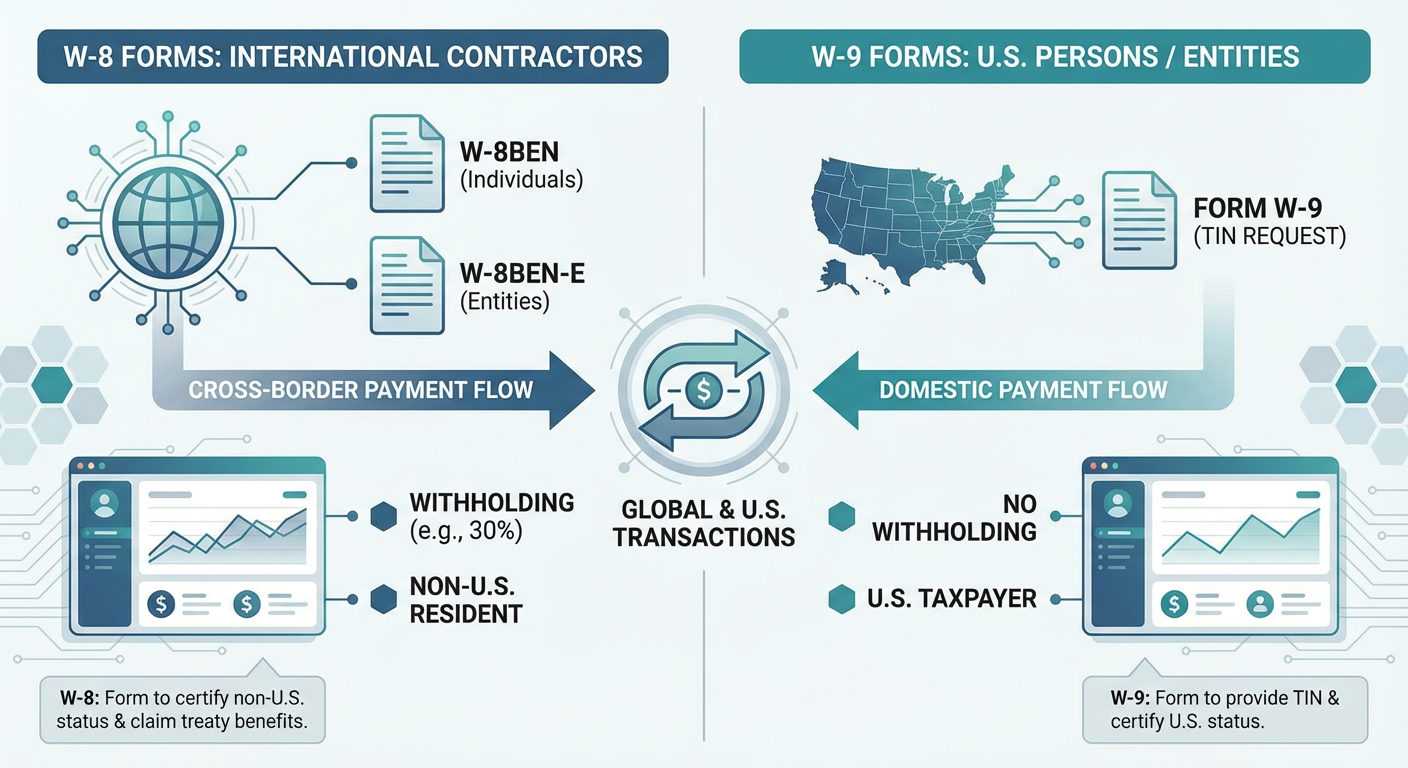
At its core, the choice between a W-9 and a W-8 series form depends entirely on the tax residency of the person or entity receiving the money.
S. persons. S. citizens, resident aliens, and entities (like LLCs or Corporations) organized in the United States. When a contractor submits a W-9, they are providing you with their Taxpayer Identification Number (TIN) and certifying they are not subject to backup withholding.
S. persons. This is the form global contractors use to certify their foreign status. S. -source income.
Misclassifying a vendor here is the fastest way to trigger a "Margin Leak." If you treat a U.S. person as a foreign entity, you miss mandatory 1099 reporting. If you treat a foreign entity as a U.S. person without a W-9, you're on the hook for uncollected withholding.
## 2. Knowing Which W-8 to Use (It’s Not Just One Form)
While the W-9 is a standardized one-page document, the W-8 family is a complex ecosystem. Using the wrong one is a common pitfall for operations teams.
W-8BEN: Used by individual foreign contractors (influencers, freelancers).
W-8BEN-E: Used by foreign entities (agencies, offshore software houses). This form is significantly more complex due to FATCA (Foreign Account Tax Compliance Act) requirements.
W-8ECI: Used by foreign persons whose income is "effectively connected" with a U.S. trade or business.
W-8IMY: Used by foreign intermediaries or flow-through entities.
For most creator platforms, the W-8BEN and W-8BEN-E are the heavy hitters. Failing to distinguish between an individual creator and their loan-out corporation can lead to invalid documentation. To scale effectively, you need a system that automatically prompts the user for the correct version based on their entity type.
For more on managing these high volumes of stakeholders, see our guide on The CFO’s Guide to 1,000+ Creator Payouts: How to Scale Without the Admin Tax.
## 3. The Power of Tax Treaties: Reducing the 30% Withholding
By default, the IRS requires a 30% withholding tax on payments made to foreign entities for services performed within the U.S. or for certain types of passive income (royalties, etc.). However, the U.S. has income tax treaties with over 60 countries.
A correctly completed W-8BEN allows a contractor to claim these treaty benefits. For example, a creator in the UK might qualify for a 0% withholding rate on certain income types. Without a valid W-8, you are legally required to withhold that 30% and remit it to the IRS. If you pay the full amount without the form, that 30% comes directly out of your pocket during an audit. This is why automating the collection of these forms is non-negotiable for platforms scaling into 150+ countries.
Managing this manually across thousands of partners is what we call the "administrative tax." You can learn how to bypass this manual burden in our article on How to Scale Affiliate Payouts to 10,000+ Partners Without Increasing Your Finance Headcount.
## 4. The Expiration Clock: W-8s Don't Last Forever
Unlike a W-9, which generally remains valid until the contractor's information changes, a W-8BEN or W-8BEN-E typically expires on the last day of the third succeeding calendar year. If you collected a W-8 in 2023, it will expire on December 31, 2026.
Operating with expired forms is equivalent to having no form at all. In an audit, the IRS will look for "refresh" cycles. If your treasury team is tracking expiration dates in a spreadsheet, you are playing "IRS Roulette." Modern finance operations use Touchless Finance to automatically trigger re-certification requests to vendors 90 days before expiration.
## 5. Identifying "U.S. Source" Income vs. Foreign Services
A common misconception is that any payment to a foreign person requires withholding. In reality, the IRS generally taxes foreign persons only on income from U.S. sources.
Services: The source of income from performing services is determined by where the services are physically performed. If a software developer in Poland writes code in Poland for a U.S. company, it is foreign-source income and generally not subject to U.S. withholding.
Royalties: If you are paying an influencer for the right to use their likeness or content in the U.S., this may be considered U.S.-sourced royalty income, which does require a W-8 and potentially withholding.
Distinguishing between these requires robust data ingestion at the point of the payout. If your payment platform doesn't "talk" to your tax engine, you risk over-withholding (upsetting your talent) or under-withholding (upsetting the IRS). This is especially critical when dealing with complex regions like Southeast Asia. Check out why The Philippines Payout Trap is a prime example of where compliance and FX costs collide.
## 6. Digital Signatures and "Reason to Know" Standards
The IRS has strict requirements for electronic signatures on W-8 and W-9 forms. You cannot simply accept a typed name in a standard email. Furthermore, as a "withholding agent," you are held to a "reason to know" standard.
If a contractor submits a W-8BEN claiming they are a resident of France, but their IP address is in New York and they have a U.S. bank account, you have a "reason to know" the form might be invalid. Ignoring these red flags can lead to penalties under the KYC (Know Your Customer) and AML (Anti-Money Laundering) regulations.
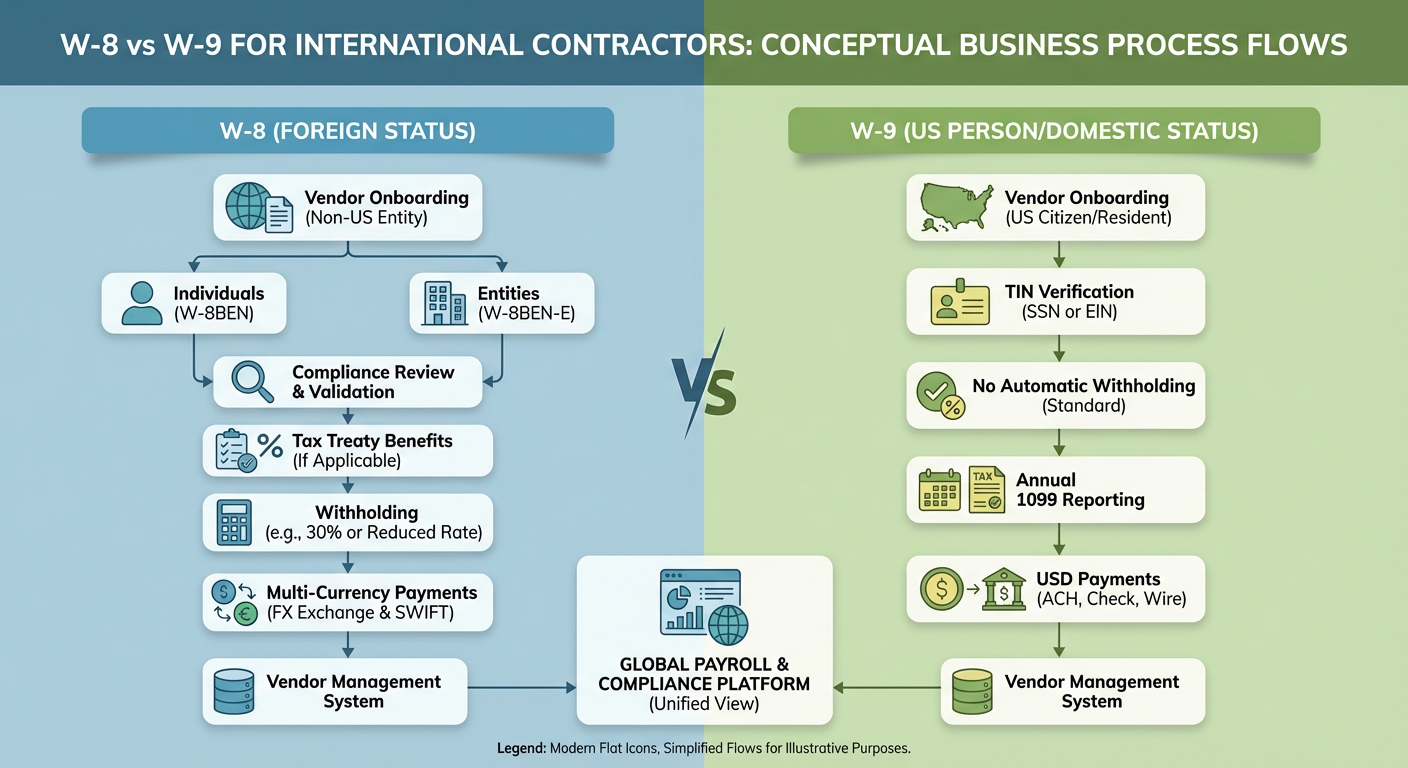
To mitigate this, many ad networks are moving toward integrated vendor portals where identity verification (KYC) and tax form collection happen in a single, unified workflow. This ensures that the data on the ID matches the data on the tax form.
## 7. The Move Toward 1099-K and Real-Time Reporting
The landscape is shifting. With the IRS lowering reporting thresholds for 1099-K forms, the pressure to have perfectly manicured W-9 and W-8 data is higher than ever. By 2026, we expect even more stringent requirements for real-time reporting of gig economy payments.
Platforms that rely on manual year-end "cleanups" will find themselves paralyzed. The solution is to move tax compliance "upstream." By making W-8/W-9 collection a prerequisite for the first payout, you ensure 100% compliance from day one. This proactive approach is a hallmark of an Operations-First FinTech strategy.
If you’re also exploring the efficiency of crypto payouts for your global network, remember that the IRS still requires the same tax documentation regardless of whether you pay in USD, EUR, or USDT. Using stablecoins as a settlement layer doesn't exempt you from W-8/W-9 requirements; it just makes the payment move faster once the compliance check is cleared.
### Conclusion: Automation is the Only Way to Scale
Navigating the W-8 vs. W-9 divide is not a task for a human with a spreadsheet. It is a logic problem that requires a unified platform. Payouts.com eliminates the friction of global tax compliance by automating the ingestion, verification, and renewal of these critical forms. By integrating tax logic directly into your payout workflow-supporting 135+ currencies and 150+ countries-you can focus on growth while we handle the IRS.
Ready to eliminate the "administrative tax" on your global operations? Book a demo with Payouts.com today and see how our flat-fee automation can safeguard your margins.