

- The Harmonization of Global Identity: Beyond Simple Document Uploads
- Tax Compliance as the New KYC: The IRS and the Global Reach of W-8/W-9
- The Transition to Crypto Settlement: Compliance in a Hybrid World
- Regional Specifics: Navigating the 'High-Risk' Jurisdictions
- The CFO’s Mandate: Automation or Stagnation?
The era of 'move fast and break things' has officially collided with the era of 'verify everyone and everything.' As we head into 2026, the landscape for cross-border marketplace sellers is undergoing a seismic shift. What used to be a secondary concern for operations teams-Know Your Customer (KYC) and Know Your Business (KYB) onboarding-has become the primary bottleneck for global scaling.
For marketplaces, ad networks, and influencer agencies operating across 150+ countries, the 'compliance tax' is no longer a localized nuisance; it is a systemic risk. Between the tightening of the EU’s AMLD6 (Sixth Anti-Money Laundering Directive), the maturation of the US INFORM Consumers Act, and the global adoption of DAC7 reporting standards, the margin for error has vanished. Companies that fail to adapt their onboarding workflows face more than just fines-they face permanent de-platforming from the global banking ecosystem.
- The Harmonization of Global Identity: Beyond Simple Document Uploads
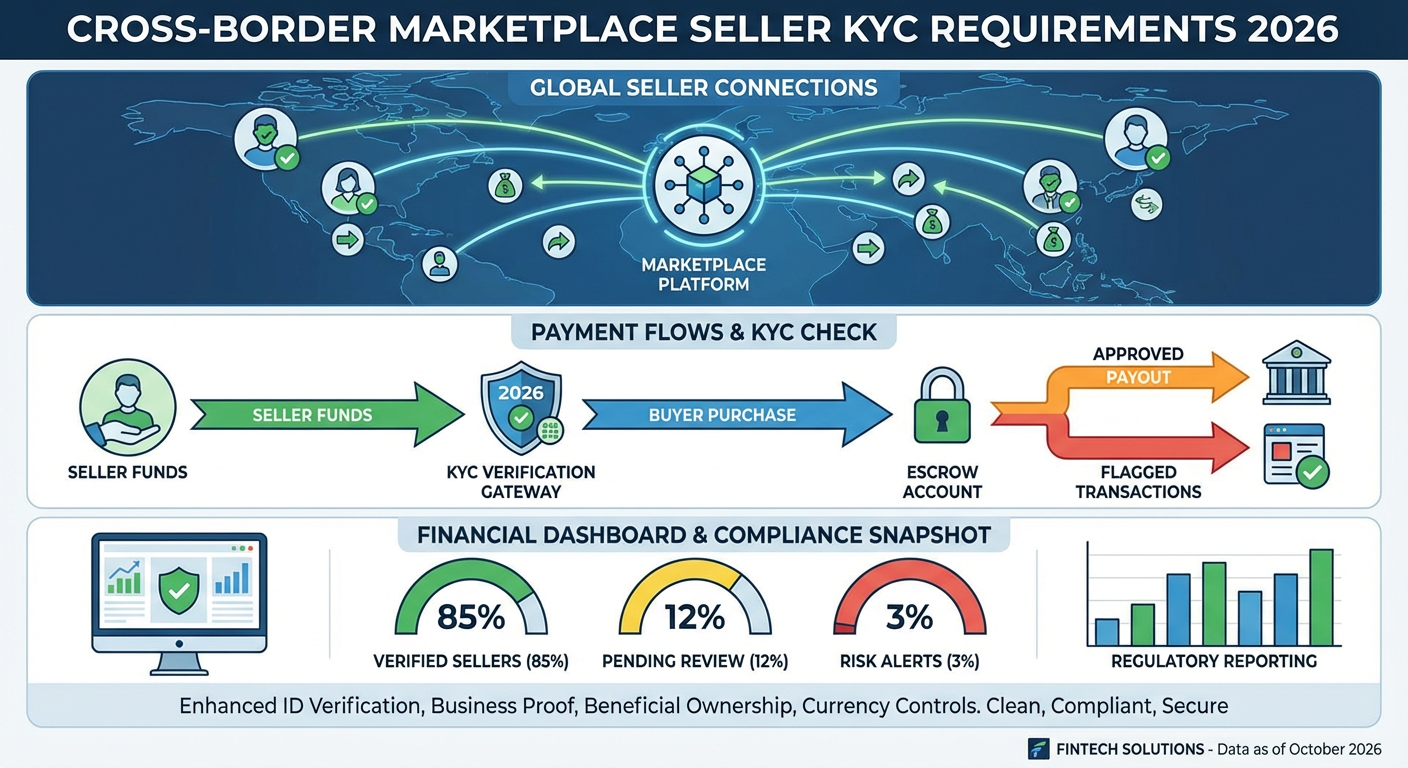
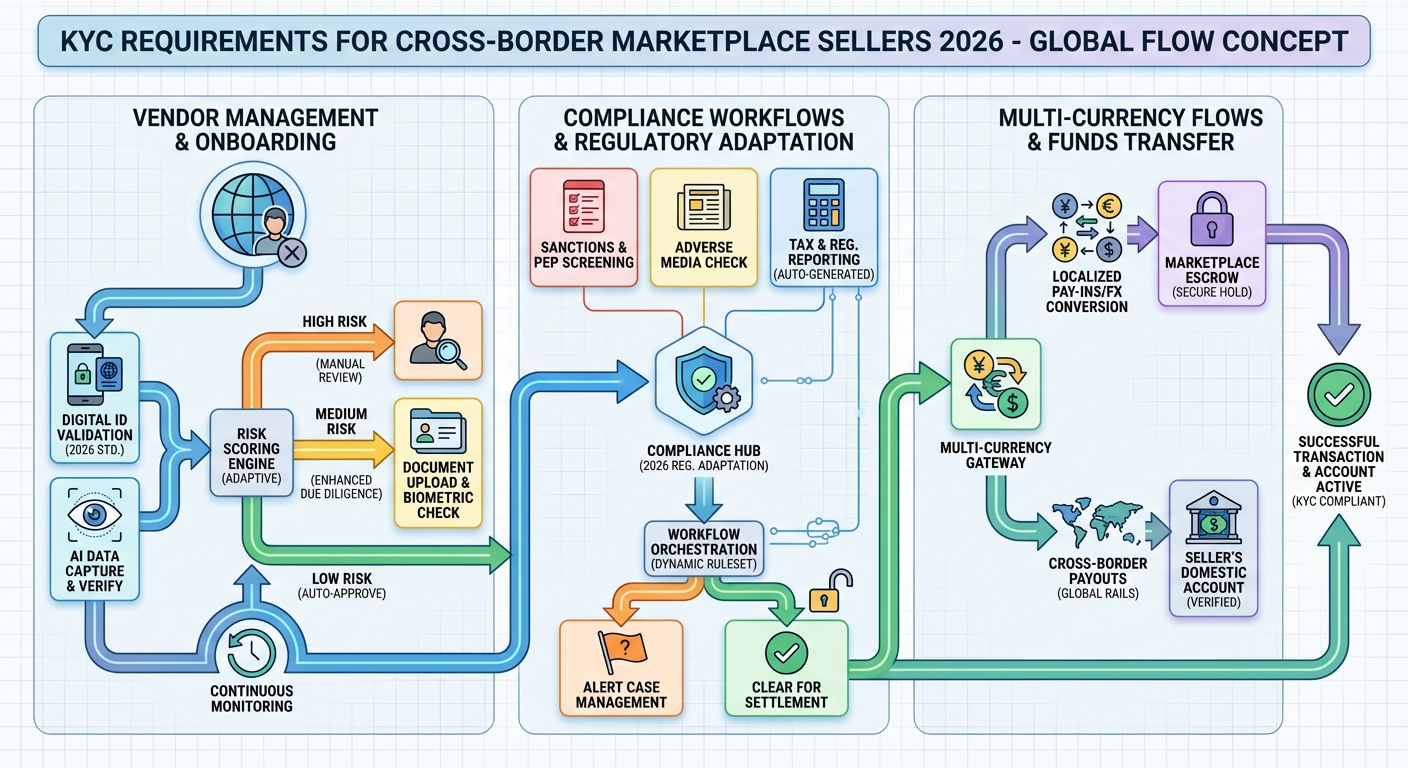
By 2026, the standard practice of asking a seller in Southeast Asia or Eastern Europe to 'upload a photo of your ID' is effectively obsolete. High-growth platforms are moving toward 'Touchless Finance'-a state where identity is verified through encrypted data exchange rather than manual review.
Regulatory bodies are now demanding more than just identity; they require dynamic verification. This means marketplaces must not only verify who a seller is at the point of entry but must continuously monitor for changes in beneficial ownership (UBO), sanctions list updates, and shifting tax residency. For platforms managing thousands of stakeholders, this is where the 'administrative tax' begins to erode profitability.
Managing these workflows manually is the fastest way to kill your operational efficiency. To learn more about reclaiming your team's time, see how to build a zero-touch vendor onboarding workflow that actually scales.
The Surge of Electronic Identification (eID) and Bio-Linking
In Europe and parts of Asia, the rise of government-backed eIDs is streamlining the KYC process. By 2026, the integration of these digital identities into marketplace onboarding will be the gold standard. Sellers will no longer 'fill out forms'; they will grant temporary access to their verified government data.
For the marketplace, this reduces the risk of synthetic identity fraud-a growing threat where AI-generated personas pass traditional document checks. To stay ahead of these threats, platforms are increasingly turning to automated systems to stop the bleed and prevent 99% of global payout fraud using AI.
- Tax Compliance as the New KYC: The IRS and the Global Reach of W-8/W-9
The line between identity verification and tax compliance has blurred into non-existence. In the eyes of the IRS and international tax authorities, a seller is not 'verified' until their tax status is documented and validated. For US-based marketplaces paying international vendors, correctly distinguishing between W-8 and W-9 forms is the difference between a seamless payout and a massive withholding liability.
Many platforms still treat tax documentation as an afterthought, leading to what we call the 'VAT Trap'-a scenario where local tax obligations in the seller’s country are ignored until an audit occurs. Understanding the 7 secrets to avoiding the IRS scale-killer is critical for any CFO overseeing 1,000+ creator payouts. By 2026, automated tax validation tools that check TIN (Taxpayer Identification Number) accuracy in real-time will be mandatory for any platform hoping to avoid significant penalties.
- The Transition to Crypto Settlement: Compliance in a Hybrid World
The most significant trend for 2026 is the mainstreaming of stablecoins (USDT, USDC) as the preferred settlement layer for cross-border payouts. While this offers incredible speed and liquidity, it introduces a new layer of KYC requirements. Regulators are now applying the 'Travel Rule' to stablecoin transactions, requiring that the identity of both the sender and the receiver be known and recorded.
Forward-thinking marketplaces are realizing that merging crypto and fiat is the only way to scale without chaos. By using stablecoins, platforms can offer instant liquidity to sellers in regions with restrictive banking systems-like the Philippines or Brazil-without the traditional 5-day wire lag. However, this requires a unified compliance engine that handles both fiat and crypto KYC under a single roof.
Scaling in this hybrid environment is the secret weapon for scaling global contractor networks in 2026.
The Rise of Advanced Payment and Instant Liquidity
Sellers in 2026 will no longer tolerate Net-30 or even Net-15 terms. The 'creator economy' and 'gig economy' have shifted expectations toward 'Advanced Payment'-the ability for a seller to access their earned funds immediately. For a marketplace to offer this, their KYC must be bulletproof.
You cannot advance funds to an unverified entity. Automated payout platforms now integrate 'Instant Pay' features that are unlocked only after a seller clears a multi-layered compliance check, effectively using liquidity as an incentive for compliance.
- Regional Specifics: Navigating the 'High-Risk' Jurisdictions
Expanding into markets like the Philippines, Vietnam, or Turkey offers massive growth potential but carries significant FX and compliance risks. In the Philippines, for example, many platforms fall into the 'payout trap' of hidden FX fees and complex local reporting. Success in these regions requires a partner that offers flat-fee per transaction models rather than percentage-based fees, which can quietly kill margins as you scale.
This is especially true for ad networks and affiliate platforms where high-volume, low-margin transactions are the norm.
- The CFO’s Mandate: Automation or Stagnation?
The role of the CFO has evolved from financial gatekeeper to 'Operations-First' leader. In 2026, the CFO is responsible for ensuring that the infrastructure supporting 150+ countries doesn't require a proportionally large headcount to manage. According to the Financial Action Task Force (FATF), the cost of compliance has risen by over 30% in the last three years, largely due to fragmented data.
Solving this requires a 'Unified Connector' approach-integrating your marketplace directly with ERPs like NetSuite, QuickBooks, or SAP. When KYC data, tax forms, and payment instructions flow seamlessly into the accounting system, the 'Where is my money?' queries disappear. Real-time tracking becomes the new standard for global vendor payouts, providing transparency to the seller and peace of mind to the finance team.
Conclusion: Winning the Global Scale Game
The complexity of global marketplace operations in 2026 cannot be overstated. Between shifting KYC laws, the rise of stablecoin settlements, and the constant threat of sophisticated fraud, the 'manual' way of doing things is a fast track to obsolescence. The winners will be the platforms that treat compliance not as a barrier, but as a competitive advantage.
By automating the 'administrative tax,' companies can scale to thousands of vendors across the globe with zero new hires, reclaiming their margins and their time.