

4 billion in 2026. For CFOs and finance directors at high-growth digital companies, this expansion presents a dual-edged sword. While revenue opportunities multiply, the operational burden of managing global affiliate spend and payouts escalates, creating an 'administrative tax' that stifles scale.
Manual workflows, high cross-border fees, and complex tax compliance for a geographically dispersed partner base are no longer sustainable.
As businesses scale their affiliate programs, the financial infrastructure supporting them must evolve. The solution lies in a strategic adoption of multi-currency virtual cards, but not as a simple, standalone tool. The future belongs to an integrated approach where virtual cards are a core component of a unified financial operating system.
This article compares the traditional, siloed methods of managing affiliate spend with the forward-looking, platform-based approach that enables true 'Touchless Finance' and operational excellence.
The Traditional Model: Single-Currency Cards and Manual FX
Historically, many businesses have defaulted to using standard corporate credit cards, typically tethered to a single headquarters currency like the US Dollar, for all affiliate-related expenditures. This includes paying for ad placements on various networks and, in some cases, directly paying affiliates. While seemingly straightforward on the surface, this approach quickly becomes a significant operational and financial bottleneck as a company’s global footprint expands.
The Hidden Costs of Inefficient FX Management
When paying an international ad network or affiliate in their local currency from a USD-denominated card, a currency conversion is inevitable. Traditional card issuers and banks often apply opaque, percentage-based fees to these conversions, which can erode margins significantly over thousands of transactions. This lack of predictability makes financial forecasting difficult and introduces a level of uncertainty that finance leaders cannot afford, especially amidst volatile trade conditions.
These costs are not just financial; they are also strategic. Without direct control over exchange rates, companies are at the mercy of market fluctuations and unfavorable terms dictated by financial intermediaries. This stands in stark contrast to a platform model offering a flat-fee per transaction, which provides the cost consistency required for accurate planning and budgeting in a global operational environment.
Operational Drag and Reconciliation Nightmares
Beyond the direct costs, the operational drag of the traditional model is substantial. Finance teams are left to manually reconcile transactions across multiple currencies and payment platforms, a process that is both time-consuming and prone to error. Data is fragmented, residing in separate ad network dashboards, bank statements, and spreadsheets, making it nearly impossible to get a clear, real-time view of global spend.
This data fragmentation creates downstream chaos for accounting. Without a seamless data flow, integrating transaction details into an ERP system-whether it's NetSuite, QuickBooks, Xero, or SAP-requires significant manual effort. This is the very definition of an 'administrative tax' that prevents finance teams from focusing on strategic analysis and instead mires them in low-value data entry.

The Next Step: Standalone Virtual Card Providers
Recognizing the limitations of traditional corporate cards, many organizations have turned to standalone virtual card providers. These platforms represent a significant step forward, offering the ability to issue unique virtual cards for specific vendors, campaigns, or employees. This offers a new layer of control and security that is a clear improvement over sharing physical card details.
As outlined by some of the best virtual card providers, these tools excel at spend management. You can set precise limits, define usage parameters (e.g., locking a card to a single ad network), and activate or deactivate cards on the fly. For a media buyer managing dozens of campaigns, this granular control is invaluable for preventing budget overruns and mitigating fraud.
Strengths: Granular Control and Security
The primary advantage of these dedicated providers is risk mitigation. By generating a unique card number for each major vendor or subscription, a company dramatically reduces its exposure in the event of a data breach. If one vendor's security is compromised, the finance team can instantly cancel that specific virtual card without affecting any other payment relationships, ensuring business continuity.
This micro-level control is essential for the dynamic nature of affiliate marketing. As new ad networks are tested and dropped, or as campaign budgets are reallocated, virtual cards provide the agility to manage spend in real-time. This capability empowers teams to be more nimble and responsive to market opportunities without waiting for traditional procurement or finance approvals.
Limitations: A Disconnected Financial Stack
However, while standalone virtual card solutions solve the immediate problem of spend control, they often create a new one: another data silo. The card platform manages expenditures, but it's disconnected from the broader accounts payable and vendor management ecosystem. It doesn't handle vendor onboarding, global tax compliance (like W-8/W-9 collection), or invoice processing, forcing teams to stitch together multiple systems.
A truly effective financial infrastructure requires a holistic view. As experts note, the real power of virtual cards is unlocked when they are part of a comprehensive procure-to-pay strategy. Without this, the finance team is still left manually bridging the gap between how money is spent (the virtual card platform) and why it was spent (the invoices and vendor data in the ERP). This is why a strategic approach is needed to truly capitalize on the benefits of a virtual card program implementation.
The Future: Unified Platforms and Touchless Finance
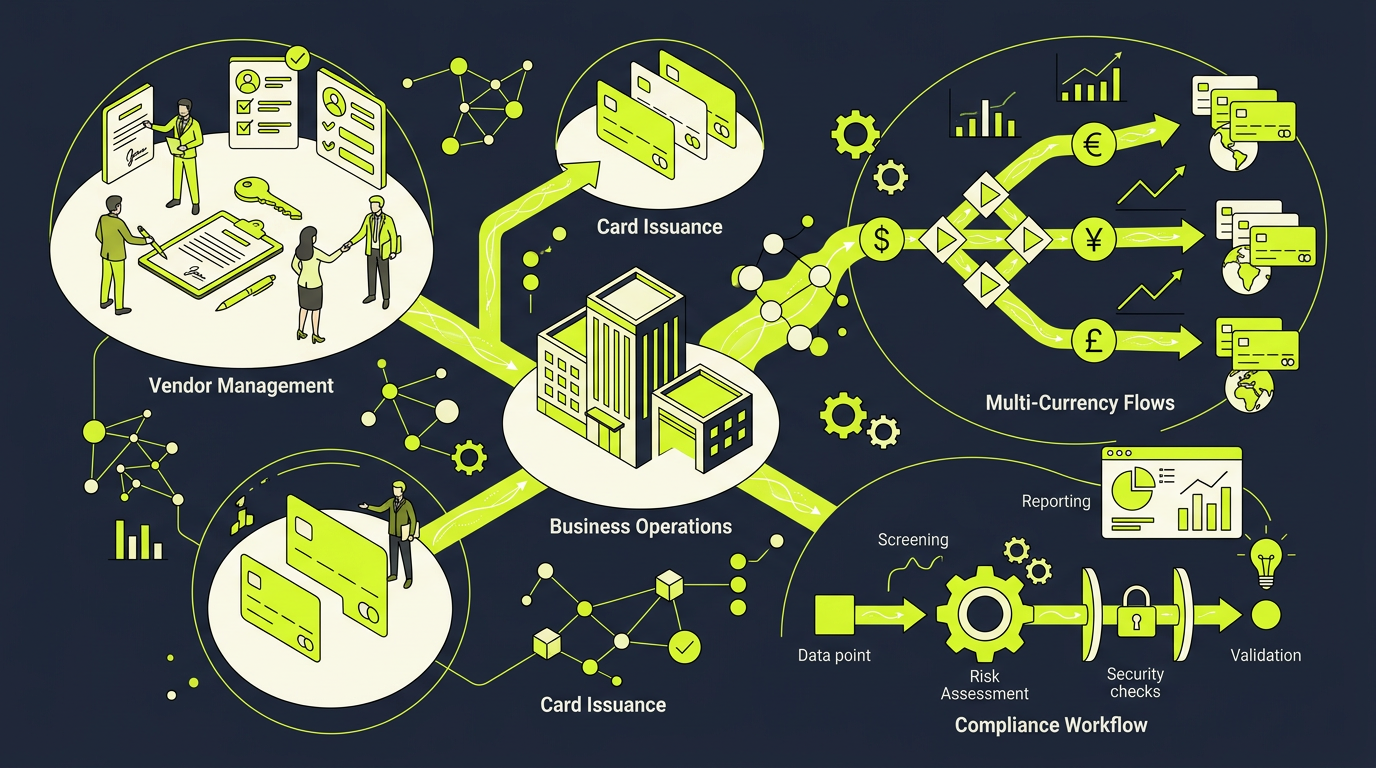
The ultimate evolution for scaling global companies is the unified platform-an 'Operations-First FinTech' model. Here, multi-currency virtual cards are not a standalone product but an integrated capability within a comprehensive system for managing all global payouts and vendor operations. This approach is designed to eliminate silos and automate the entire lifecycle of a transaction, from vendor onboarding to final payment and reconciliation.
This is the core philosophy behind a unified platform, which acts as the central operating system that connects all the moving parts. It streamlines everything from initial vendor KYC/AML checks and tax form collection to multi-currency disbursements and automatic reconciliation with over 600 ERP integrations, creating a 'touchless' workflow.
Unifying Spend, Payouts, and Compliance
Within a unified platform, issuing a virtual card is simply one of many available payment methods. A finance team can manage global ad spend with multi-currency virtual cards while simultaneously executing mass payouts to thousands of affiliates via local bank transfers, push-to-debit, or even crypto-all from the same interface. This holistic control is detailed in frameworks designed for finance leaders, such as The CFO’s Framework for Global Vendor Payments with Virtual Cards. Take a look at this The Untapped Power of Virtual Cards in B2B Payments for yet more information.
This model directly addresses the compliance burden. The system automates the collection and validation of W-8 and W-9 forms, ensuring you are withholding and reporting taxes correctly for affiliates in all jurisdictions. The vendor portal allows affiliates to self-manage their information and payment preferences, further reducing administrative overhead for the finance team while accelerating partner onboarding and payments, a key challenge when scaling influencer payouts.
Beyond Fiat: Stablecoins as a Frictionless Settlement Layer
A truly future-focused platform also embraces new payment rails that offer superior efficiency for cross-border transactions. This is not about cryptocurrency speculation but about utility. Using stablecoins like USDT as a settlement layer allows for near-instant, low-cost payments to affiliates in any of the 150+ countries supported, bypassing the delays and high fees of the correspondent banking system.
For affiliates in regions with volatile local currencies or less-developed banking infrastructure, receiving payment in a stable digital currency can be a significant advantage. Offering this flexibility positions a company as a preferred partner and provides a competitive edge in attracting top global talent. This capability transforms the finance function from a cost center into a strategic enabler of global business growth.
Comparing the Models: A Side-by-Side Evaluation for 2027
As finance leaders plan their technology roadmap, it's crucial to evaluate these different models based on the core drivers of operational efficiency and scalability. The choice is between adding more point solutions and adopting a unified financial operating system.
Cost Structure and Transparency
The traditional model is the most expensive, characterized by high, opaque FX markups and wire fees. Standalone virtual card providers offer more transparency but often retain percentage-based foreign transaction fees. The unified platform model fundamentally changes the economics by offering a predictable, flat-fee per-transaction structure. This allows businesses to scale globally without seeing their payment costs scale as a percentage of revenue.
Operational Efficiency and Integration
Operationally, the traditional approach is defined by manual labor and spreadsheet-based reconciliation. Standalone card providers improve spend control but require manual integration with other finance systems to function. A unified platform is built on the principle of automation.
With deep, API-first integrations into hundreds of ERPs, the entire process-from vendor onboarding and payment to reconciliation-is automated, eliminating the administrative tax and freeing up finance teams for strategic work.
Global Scalability and Compliance
Scalability is where the differences are most stark. The traditional model simply cannot handle global complexity. Standalone solutions help manage multi-currency spend but often leave the critical task of global tax and regulatory compliance to the user.
A unified platform is architected for global scale from day one, with built-in tools for KYC/AML, tax compliance, and multi-currency management across over 150 countries. This turns compliance from a barrier into a streamlined, automated background process.
As you move forward, the key is to adopt a holistic perspective. The benefits of virtual cards for B2B payments are maximized when they help suppliers get paid faster, which encourages adoption. Integrating these tools into a complete payment automation platform is the most effective way to achieve this and build a resilient, scalable financial operation for the future.