

For Operations Directors at scaling sweepstakes, social casino, and skill-gaming platforms, the phrase “Money IN is solved, Money OUT isn’t” is a daily reality. While sophisticated processors handle deposits with ease, the withdrawal process remains a complex, high-friction bottleneck. This is especially true when players are distributed globally, each with different regulatory requirements and payment preferences.
The administrative tax of managing player identity verification, tax compliance, and multi-currency disbursements manually is a significant drag on operational efficiency and a direct obstacle to scaling.
As platforms grow, the volume of withdrawal requests quickly overwhelms manual systems. This leads to escalating support ticket queues, frustrated players, and a compliance posture that is difficult to defend. The core challenge is the fragmented nature of the traditional payout stack: one tool for KYC, another for tax forms, and a series of manual processes involving spreadsheets and bank wires to actually move money.
This disjointed workflow isn’t just inefficient; it’s a scaling inhibitor riddled with the potential for costly errors and compliance failures.
This article compares three primary approaches to managing global player withdrawals: the traditional fragmented DIY stack, the limited functionality of deposit-focused payment providers, and the modern unified payout automation platform. We will evaluate each based on its ability to provide a seamless, compliant, and scalable KYC-to-payout workflow, enabling platforms to offer instant, multi-option withdrawals to players in any jurisdiction.

Comparing Models for Global Player Withdrawals
Choosing the right operational model for player payouts is a critical decision that directly impacts scalability, player satisfaction, and regulatory risk. The ideal system must not only deliver funds quickly and reliably but also wrap the entire process in a layer of automated compliance that functions seamlessly across borders. Let's dissect the three dominant approaches.
Approach 1: The Disconnected 'DIY' Stack
The most common starting point for new platforms is the Do-It-Yourself approach. This involves stitching together multiple point solutions: a third-party service for identity verification (KYC), manual collection of W-9 or W-8BEN forms for tax purposes, and direct bank integrations or manual wires for the final payout. While seemingly cost-effective at low volumes, this model's fragility becomes apparent as the platform scales.
Operationally, this means finance and support teams spend their days managing spreadsheets, manually validating player data against KYC results, and individually initiating payments. There is no single source of truth, leading to reconciliation nightmares and a high risk of human error. As one source notes, modern payout systems provide logs and reports that are essential for reconciliation, a feature critically absent in manual workflows. This lack of visibility makes audits difficult and troubleshooting individual payment failures a time-consuming forensic exercise.
Approach 2: Relying on Deposit Processors for Payouts
Many platforms naturally look to their existing payment processors-the ones who handle 'Money In'-to manage withdrawals. These providers often offer payout capabilities as an add-on service. While convenient, this approach has significant limitations because their core architecture is optimized for card-not-present payment acceptance, not global disbursements. Their payout offerings are often an afterthought, lacking the breadth and depth needed for a global user base.
The shortcomings manifest in several ways: limited payout methods (often restricted to bank transfers in major markets), non-competitive foreign exchange rates, and a superficial approach to cross-border compliance. These systems are not built to automate the collection of tax-compliant documentation or to adapt KYC requirements dynamically based on a player's jurisdiction. This forces operations teams back into a semi-manual state, defeating the purpose of an integrated solution and failing to create the robust, auditable trail required by today's regulators.
Approach 3: The Unified Payout Automation Platform
The third model is the 'Operations-First' approach, architected specifically to solve the 'Money Out' problem. A unified payout automation platform integrates every step of the withdrawal lifecycle into a single, cohesive workflow managed by one API. This
From the moment a player requests a withdrawal, the platform orchestrates the entire process. It triggers dynamic, jurisdiction-aware KYC verification, programmatically collects and validates the correct tax forms (W-9/W-8 series), screens against AML watchlists, and presents the player with a variety of payout options-from local bank transfers in 135+ currencies to instant push-to-card payments and even crypto stablecoins. This is the foundation of a 'touchless finance' operation, where manual intervention is the exception, not the rule.
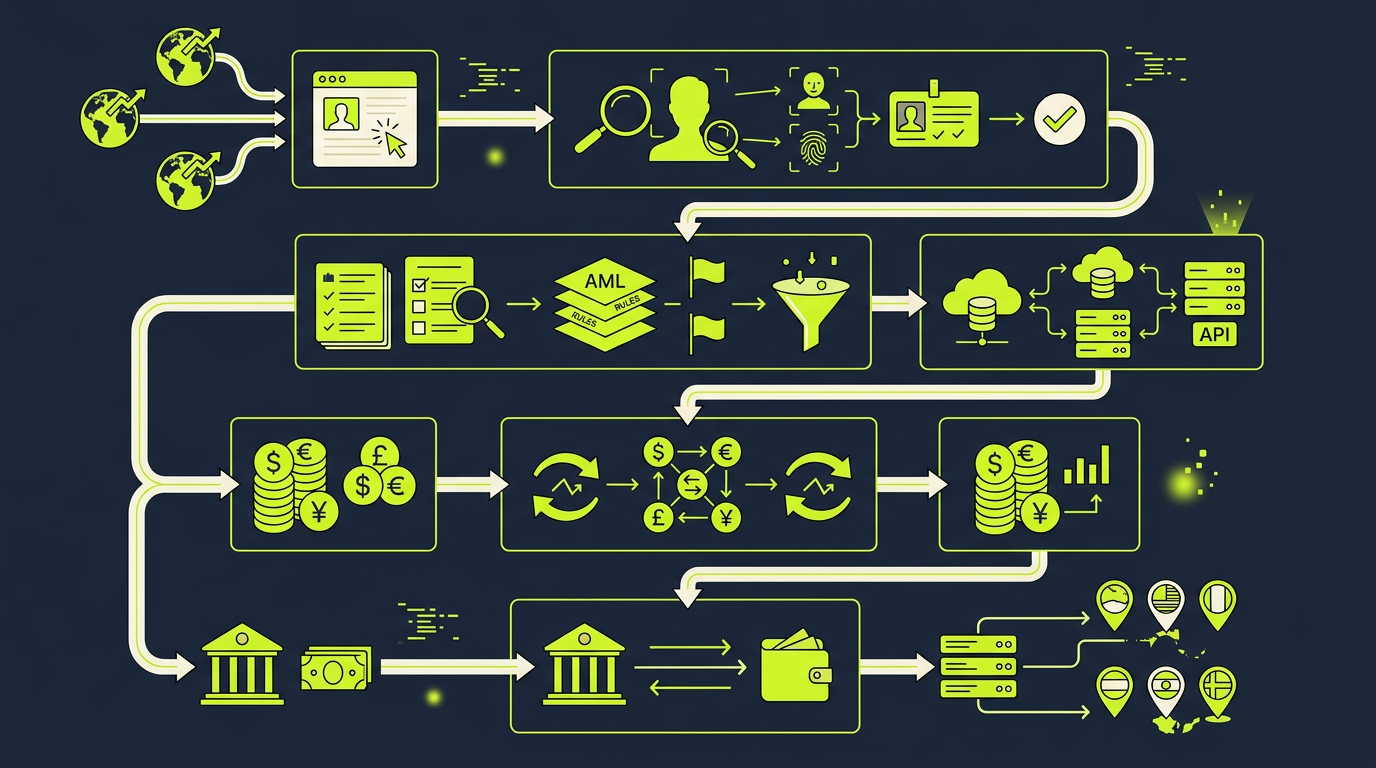
Key Components of a Scalable KYC-to-Payout Engine
To achieve true 'touchless' automation for player withdrawals, a platform must integrate several critical components into a single operating system. This is not about just sending money; it's about creating a compliant, resilient, and player-friendly financial infrastructure that scales globally.
Automated and Adaptive Identity Verification
For platforms operating across jurisdictions, a one-size-fits-all KYC process is a non-starter. A scalable system must be able to adapt verification requirements based on the player's location, risk profile, and withdrawal amount. By 2026, regulators expect technology to enhance KYC coverage and consistency, with a strong focus on governance and explainability.
A unified platform provides this by embedding KYC into the onboarding and withdrawal flow, ensuring no funds are released until a player's identity and risk level are programmatically confirmed.
This approach aligns with best practices for multi-jurisdiction compliance, which emphasize leveraging technology to streamline onboarding and automate document verification. The goal is to create a standardized global framework that remains flexible enough to meet local rules. With AML and KYC-related fines reaching over $1.23 billion in the first half of 2025 alone, embedding automated, auditable compliance checks directly into the payout workflow is no longer optional-it's essential for risk management.
Integrated Tax Compliance (W-8/W-9 Automation)
A major operational headache for platforms paying winners in the US and abroad is managing tax compliance. This involves collecting the correct documentation-W-9 for US persons, W-8BEN/W-8BEN-E for non-US individuals and entities-and ensuring it's valid before processing a payout. Manual collection via email is slow, insecure, and prone to errors.
A payout automation platform solves this by digitizing the entire process. It can intelligently request the correct form from the player based on their profile, guide them through a simple digital submission process, and automatically validate the provided information (such as a Taxpayer Identification Number). This not only accelerates player verification but also creates a clean, reportable data trail for 1099/1042-S reporting and shields the business from compliance penalties.
Multi-Rail Payout Network: Fiat and Crypto
Player expectations for withdrawals are shaped by the speed and convenience of consumer financial apps. They want options, and they want their winnings fast. A modern payout infrastructure must support a wide range of payment rails, including traditional ACH, global SEPA/BACS, instant push-to-debit-card payments, and digital wallets.
Furthermore, offering payouts in crypto, specifically stablecoins like USDT or USDC, serves as a powerful utility for frictionless cross-border settlement. For players in regions with volatile currencies or underdeveloped banking infrastructure, a stablecoin payout is often faster and more reliable. Modern platforms facilitate both fiat and crypto disbursements, allowing platforms to offer a diverse menu of withdrawal options through a single integration. This approach helps boost player retention rates by delivering a superior user experience.
The Operational Payoff: From Cost Center to Growth Enabler
Adopting a unified KYC-to-payout platform transforms the finance and operations functions from reactive cost centers into strategic enablers of growth. By automating the entire withdrawal process, platforms can stop dedicating valuable resources to manual, low-value tasks and refocus them on core business objectives like player acquisition and platform development.
The benefits are tangible and immediate. The number of withdrawal-related support tickets plummets as the process becomes transparent and self-service. The time-to-payout shrinks from days to minutes, dramatically improving player satisfaction.
Compliance becomes an automated, ongoing process, not a periodic fire drill. As one analysis of cross-border payments notes, built-in compliance and security are hallmarks of modern payout systems, reducing exposure and human error. Platforms can confidently enter new markets, knowing their financial infrastructure is built to handle the complexity.
Building a Future-Proof Payout Stack
The sweepstakes and online gaming landscape is only becoming more competitive and regulated. As platforms scale to hundreds of thousands or even millions of players across 150+ countries, the 'Money Out' problem becomes the single biggest threat to operational stability. The regulatory bar is rising, with authorities demanding greater transparency and accountability.
The path forward is to unify player withdrawals with a single API that treats identity verification, tax compliance, and payment disbursement as a single, interconnected workflow. This 'Operations-First' approach provides the financial operating system necessary to scale globally. By leveraging a system that supports broad ERP integrations and a transparent pricing model, organizations can achieve 'touchless finance' and turn their payout process into a competitive advantage.