

For any Director of Payments in the gaming, sweepstakes, or skill-gaming space, the "money in" side of the equation is largely a solved problem. You have robust partners for deposits. The real operational bottleneck, the one that silently drains engineering resources and frustrates players, is on the "money out" side.
Player withdrawals are often a fragmented patchwork of different providers for ACH, another for crypto, and yet another for nascent push-to-card options. This complexity isn’t just inefficient; it’s a strategic liability.
This multi-vendor approach creates an "administrative tax" on your operations. It means juggling multiple APIs, reconciling disparate data streams, and managing separate compliance protocols. Each new payout method adds another layer of complexity, pulling your team away from core product innovation. For platforms targeting global scale, this model is unsustainable. It creates friction for players and imposes a ceiling on your growth.
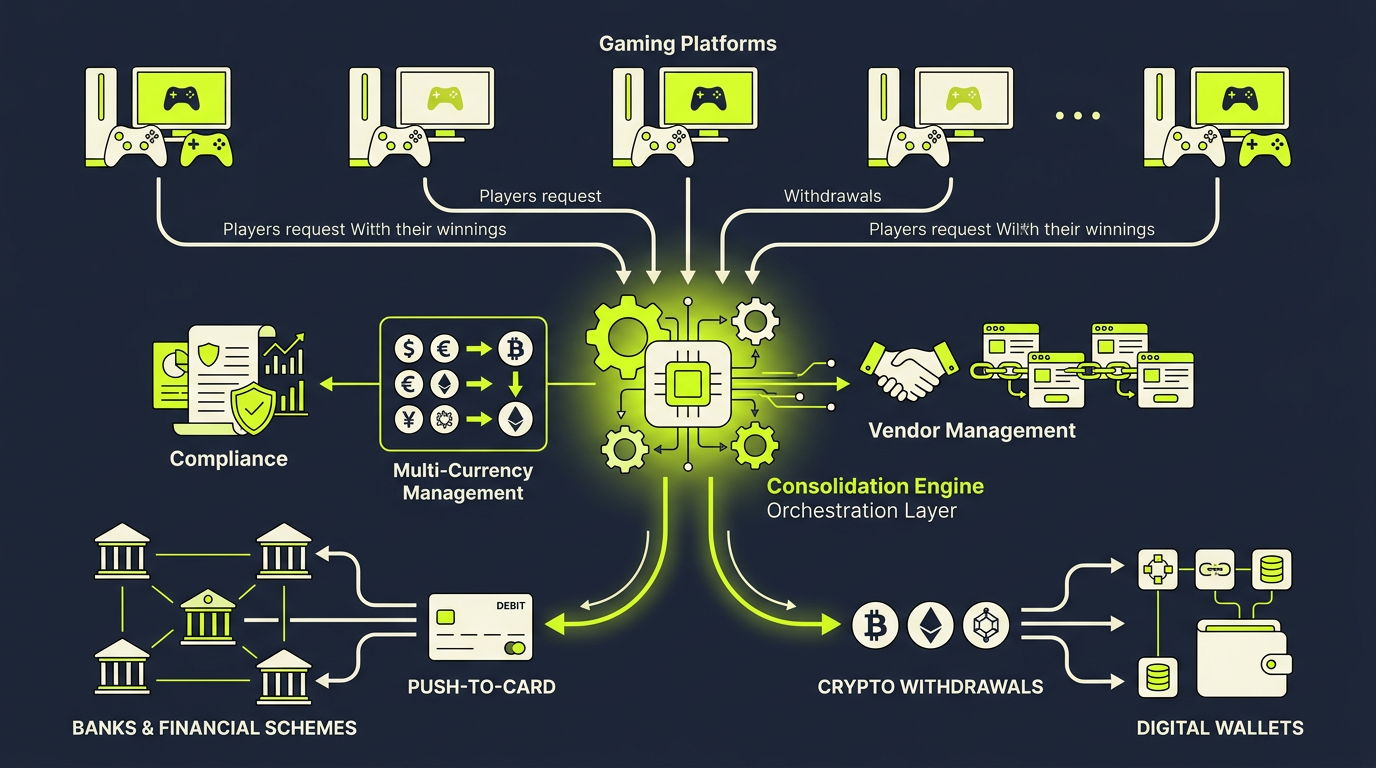
The solution is to move beyond the bolt-on approach and embrace a unified withdrawal architecture. By consolidating all player payouts-from traditional bank transfers to instant card disbursements and crypto settlements-through a single payout automation platform, you can eliminate manual workflows, reduce operational overhead, and deliver the speed and choice modern players demand. This is the foundation of a "touchless finance" operation, built for scale.
The Core Challenge: Why Fragmented Withdrawals Stall Growth
The default state for many gaming platforms is a withdrawal system built piecemeal. As player demand for new payout methods grew, new single-point solutions were bolted on. While this may seem like a quick fix, it creates deep-seated operational fractures that worsen over time. This reactive approach leads to a fragile ecosystem that is difficult to manage and impossible to scale efficiently.
The "Bolt-On" Problem: Juggling Multiple Payment Rails
Your current payout stack likely involves a dedicated provider for domestic ACH, an entirely separate processor for international wires, a third for crypto, and maybe you’re exploring a fourth for push-to-card payments. Each of these rails operates in a silo. This forces your engineering team to build and maintain multiple, distinct integrations, each with its own API documentation, failure points, and update cycles.
This fragmentation is a primary cause of data chaos. Without a single source of truth, finance and operations teams are left to manually consolidate transaction data from different sources, a process that is both time-consuming and prone to error. The challenge is compounded when dealing with crypto, where tracking flows across multiple wallets and exchanges becomes a significant reconciliation burden. This is the essence of a fragmented operation that hinders visibility and strategic decision-making.
Player Churn and High Operational Overhead
For players, the withdrawal experience is a critical touchpoint that directly impacts their loyalty. When payouts are slow, unreliable, or lack desired options, churn is the inevitable result. A player who waits days for an ACH transfer when they wanted an instant card payout is a player who may not return. As explored in How Optimized Withdrawals Boost Player Retention Rates, the speed and reliability of payouts are directly correlated with player satisfaction and retention.
Behind the scenes, this friction translates into significant operational costs. Every failed or delayed payment creates a support ticket. Every inquiry about "where is my money?" requires a team member to manually trace funds across different systems. This reactive support model is expensive and pulls skilled staff into low-value, repetitive tasks. It’s a classic symptom of an operations infrastructure that has not kept pace with the front-end user experience.

The Solution: A Unified Architecture for Global Payouts
The strategic response to this fragmentation is not another "bolt-on" solution but a foundational shift in how you manage player withdrawals. An "Operations-First FinTech" approach treats payouts as a core business function, centralizing all disbursement methods into a single, intelligent layer. This layer acts as a financial operating system for your business, connecting to your existing systems via one API to manage all outbound payments.
A unified payout automation platform like Paddle allows you to offer players a full spectrum of withdrawal options-Push-to-Card, ACH, prepaid cards, crypto, and more-without adding engineering complexity. Instead of managing multiple integrations, your team integrates once. This single connection provides access to a global payment network spanning over 150 countries and 135+ currencies, all managed through a central dashboard.
How to Consolidate Your Withdrawal Stack: A Step-by-Step Guide
Migrating from a fragmented, multi-vendor system to a unified payout architecture is a deliberate process. It involves a clear-eyed assessment of your current state and a strategic implementation of a new, scalable infrastructure. For a Director of Payments, this transition is about taking control of the "money out" problem once and for all.
Step 1: Audit Your Current Payout Operations
The first step is to conduct a comprehensive audit of your existing withdrawal ecosystem. Map every payment method you offer, the provider for each, their fee structures (transaction fees, integration costs, maintenance overhead), and the geographic regions they cover. Document the end-to-end process for each payment type, paying close attention to any points that require manual intervention, from player verification to payment approval and reconciliation.
Quantify the "administrative tax" you are paying. How many hours does your finance team spend on manual reconciliation each month? What is the average time-to-resolution for a payment support ticket? How much engineering time is dedicated to maintaining payout integrations versus building new features? This data will form the business case for consolidation and a baseline for measuring ROI. The goal is to move beyond just managing transactions and begin to fix your fragmented global payment operations before they create irreversible damage.
Step 2: Define Your Ideal State: The Unified Payout Layer
With a clear picture of your current challenges, define the target state. This vision should be centered around a "single API for all withdrawals" philosophy. List the essential payout methods your players demand now and in the future: instant push-to-card, low-cost ACH, global bank transfers, virtual cards, and crypto settlements (primarily stablecoins like USDT). The system must be able to support this mix seamlessly.
Your ideal architecture should prioritize automation and resilience. This means defining requirements for features like automated routing logic, which can dynamically select the most efficient payment rail for each transaction. Furthermore, the infrastructure must be built for high availability. Best practices involve implementing systems that can take over from one another without downtime, ensuring operational continuity even if a specific rail or region experiences an outage.
Step 3: Implement a Single API for Global Disbursement
The final step is implementation. Choose a payout automation partner whose platform is built for this purpose. The key is a robust, well-documented API designed to be "dropped in" to your existing environment with minimal disruption. The platform should offer comprehensive tools that extend beyond the API itself, including a vendor portal where players can manage their own payment information and track withdrawal status, reducing the burden on your support team.
This unified system must also solve for compliance and back-office integration. Look for a platform that automates tax compliance by collecting and validating W-8/W-9 forms and integrates with your existing ERPs like NetSuite, QuickBooks, or Xero. Many industry leaders offer over 600 ERP integrations to ensure that payment data flows seamlessly into your financial record-keeping systems. This level of API support and robust integration is what enables true "touchless finance" and allows your platform to scale globally.
Beyond Consolidation: Unlocking New Capabilities
Consolidating your withdrawal stack is not just an exercise in cost-cutting. It’s about building a strategic foundation to unlock new capabilities that enhance the player experience and create a competitive advantage. Once you have a unified payout infrastructure, you can begin to leverage advanced payment modalities and settlement layers that were previously too complex to manage.
Leveraging Stablecoins for Frictionless Cross-Border Settlement
While the gaming world has seen explosive growth in speculative assets, the most practical application of digital currency for operations is the use of stablecoins (like USDT or USDC) as a settlement utility. In Q1 2026, about 22% of all gambling deposits in regulated markets were crypto, showing players are clearly comfortable with the technology. A unified platform allows you to treat stablecoins as just another payment rail for fast, low-cost, cross-border payouts without exposing the business to volatility.
This is particularly powerful for platforms with a global player base. Sending small, frequent payments to jurisdictions with underdeveloped banking infrastructure can be slow and expensive via traditional rails. Stablecoins offer a near-instant, flat-fee alternative. As the global crypto regulation landscape matures, having a compliant partner that can manage both fiat and crypto payouts from a single platform is critical for future-proofing your operations.
Enhancing Player Liquidity with Advanced Payment Options
A unified payout system also enables you to offer innovative tools that give players instant access to their winnings. This includes issuing virtual or prepaid cards directly from the platform, which can be loaded with funds in real-time upon withdrawal. Players can then use these cards immediately online or at the point of sale, creating a closed-loop ecosystem that boosts engagement.
Furthermore, select platforms offer an "Advanced Payment" feature, providing instant liquidity to players even before standard settlement times are complete. For a skill-gaming or sweepstakes winner, the difference between waiting three days for an ACH transfer and having instant access to their funds is monumental. This capability transforms the withdrawal from a simple transaction into a powerful retention tool, building loyalty by delivering the instant gratification that modern consumers expect.
Conclusion: From Operational Burden to Strategic Advantage
The "money out" problem is a defining challenge for scaling gaming platforms. A fragmented, multi-vendor withdrawal system creates an operational drag that increases costs, frustrates players, and limits global growth. It represents a significant "administrative tax" that prevents your finance and engineering teams from focusing on high-value initiatives.
By adopting a unified payout automation platform, you transform withdrawals from a complex burden into a strategic asset. A single API for all payout methods-Push-to-Card, crypto, global ACH, and more-eliminates manual workflows and provides the operational backbone needed to scale efficiently. This is how you stop being a transaction manager and start building a truly scalable, global financial operation that delivers an exceptional player experience.