

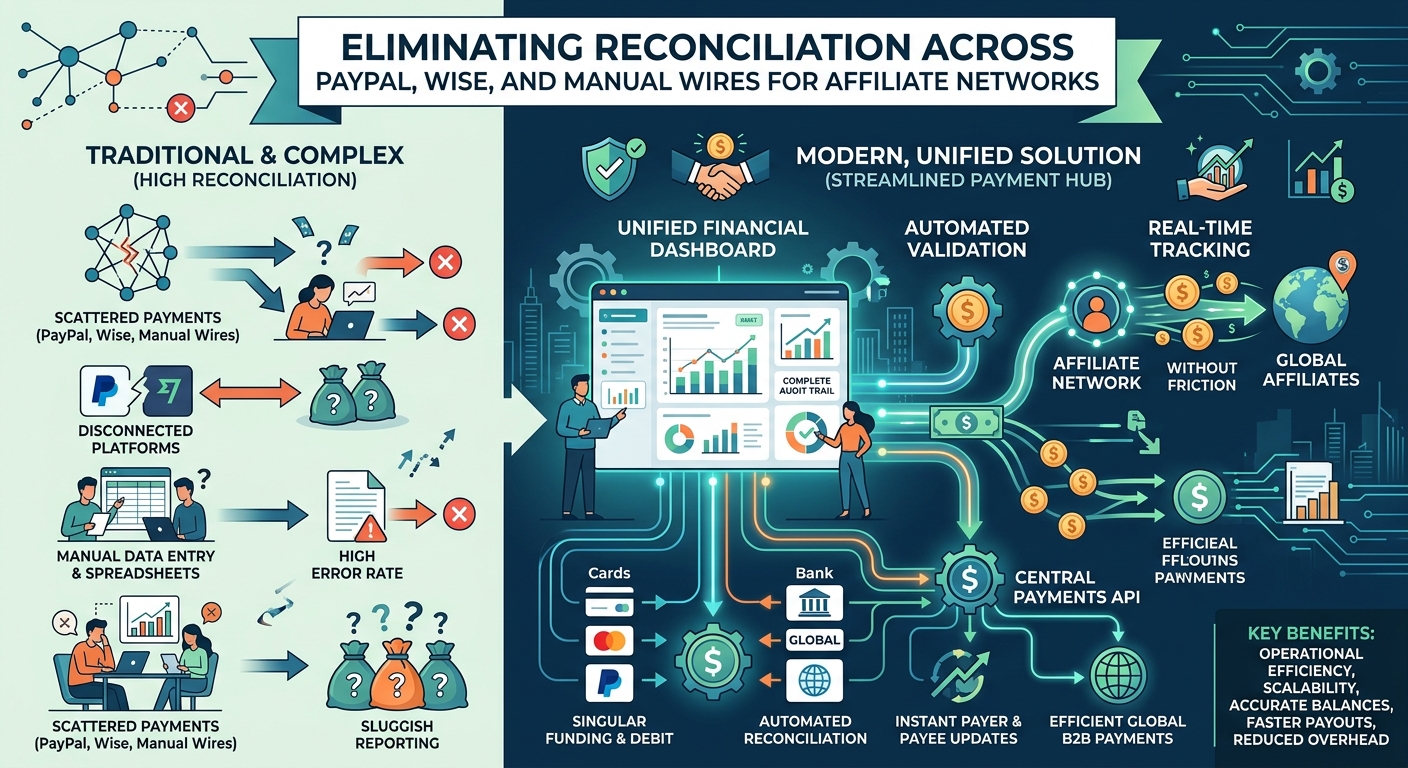
For a COO or VP of Operations at a scaling affiliate network, the morning routine is telling. Before the day's strategic fires even start, you're triaging yesterday's payment fires. An email from a whale affiliate in Germany whose payment is lost. A Slack thread from your finance team, drowning in a CSV reconciliation nightmare between PayPal, Wise, and manual bank wires. This isn't just a daily annoyance; it's a systemic drag on your entire operation.
This fragmented payout stack-a cobbled-together system of consumer-grade payment apps and traditional banking-is the silent killer of scale. Each platform has its own dashboard, its own fee structure, and its own data format. The operational cost of manually managing this complexity is immense, creating an "administrative tax" that directly consumes your finance team's time and your company's margin. It's a system that actively prevents you from scaling without scaling your operations headcount.
The hard truth is that your payout process is no longer just a back-office function. For an affiliate network, it's a core part of your product. Affiliates, particularly top performers, will abandon a network for one that offers faster, more reliable, and more flexible payments. To win, you must move beyond this fragmented approach and adopt a unified financial operating system designed for global payment operations.
The Hidden Costs of a Disconnected Payout System
The 'Administrative Tax' on Your Operations Team
Think of the hours your team spends each month exporting commission data from your tracking platform (like Everflow, CAKE, or TUNE), manually formatting it for different payment providers, uploading multiple files, and then attempting to reconcile the payments back in your accounting software. Every step is a potential point of failure, from data entry errors to payment rejections. This is the very definition of non-scalable work.
This manual reconciliation is more than just tedious; it's a financial black hole. Some sources suggest automation can reduce these operational costs significantly, but the impact goes beyond direct expenses. While your team is bogged down in spreadsheets, they aren't performing higher-value tasks like financial analysis, forecasting, or optimizing cash flow. This is the core challenge detailed in articles like Death to the CSV: How to Automate Affiliate Reconciliation and Reclaim 20% of Your Finance Team’s Time.
How Inconsistent Payouts Erode Affiliate Trust
From an affiliate's perspective, a fragmented payout system is opaque and frustrating. When you send a payment via a basic money-mover, the affiliate often has no idea what the final received amount will be after correspondent bank fees and surprise currency conversion rates are applied. This lack of clarity leads to a stream of support tickets, erodes trust, and makes your network seem amateurish.
Top affiliates have choices. They view payout speed and reliability as a key factor when choosing a network. If their payments are consistently late, subject to unclear fees, or lack method optionality (like local bank transfers in their own currency), they will find a network that has solved these problems. In this competitive landscape, your payout speed becomes your recruiting edge, and a clunky system is a direct threat to your revenue.
The Compliance Tightrope: W-9s, 1099s, and Global KYC
Beyond the operational headaches, a manual system creates significant compliance risk. Are you collecting W-9s from your US-based affiliates and W-8BEN forms from your international ones before you pay them? Are you validating this information to ensure it's accurate? Manually tracking this across thousands of global affiliates is nearly impossible and leaves you dangerously exposed during an audit.
AP automation platforms help solve this by integrating tax compliance directly into the onboarding process. They can instantly capture and validate supplier tax information, making you audit-ready from day one. Without this, you risk fines, penalties, and even having to withhold payments, which can be catastrophic for affiliate relationships.
Why Standalone Tools Like PayPal and Wise Don't Scale
The PayPal Problem: High Fees and Blind Spots
With a 45% share of the global payments market and over 434 million active users, PayPal is an undeniable force. Many affiliates expect it as an option. However, for the network paying out commissions, its model is problematic at scale. Its percentage-based transaction fees become punishingly expensive as your payout volume grows, directly eating into your margins.
Furthermore, while PayPal is available in over 200 markets, it's not a truly global solution. There are countries where it's not available or has limited functionality. Relying on it as your primary solution creates geographical blind spots in your network's reach and forces you to find one-off solutions for affiliates in unsupported regions, adding yet another manual process to your stack.
The Wise Dilemma: A Great Tool, But Not a System
Wise (formerly TransferWise) has been a go-to for international money movement with transparent mid-market rates. It serves a valuable purpose for sending individual payments. However, as many have noted, it is strictly a money movement tool, not a comprehensive payout system. It lacks the critical layers of automation and control that a scaling affiliate network requires.
Crucially, Wise offers no built-in compliance layer for collecting tax forms or validating vendor identities. Using it for mass payouts requires significant manual work to track who has been paid and reconcile those payments against your commission data. While you can build a custom API integration, that requires significant development resources, turning your finance team's problem into your engineering team's problem.
The Blueprint for Touchless Finance: A Unified Payout Platform
Centralizing Data: The Power of 'One Integration'
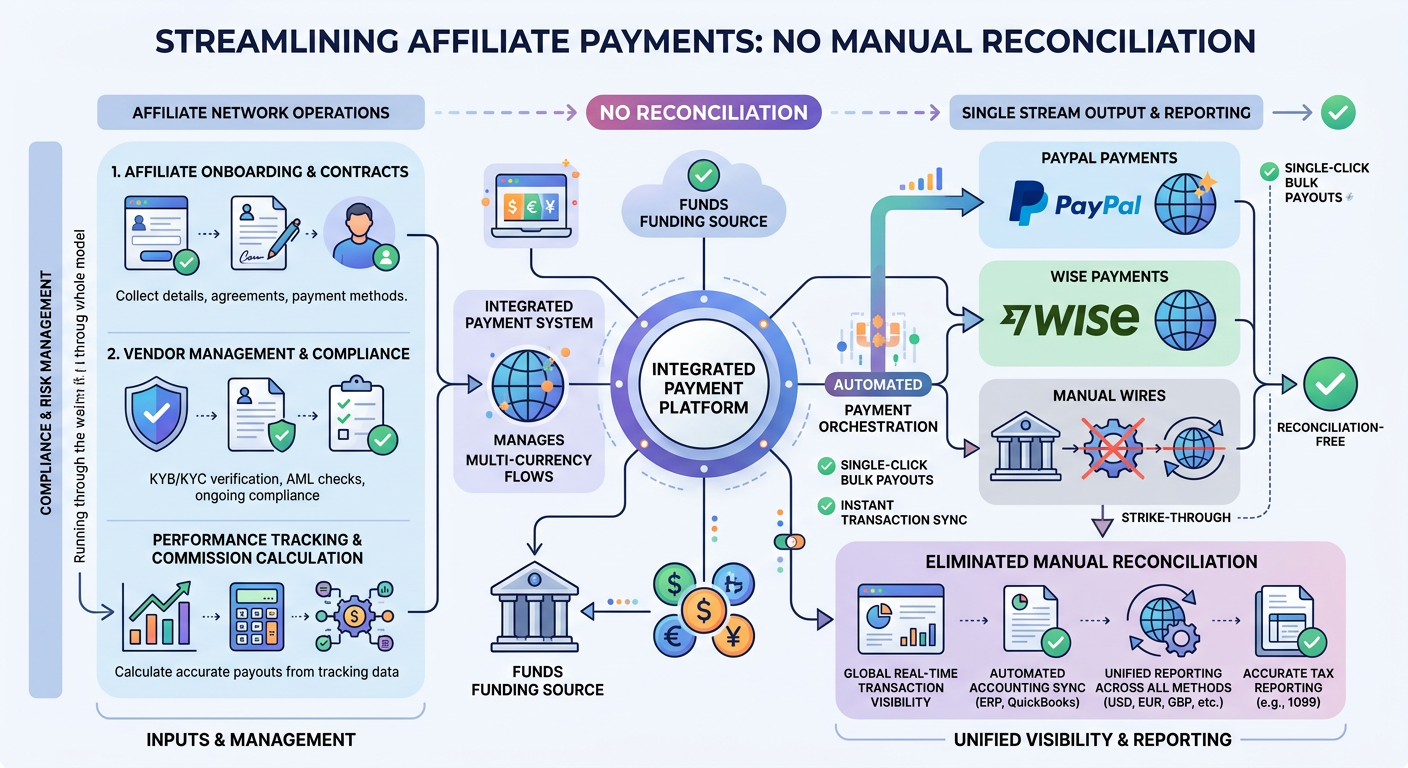
Imagine a world where you don't export CSVs. The solution is a single platform that acts as the financial operating system for your entire network. This system integrates directly with your affiliate performance tracking software to automatically ingest commission data. It also integrates with your ERP (like NetSuite, QuickBooks, or Xero) to ensure perfect, real-time reconciliation.
This "one integration" approach eliminates manual data handling entirely. Payouts are triggered based on accurate, real-time data from the source of truth. Payments are made, and the results are reconciled back to your general ledger automatically. This is the foundation of moving Beyond the Spreadsheet: 6 Ways to Fix Your Fragmented Global Payment Operations Before They Tank Your Margins.
Automating Global Compliance and Tax Season
A modern payout platform embeds compliance directly into the workflow. When a new affiliate joins, they are directed to a multi-language self-service portal where they onboard themselves. During this process, the system intelligently collects the correct tax form (W-9, W-8BEN, etc.) based on their country and business type, digitally validating the information in real time.
This automated, front-loaded approach ensures that 100% of your payees are compliant before the first dollar is ever sent. At year-end, the platform can automatically generate 1099s for eligible US-based affiliates, transforming tax season from a multi-week fire drill into a non-event. This is how you build an operation that is perpetually audit-ready.
Offering Payout Choice as a Competitive Edge
Instead of forcing your affiliates into one or two payment methods, a unified platform allows you to offer a full menu of options through a single integration. Affiliates can choose what's best for them: ACH in the US, SEPA in Europe, local bank transfers in 135+ currencies, instant prepaid cards, or even digital currency.
This is possible because the platform manages the complexity of the global banking network on the back end. For the network, this model is often far more cost-effective. Instead of paying percentage-based fees, platforms provide predictable costs that don't penalize you for scaling your payout volume.
The Role of Stablecoins in Frictionless Settlement
For affiliates in regions with challenging or slow traditional banking rails, emerging payment methods are becoming powerful tools. A unified platform can offer payouts in stablecoins (digital currencies pegged to a stable asset like the US dollar), which act as a frictionless settlement layer. This allows for near-instant, low-cost payments globally, 24/7.
This isn't about currency speculation; it's about utility. For an affiliate in a country with high inflation or slow banking, receiving a stablecoin like USDT can be a faster and more secure way to get paid. Offering this as an option demonstrates that your network is forward-thinking and committed to providing the best possible experience for global partners.
Ultimately, moving from a fragmented collection of tools to a unified financial operating system is no longer a luxury but a strategic imperative. The manual processes that plague your operations are a direct barrier to growth, affiliate retention, and profitability. By eliminating reconciliation and automating compliance, you can finally focus on what truly matters: growing your network.