

The modern enterprise is global by default. Your top engineer might be in Brazil, your best marketing affiliate in Germany, and your most influential creator in Japan. Technology has made it simpler than ever to source and collaborate with talent from over 150 countries. Yet, for most finance and operations teams, the infrastructure to pay this global workforce is stuck in a previous era.
The systems designed for domestic, W-2 employee payroll are fundamentally ill-equipped for the complexities of global contractor and vendor payouts. When confronted with cross-border payments, multiple currencies, and varied local compliance needs, these legacy stacks begin to fracture. The result is an invisible but costly 'administrative tax' - a mix of high fees, manual data entry, settlement delays, and compliance risks that actively throttles a company's ability to scale.
This operational friction isn't a minor inconvenience; it's a strategic liability. As high-growth ad networks, creator economy platforms, and digital marketplaces expand, the manual workflows that were manageable with ten international vendors become impossible with one thousand. The solution lies not in hiring more people to chase wires and reconcile spreadsheets, but in upgrading the underlying financial plumbing.
For a growing number of operations-first companies, that upgrade is happening via stablecoin settlement layers.
The Operational Drag of Traditional Cross-Border Payouts
For CFOs and Finance Directors, the promise of a global workforce is often overshadowed by the practical nightmare of paying them. The traditional correspondent banking system, primarily relying on SWIFT, was designed for large, infrequent transactions between institutions, not for the high-volume, low-value payouts that characterize the modern digital economy. This mismatch creates significant operational bottlenecks and value leakage.
The Anatomy of a Delayed SWIFT Payment
When you initiate a cross-border wire payment, it doesn't travel directly from your bank to your contractor's. It traverses a chain of intermediary and correspondent banks, each stop adding time, cost, and uncertainty. A payment from the US to South Africa might be routed through London or Frankfurt, with each bank in the chain taking a fee and adding days to the settlement time.
In fact, some analyses show that stablecoin settlement pilots reduced international transaction settlement time from days to under 24 hours in select corridors.
This lack of transparency means your finance team is often flying blind, unable to confirm when a payment will land or how much will arrive after fees are deducted. For the contractor, this creates anxiety and damages their relationship with your company. For your team, it means hours wasted tracking payments and fielding inquiries from frustrated vendors, a process that simply cannot scale.
The Hidden Costs of Currency Conversion and FX Risk
Beyond wire fees, the most significant cost in traditional payouts is currency exchange. Most providers charge a percentage-based fee on the spot rate, which can quietly erode 2-5% of the payment value. For a company processing millions in global payouts, this amounts to a substantial and unnecessary cost center. This is a stark contrast to modern platforms built on a flat-fee per transaction model, which prioritizes transparency and predictability.
Furthermore, the multi-day settlement window of traditional rails introduces currency fluctuation risk. The exchange rate on the day you send the payment may be different from the rate when it finally arrives, creating reconciliation headaches and potential losses for either you or your contractor. This forces finance teams into complex and costly hedging strategies that are misaligned with the goal of paying people quickly and efficiently.
Stablecoins as a Financial Operating System Upgrade
It is critical to distinguish stablecoins as a settlement utility from the speculative world of cryptocurrency trading. For operational purposes, stablecoins are simply a container for value - a digital dollar (like USDC or USDT) that moves on modern, efficient, global rails. They are not an investment; they are an infrastructure upgrade. With astounding figures like stablecoins processing more than $12 trillion in total transfer volume in 2025, this infrastructure has already achieved enterprise scale.
Viewing stablecoins through this lens reveals their true potential for scaling businesses. They are not a replacement for your treasury strategy but a superior rail for executing it. They allow a company to hold and manage its core treasury in USD or EUR while using a frictionless layer to deliver precise value to stakeholders in over 150 countries, almost instantly.
From Days to Minutes: The Speed of On-Chain Settlement
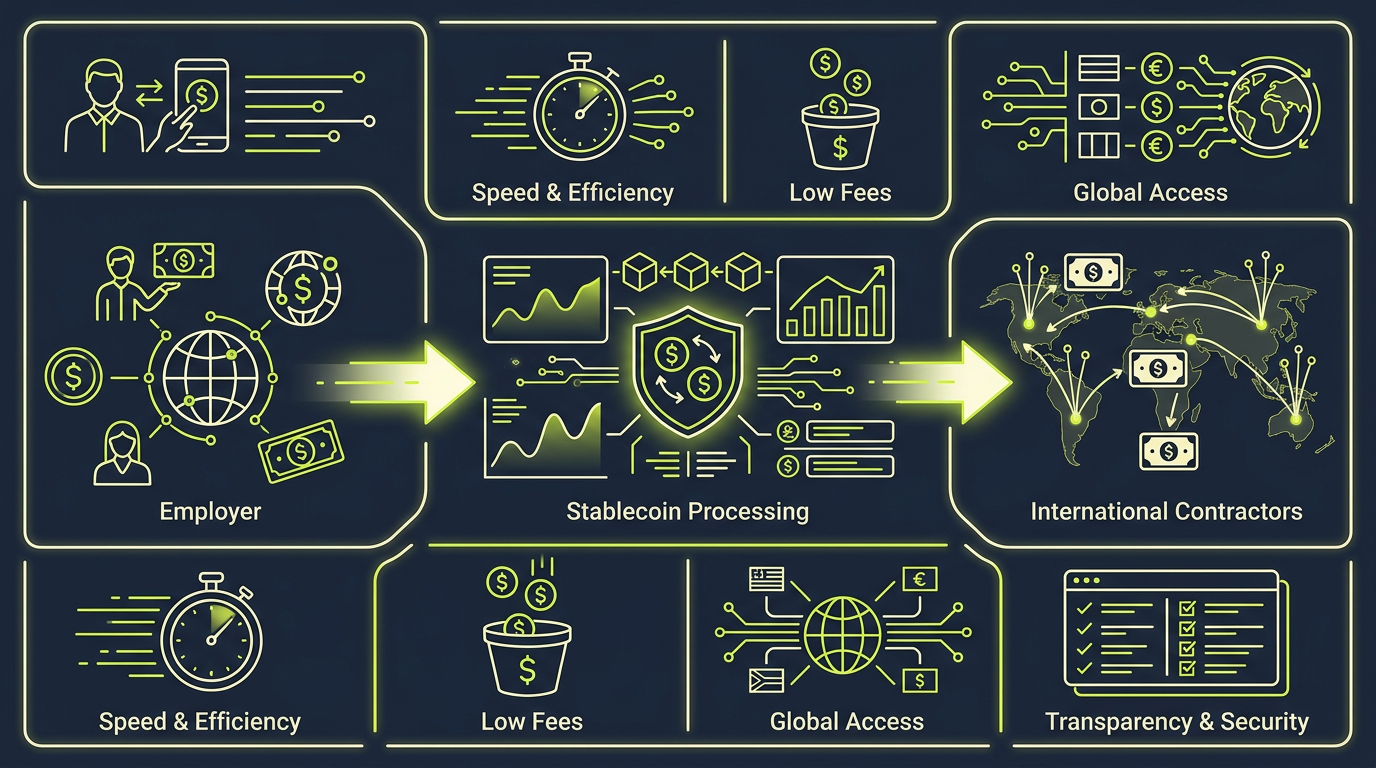
Unlike a SWIFT transaction, an on-chain stablecoin payment is a peer-to-peer transfer of value recorded on an immutable ledger. There are no intermediary banks, no multi-day holds, and no black boxes. The transaction is settled, final, and verifiable within minutes. As one guide on how to pay international contractors with stablecoins highlights, the process is direct and confirmed quickly.
This speed transforms the vendor experience and unlocks operational capacity for finance teams. Imagine a world where your payouts don't just settle in days, but where settlement happens in minutes. This predictability eliminates the need for payment-status inquiries, freeing up your team to focus on strategic financial analysis rather than administrative support.
Radically Lower Costs and Transparent Fees
Because they bypass the correspondent banking system, stablecoin transactions avoid the stacked fees associated with wire transfers. On efficient networks, transaction fees can be averaged under $1 per transfer on low-cost chains, regardless of the transaction size or geographic destination. This allows businesses to execute micropayouts to the long tail of global creators or affiliates without costs consuming the payment itself.
When combined with a payout automation platform that operates on a simple flat-fee model, the total cost of execution plummets. This creates a predictable cost structure that can be modeled accurately, allowing finance leaders to forecast expenses and manage budgets with much greater precision. The savings can then be reinvested into growth or passed on to vendors, strengthening the business ecosystem.
Building a Touchless Finance Workflow for Global Payouts
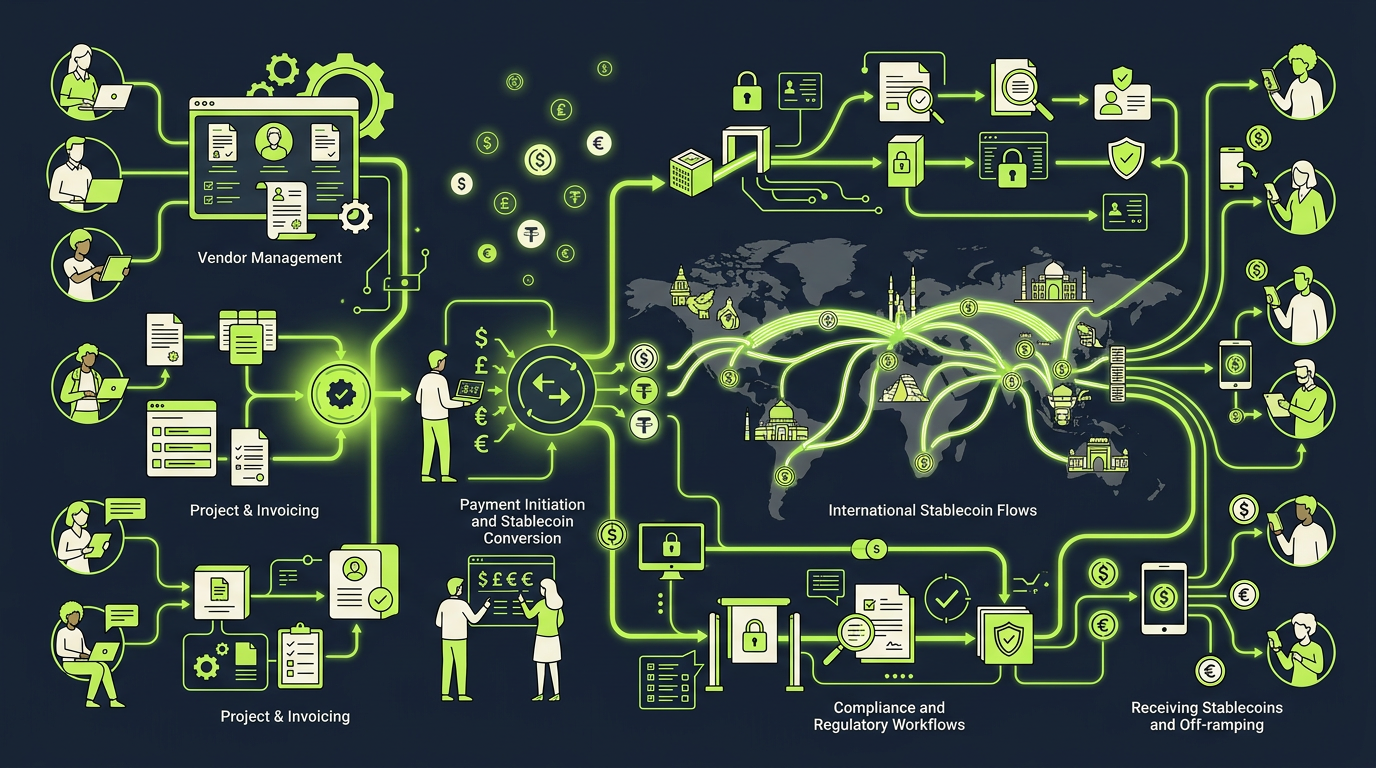
Simply sending stablecoins from a wallet to a contractor's address is not a scalable or compliant strategy. The real operational leverage comes from integrating this new payment rail into a holistic payout automation and vendor management platform. The goal is to build a 'Touchless Finance' function, where payments from data ingestion and tax compliance to multi-currency disbursement are automated.
Automating Compliance at Global Scale
Compliance is non-negotiable when paying a global workforce. A robust payout platform automates the collection and validation of tax forms like W-8s and W-9s, performs KYC/KYB on vendors, and continuously screens against global sanctions lists. As explained in guides on the topic, compliance is a significant concern that requires a systemic solution.
This process should be embedded into the vendor onboarding experience via a self-service portal. The contractor can upload their own information, choose their preferred payout method (local bank transfer, prepaid card, or stablecoin wallet), and complete tax documentation digitally. This not only removes the administrative burden from your finance team but also ensures a complete, auditable compliance trail for every single payout.
Integration is Everything: Connecting Payouts to Your ERP
A payout solution that doesn't communicate with your core financial system creates more work than it saves. Data silos between your payment platform and your ERP lead to hours of manual reconciliation and increase the risk of errors. True automation requires deep, bi-directional integration.
A payout solution that doesn't communicate with your core financial system creates more work than it saves. Data silos between your payment platform and your ERP lead to hours of manual reconciliation and increase the risk of errors. True automation requires deep, bi-directional integration with your core financial systems, including NetSuite, QuickBooks, Xero, and SAP.
This ensures that every payment, whether executed via ACH, SEPA, or stablecoin rails, is automatically reconciled and reflected in your general ledger. This creates a single source of truth for all global payables and closes the loop on the payment lifecycle.
The Future of Global Payouts is Unified
The conversation is no longer about whether to use traditional rails or stablecoin rails. The future of global payouts is a unified platform that offers both, allowing the sender to be rails-agnostic and the recipient to choose their preferred method. This approach provides the ultimate flexibility, optimizing for speed, cost, and local preference on a payment-by-payment basis.
For operations leaders at scaling companies, the mandate is clear: build a financial infrastructure that enables growth, rather than constraining it. This means moving beyond the legacy systems built for a domestic, centralized workforce and embracing a global, automated, and multi-rail approach. It's about recognizing that the future of global payouts lies beyond SWIFT and in a unified system.
By shifting from manual processes to an automated financial operating system, companies can finally eliminate the 'administrative tax'. This frees up capital and human resources to be deployed on strategic initiatives-developing new products, entering new markets, and building stronger relationships with the global talent that powers their growth.