

The global digital advertising market has surged past $740 billion, and for ad networks, agencies, and creator platforms, diversification is no longer a choice-it's the default strategy for survival and growth. To maximize yield, you must work with a portfolio of monetization partners, from giants like Google AdMob to high-performers in specific verticals like Unity Ads and Liftoff. This strategy, however, introduces a significant and often underestimated challenge: operational chaos.
Each new ad network added to your stack brings its own reporting format, API endpoint, payment cycle, and data structure. Your finance and operations teams are quickly buried in an avalanche of manual work-downloading CSV files, painstakingly normalizing disparate data, and manually processing payouts to a global base of publishers. This administrative tax doesn't just drain resources; it actively throttles your ability to scale.
The friction created by data fragmentation directly impacts your capacity to onboard new publishers and expand into new markets.
Many leaders believe the answer is to limit partners, thereby sacrificing revenue for the sake of simplicity. The more effective, scalable solution is not to shrink your opportunities but to build a 'touchless finance' infrastructure. By automating the ingestion of data from all your ad network partners and connecting it to a unified payout system, you can eliminate manual workflows, enhance data accuracy, and unlock true operational scale.
This guide provides a blueprint for achieving that consolidation.
The Data Fragmentation Challenge in a Multi-Network World
The ad monetization landscape is not uniform. A winning strategy on iOS might not translate to Android. As recent benchmarks show, growth is selective; on iOS, networks like Unity Ads show significant year-over-year gains, while on Android, Google AdMob and Pangle command the lead. This forces ad-driven businesses to maintain a fluid, multi-network approach to capture the best performance and highest eCPMs across different platforms and geographies.
While this diversification is essential for revenue optimization, it creates a severe backend problem. The ad networks market is projected to nearly double, reaching almost $105 billion by 2035, which means this data fragmentation will only intensify. Without a robust system to manage it, the operational burden can quickly outweigh the financial benefits of working with multiple networks, putting a hard ceiling on growth.
From Silos to Spaghetti: The Cost of Disparate Data
When you operate across multiple ad platforms, your finance team’s reality involves logging into numerous dashboards to download performance reports. Each report is a data silo with its own unique structure, terminology, and metrics. The process of manually stitching this information together is not just inefficient; it's a minefield of potential errors. This is a common pain point for media agencies and platforms that are consolidating payments across multiple platforms.
This manual effort transforms clean, siloed data into a tangled mess of 'spaghetti'-interconnected spreadsheets that are fragile, difficult to audit, and prone to breaking. A single copy-paste error can lead to a publisher being overpaid or underpaid, damaging trust and creating compliance risks. This manual process is the antithesis of the scalable infrastructure needed to support a global publisher base.
The Hidden Costs of Manual Reconciliation
The obvious cost of manual reconciliation is the time your skilled finance professionals spend on low-value data entry. This is time that could be dedicated to strategic financial planning, cash flow optimization, and growth analysis. As recent reports from Ad Age note, holding companies are increasingly chasing growth with fewer people, making automation a critical lever for efficiency. Wasting talent on manual tasks is a luxury no scaling company can afford.
The hidden costs, however, are far more corrosive. Delayed publisher payments due to cumbersome approval workflows can harm your reputation and make it difficult to attract top-tier publishers. A lack of real-time visibility into your earnings and payout liabilities makes accurate cash flow forecasting impossible. Furthermore, a manual process lacks the rigorous controls needed for global payouts and local compliance, exposing your business to financial and regulatory risks.
The Integration-First Approach: A Blueprint for Consolidation
To break free from this cycle, you need a financial operating system-an integrated platform that orchestrates the entire data and payment lifecycle. This system should not just be a payment gateway but a that starts with data ingestion. An integration-first approach treats your a.d networks not as problems to be managed, but as data sources to be connected.
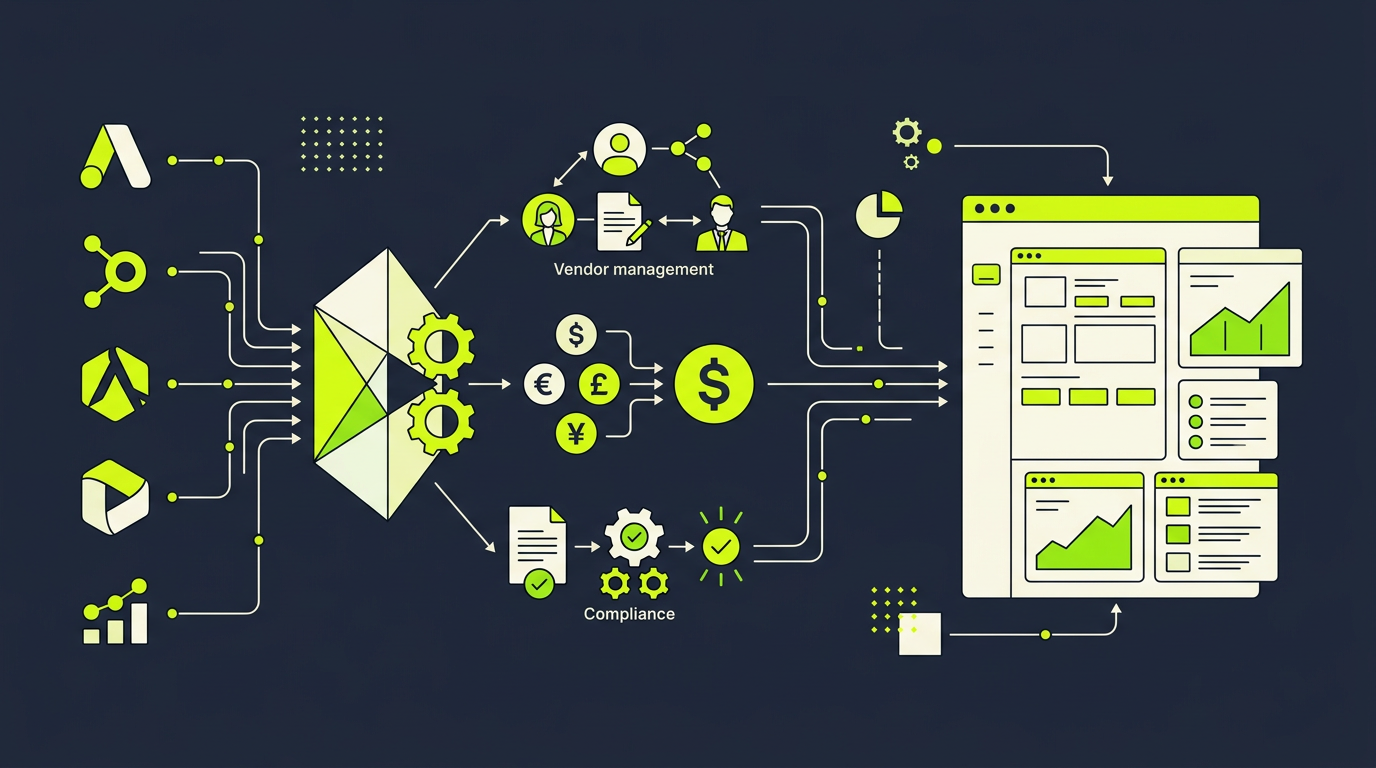
The goal is to create a single, automated pipeline that pulls performance data, calculates earnings, manages approvals, executes payments, and reconciles transactions back to your financial records. This establishes a single source of truth for your entire revenue and payout operation, providing the stability and efficiency needed to scale globally.

Step 1: Universal Connectors for Seamless Data Ingestion
The foundation of this automated system is the ability to connect to any ad network, regardless of its technology. This is achieved through 'Universal Connectors,' which are flexible data ingestion tools capable of integrating with platforms via API, secure file transfer protocol (SFTP), or even structured file uploads (e.g., CSV, XML). Payouts.com utilizes this approach to eliminate the need for manual data downloads.
Instead of your team logging into ten different dashboards, the system automatically pulls critical data points at scheduled intervals-impressions, clicks, installs, revenue, publisher IDs, and more. This ensures that the data flowing into your financial workflow is timely, complete, and sourced directly from the platform of record, removing the risk of human error from the very first step.
Step 2: Normalizing and Validating Data On Autopilot
Once data is ingested from multiple sources, it must be standardized into a single, cohesive format. An automated platform handles this data normalization instantly. For example, 'Publisher ID' from one network and 'Affiliate_ID' from another are mapped to a unified 'Payee ID' field within the system. This creates a clean, consolidated dataset that is ready for processing.
Beyond normalization, the system should apply automated validation rules to ensure data integrity. These rules can be configured to flag duplicate entries, identify unusually high earnings that may indicate fraud, and check for missing information required for payment processing. This is a critical best practice for any platform implementing payout automation for ad networks. This automated validation step serves as a crucial line of defense, preventing erroneous data from triggering incorrect payments.
Connecting Ingestion to ERPs and Global Payouts
Consolidating data is only half the battle. To achieve a true 'touchless' workflow, this normalized data must flow seamlessly into your core financial systems and power the final disbursement to publishers. This is where the integration between a payout automation platform and your Enterprise Resource Planning (ERP) system becomes the engine of operational efficiency.
This connection transforms raw performance data from ad networks into reconciled financial entries and executed global payments without a single manual keystroke. It closes the loop on the entire process, providing end-to-end visibility and control from initial data ingestion to the final line item in your general ledger.
The NetSuite Connector Example: Bridging Ad Revenue to Financials
Consider a practical example using a widely adopted ERP. With a pre-built connector, the Payouts.com platform can automatically sync all publisher earnings data with your NetSuite instance. When performance data is ingested and validated, a corresponding vendor bill is automatically created in NetSuite for each publisher, reflecting the precise amount owed for that payment period.
Once the payment is executed through the Payouts.com platform, the status is pushed back to NetSuite, marking the bill as paid and triggering the appropriate journal entries for reconciliation. This creates a perfect, auditable loop. This is the core principle of scaling global payouts with ERP connectors. With over 600+ ERP integrations, including systems like QuickBooks, Xero, and SAP, this automated reconciliation can be applied to nearly any existing financial stack.
From Data to Disbursement: Executing Global Payments
With data validated and synced, the final step is flawlessly executing payouts to your global publisher base. A unified platform handles this complexity by supporting payments to over 150 countries in more than 135 local currencies. This removes the need for your team to manage multiple banking relationships or worry about the intricacies of cross-border transfers.
This modern approach also provides flexibility in payment methods. Publishers can choose to receive funds via local bank transfer, prepaid debit cards, or virtual cards. Furthermore, the platform can utilize stablecoins as a settlement layer, offering a near-instant, low-cost option for cross-border transactions.
This moves beyond traditional banking rails, exploring modern settlement options. Critically, this is all managed under a flat-fee-per-transaction model, providing predictable costs that don't penalize growth.
Building a Future-Proof 'Touchless Finance' Stack
The culmination of this integration strategy is a 'touchless finance' stack that is scalable, accurate, and resilient. By automating the full cycle from data ingestion to reconciliation, you eliminate the administrative tax that punishes growth. Your finance team is elevated from data entry clerks to strategic partners, focusing on optimizing financial performance instead of chasing down CSV files.
This operational excellence becomes a powerful competitive advantage. It enables you to onboard publishers faster, pay them more accurately and reliably, and expand into new markets with confidence. As agencies adapt to doing more with less, this level of automation is no longer a luxury-it's the core engine of sustainable growth.
While this guide focuses on ad networks, this same blueprint applies across the digital economy. The challenges of managing performance data and executing global payouts are identical for influencer agencies, affiliate marketers, and creator economy platforms, a segment that continues to see explosive growth according to recent creator and influencer trends. A platform built for programmatic payments provides the foundational infrastructure to power all these use cases from a single, unified system.