

The influencer marketing industry is not just growing; it's undergoing a fundamental shift from an experimental tactic to a core pillar of corporate strategy. With the market projected to surge from USD 40.51 billion in 2026 to over USD 152.56 billion by 2031, businesses are allocating multi-year budgets to creator partnerships, recognizing them as a powerful and efficient customer acquisition channel. This explosive growth, however, conceals a dangerous operational bottleneck that threatens to capsize even the most promising influencer networks and agencies: global payment disbursement.
What was once manageable-paying a handful of domestic creators-has ballooned into a complex logistical nightmare of cross-border transactions, multi-currency conversions, and labyrinthine tax compliance. This "administrative tax" on operations drains resources, erodes margins, and directly impedes a company's ability to scale. Finance teams are buried in manual workflows, chasing invoices and navigating international payment rails, while the strategic growth of the creator network stalls.
The challenge is no longer just finding the right influencers; it's building a financial operating system that can support them at scale.
The New Economics of Influence: Why Payment Operations are a Strategic Priority
As brand owners transition their mindset, treating influencer collaborations as a strategic acquisition lever, the financial plumbing behind these partnerships comes under intense scrutiny. This isn't just about sending money; it's about building a reliable, scalable, and efficient infrastructure that can handle the velocity and volume of a rapidly expanding global creator base. The economics have shifted, and the operational capacity to execute payments has become a competitive differentiator.
From Experimental Spend to Strategic Acquisition
The days of one-off, experimental campaigns are over. Today, finance teams approve substantial, multi-year allocations for creator programs because the data is clear: blended customer-acquisition costs often decrease when budgets shift from traditional paid search to authentic creator voices. As some reports note, this strategic pivot means that influencer programs are now a core component of the marketing mix, demanding a higher level of operational rigor and financial oversight.
This formalization of influencer marketing puts immense pressure on back-office operations. A system built for sporadic, local payments is simply not equipped to handle hundreds or thousands of monthly payments to creators in 150+ countries. The reliance on spreadsheets, manual data entry, and individual wire transfers becomes a critical point of failure, introducing errors, delays, and significant hidden costs that undermine the very ROI the program was designed to achieve.
Rising Creator Costs and Mounting ROI Pressure
Compounding the challenge is the economic reality of the market itself. A 2026 industry survey identified rising creator costs as the single top challenge for marketers, with over 35% citing it as their primary concern. As creators become more sophisticated and their value more apparent, their compensation expectations rise accordingly. This pricing pressure forces finance and operations leaders to find efficiencies elsewhere in the value chain.
When the primary cost-creator fees-is rising, the secondary costs associated with payment processing, currency conversion, and administrative overhead become a critical area for optimization. A percentage-based fee on a large payout to a top-tier influencer can be substantial, directly eating into campaign margins. This is why a flat-fee per transaction model is becoming increasingly attractive for platforms managing high-volume payouts, as it provides predictable costs that don't penalize growth.
The Administrative Tax: How Manual Payouts Cripple Scaling Agencies
The 'administrative tax' is the silent killer of growth for influencer agencies and marketplaces. It's the sum of all the time, resources, and capital wasted on inefficient, manual payment workflows. This includes the hours your finance team spends chasing down invoices, correcting data entry errors, and manually reconciling payments instead of focusing on strategic financial planning.
It’s a tax that grows exponentially with your business, making true global scale impossible to achieve sustainably.
The Hidden Costs of Cross-Border Complexity
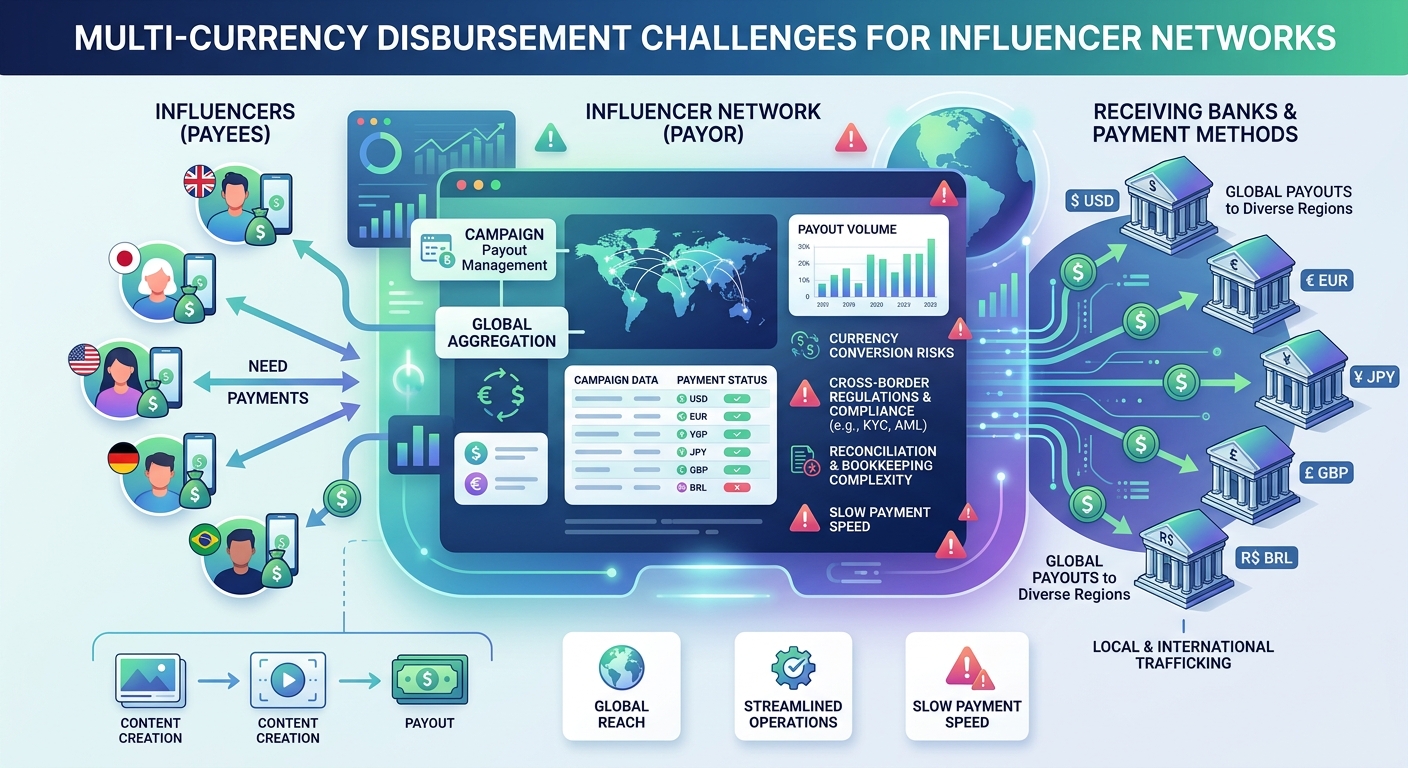
Processing payments to a creator in London is one thing; managing simultaneous payouts to creators in Tokyo, São Paulo, and Dubai is another matter entirely. Each transaction involves navigating different banking systems, currency fluctuations, and regulatory requirements. As one analysis points out, the complexity of cross-border payments involving multiple currencies can quickly lead to compliance issues and incorrect payout amounts. These are not just minor inconveniences; they are significant financial and legal risks.
Without an automated system, finance teams are left to wrestle with unpredictable wire transfer fees, opaque currency exchange rates, and payment failures due to incorrect banking information. This manual approach is not only inefficient but also damaging to creator relationships. delayed or incorrect payments erode trust, making it harder to retain top talent in a competitive market. To truly scale, businesses need to abstract away this complexity, leveraging platforms that can handle multi-currency payouts seamlessly.
Compliance Nightmares: The Global Gauntlet of W-8/W-9 and KYC
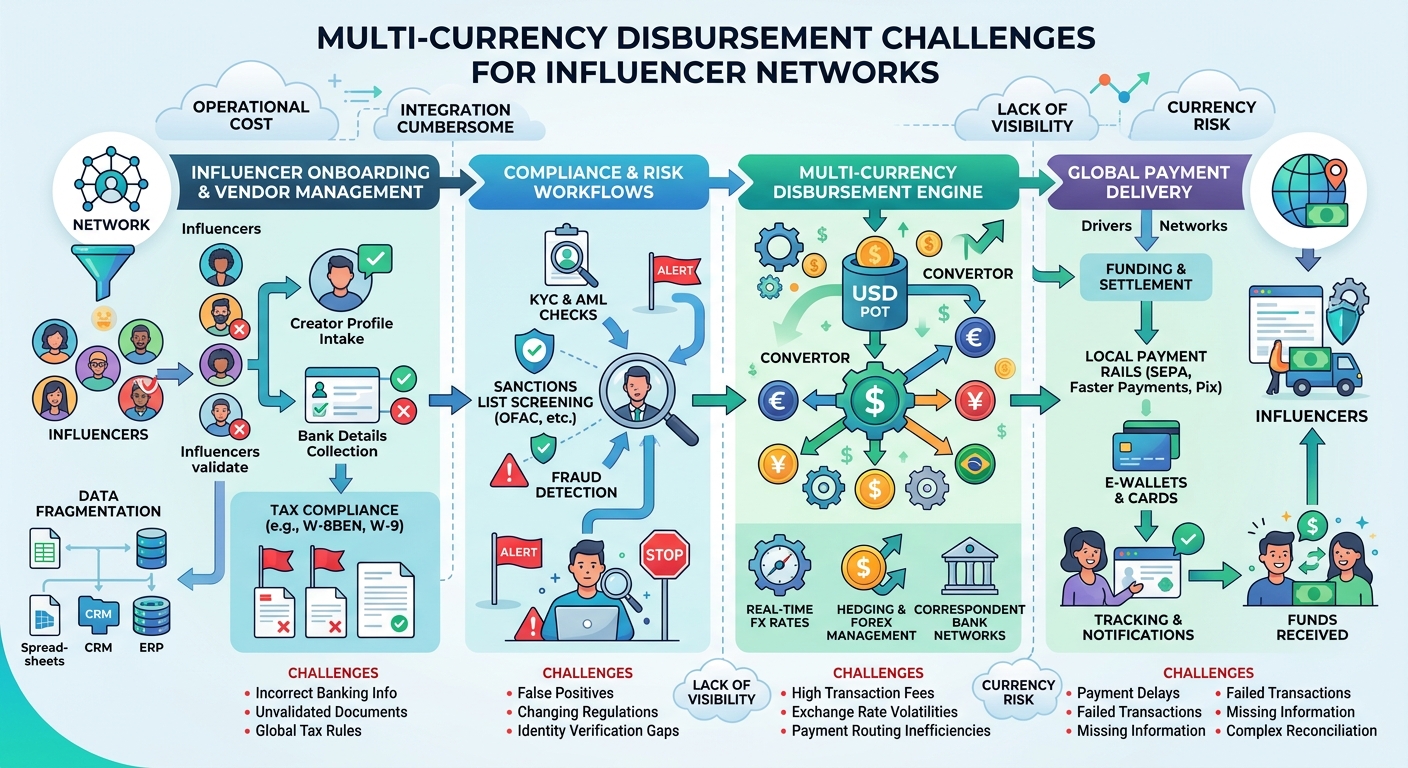
Perhaps the most significant operational hurdle in global payouts is tax and identity compliance. Onboarding a creator requires more than just getting their payment details; it involves collecting the correct tax documentation (like W-9s for US persons and the W-8 series for non-US persons) and performing Know Your Customer (KYC) and Anti-Money Laundering (AML) checks to comply with regulations from bodies like FinCEN and FATF.
Manually collecting, validating, and managing these documents for a global creator base is an exercise in futility. The rules are complex, the forms are confusing for creators, and the risk of error is high. An incorrect or missing form can result in significant tax penalties and backup withholding requirements.
Automating the collection and validation of these forms within the onboarding workflow is no longer a luxury but a necessity for any company operating at scale. This journey requires moving forward with secure creator payment systems for global agencies.
From Fragmentation to a Unified Financial Operating System
Many scaling businesses find themselves caught in a web of disconnected tools: one platform for affiliate and influencer tracking, a separate system for mass payments, spreadsheets for reconciliation, and the company’s core ERP for accounting. This fragmented approach creates data silos and forces finance teams into a perpetual cycle of exporting and importing CSV files-a process that is both inefficient and highly prone to error. The solution lies in creating a single source of truth through a unified financial operating system.
The Problem with Piecemeal Solutions
While specialized tools for parts of the workflow can be helpful, they often fail to address the complete end-to-end process. A standalone payment platform, for instance, might not offer robust tax compliance features or integrate seamlessly with your performance marketing software. This forces teams to bridge the gaps with manual workarounds, effectively re-introducing the very administrative tax they sought to eliminate.
This fragmentation is a primary reason why many businesses feel stuck, unable to grow their creator network without exponentially increasing their back-office headcount. The key is to think holistically about the entire financial operation, from creator onboarding and data ingestion to payment execution, tax reporting, and ERP reconciliation. It's time to look beyond the spreadsheet to fix fragmented global payment operations before they tank margins.
The Power of Integration: Connecting Your Financial Stack
A true financial operating system serves as the central hub connecting all spokes of your financial data. Through robust integrations, it can automatically pull performance data from affiliate or influencer networks, trigger payments based on predefined rules, and then push reconciled data directly into your accounting software. This creates a state of 'Touchless Finance,' where the entire lifecycle of a payment occurs without manual intervention.
This level of automation is achieved via deep, two-way integrations with over 600+ ERP systems, including major platforms like NetSuite, QuickBooks, Xero, and SAP. When your payment platform communicates seamlessly with your accounting system, you eliminate the need for manual reconciliation, close your books faster, and gain a real-time, accurate view of your financial position. This is the foundation upon which scalable growth is built.
The Future of Creator Compensation: Speed, Flexibility, and Trust
As the creator economy matures, so do the expectations of its participants. Creators are entrepreneurs running their own businesses, and like any business, they value speed, choice, and transparency when it comes to getting paid. For influencer networks and agencies, providing a superior payment experience is a powerful tool for attracting and retaining the best talent. The future of compensation is not just about the amount, but the method and speed of delivery.
Beyond Bank Transfers: Embracing Modern Payout Methods
Relying solely on international wire transfers is an outdated model. Modern payment automation requires a sophisticated global infrastructure that provides optionality. This means supporting payouts to over 150 countries and offering a range of methods that are convenient for the recipient, including local payment rails like ACH in the US and SEPA in Europe. This approach ensures fast, compliant, and transparent payments, which are crucial for keeping talent happy and loyal.
Furthermore, a modern payment infrastructure embraces emerging technologies as a utility. For instance, using stablecoins like USDT as a settlement layer can provide a near-instant, low-cost way to move value across borders, bypassing the delays and fees of the traditional correspondent banking system. The platform can handle the crypto-to-fiat conversion, so the creator receives their payment in their local currency without ever having to touch the underlying digital asset.
It's about using the best tool for the job to achieve maximum efficiency.
Instant Liquidity and the Creator Economy
One of the most powerful ways to build loyalty with creators is to give them faster access to their earnings. The traditional model of waiting 30, 60, or even 90 days for a payment is becoming a significant point of friction. Forward-thinking platforms are now offering features like Advanced Payment, which provides instant liquidity to creators-allowing them to get paid for their work immediately, at their discretion.
This capability is more than just a convenience; it's a strategic advantage. For the growing number of young creators who, as recent studies show, are increasingly influenced by social media over traditional financial institutions, instant access to funds is a powerful motivator. Offering this flexibility demonstrates that you understand their needs and respect their contribution, positioning your network as the preferred partner in a crowded market. Effective automation requires a sophisticated payment infrastructure that can handle these complex global demands seamlessly.