

- The Mexican Operational Landscape: Why Local Knowledge is Mandatory
- The NetSuite Sync: Moving from Fragmented to Touchless Finance
- Preferred Payment Methods in Mexico: SPEI vs. Stablecoins
- Solving the W-8/W-9 and IVA Trap in Mexico
- Strategic Benefits of a Unified Payout Ecosystem
- Conclusion: The Path to Touchless Finance
Scaling a global marketplace or ad network often leads to a collision between two worlds: the sophisticated financial reporting of Oracle NetSuite and the chaotic reality of international disbursements. When your contractor base expands into high-growth regions like Latin America, specifically Mexico, the standard localized ERP modules often fall short of solving the operational 'last mile.'
Mexico has become a primary hub for digital talent, influencers, and logistical vendors. However, the country’s stringent tax requirements and unique banking infrastructure mean that if your NetSuite instance isn't synced with a specialized global payout platform, your finance team is likely drowning in manual spreadsheets and compliance anxiety.
The Mexican Operational Landscape: Why Local Knowledge is Mandatory
Operating in Mexico requires more than just a currency converter. The Mexican Tax Administration Service (SAT) is one of the most digitally advanced tax authorities in the world. Their 'Factura Electrónica' (CFDI) system requires real-time reporting that most standard US-centric ERP setups cannot handle without significant customization.
Understanding the CFDI and Tax Withholding Requirements
For high-growth companies, the biggest hurdle is identifying whether your Mexican payees are registered as 'Resico' (a simplified tax regime) or under standard professional service structures. This distinction dictates whether you must withhold 1.25% or 10.67% in VAT and ISR (Income Tax). Failure to reconcile these figures within your NetSuite general ledger leads to a 'compliance cliff.'
Without a unified connector, your finance team is forced to manually verify Tax IDs (RFCs) and upload stamped XML invoices into NetSuite. This is where high-volume agencies often hit what we call The KYC Compliance Cliff: Why Your Global Scaling Strategy is One Audit Away from Disaster. Moving beyond manual verification is the only way to protect your margins as you scale.
The NetSuite Sync: Moving from Fragmented to Touchless Finance
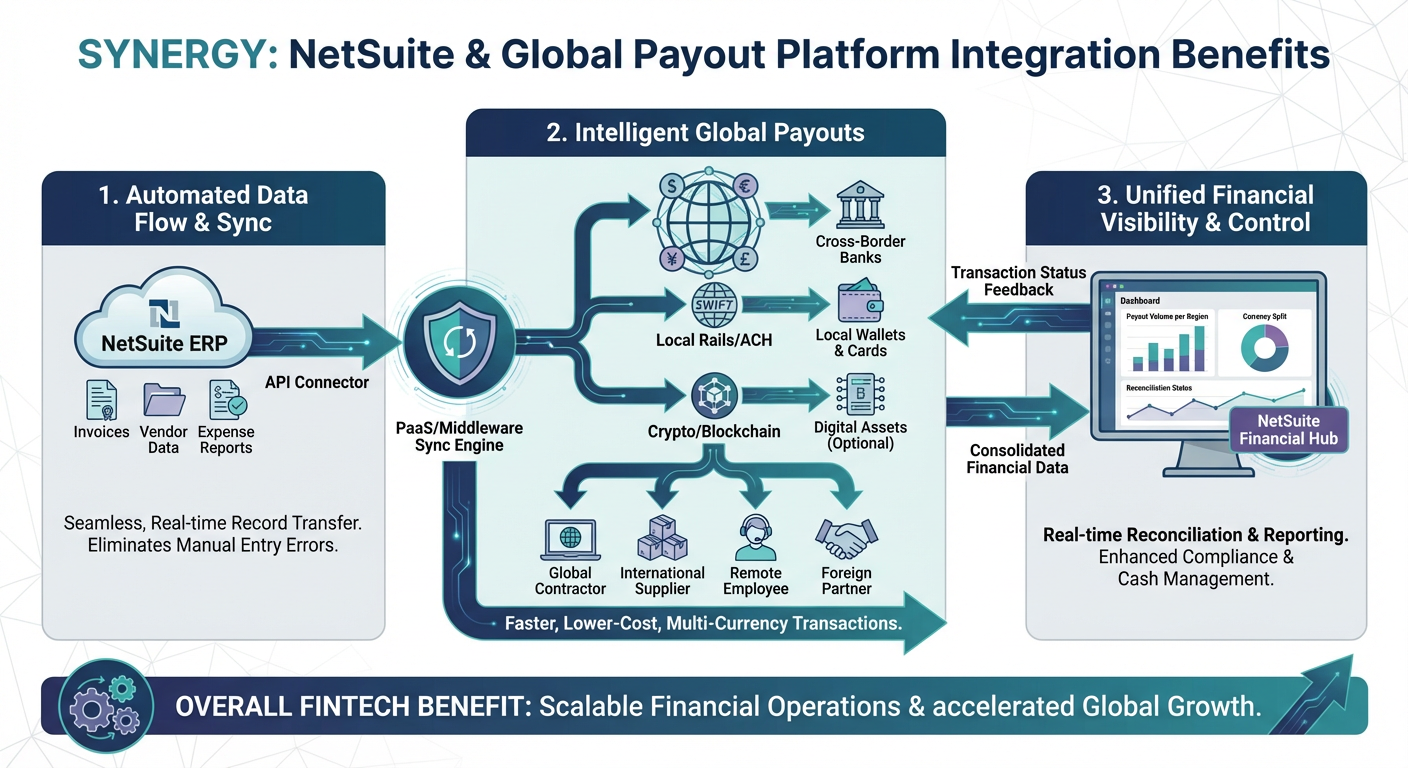
Integrating NetSuite with a global payout platform like Payouts.com transforms your 'Accounts Payable' from a cost center into a competitive advantage. Instead of manually entering bank details for SPEI (Mexico's interbank system) payments, a direct sync allows for automated data flow.
Automated Vendor Onboarding and RFC Validation
When a Mexican influencer or software developer joins your platform, they enter their details into a white-labeled vendor portal. The system automatically validates their RFC with SAT records and maps this data directly to a new Vendor Record in NetSuite. This eliminates the 'fat-finger' errors that cause 99% of payment rejections.
To understand the true cost of these errors, consult our breakdown of The $500k Error: How Manual Payment Rejections are Killing Your Global Margins (and How to Fix Them).
Eliminating Multi-Currency Chaos in the Ledger
NetSuite is excellent at multi-currency accounting, but it struggles with real-time FX fluctuations during the payment window. By syncing with a platform that offers a flat-fee per transaction model rather than a percentage-based spread, you can lock in rates and ensure the amount debited matches the 'Bill' in NetSuite to the cent. This prevents the nightmare of reconciling thousands of small FX variances at month-end, a challenge documented in The $100 Million Margin Leak: How Multi-Currency Chaos Nearly Tanked a Tier-1 Influencer Agency.
Preferred Payment Methods in Mexico: SPEI vs. Stablecoins
In Mexico, the Interbank Electronic Funds Transfer (SPEI) is the gold standard for local transfers, offering near-instant settlement. However, for digital nomads or vendors working with US-based agencies, there is a growing demand for faster, more transparent settlement layers.
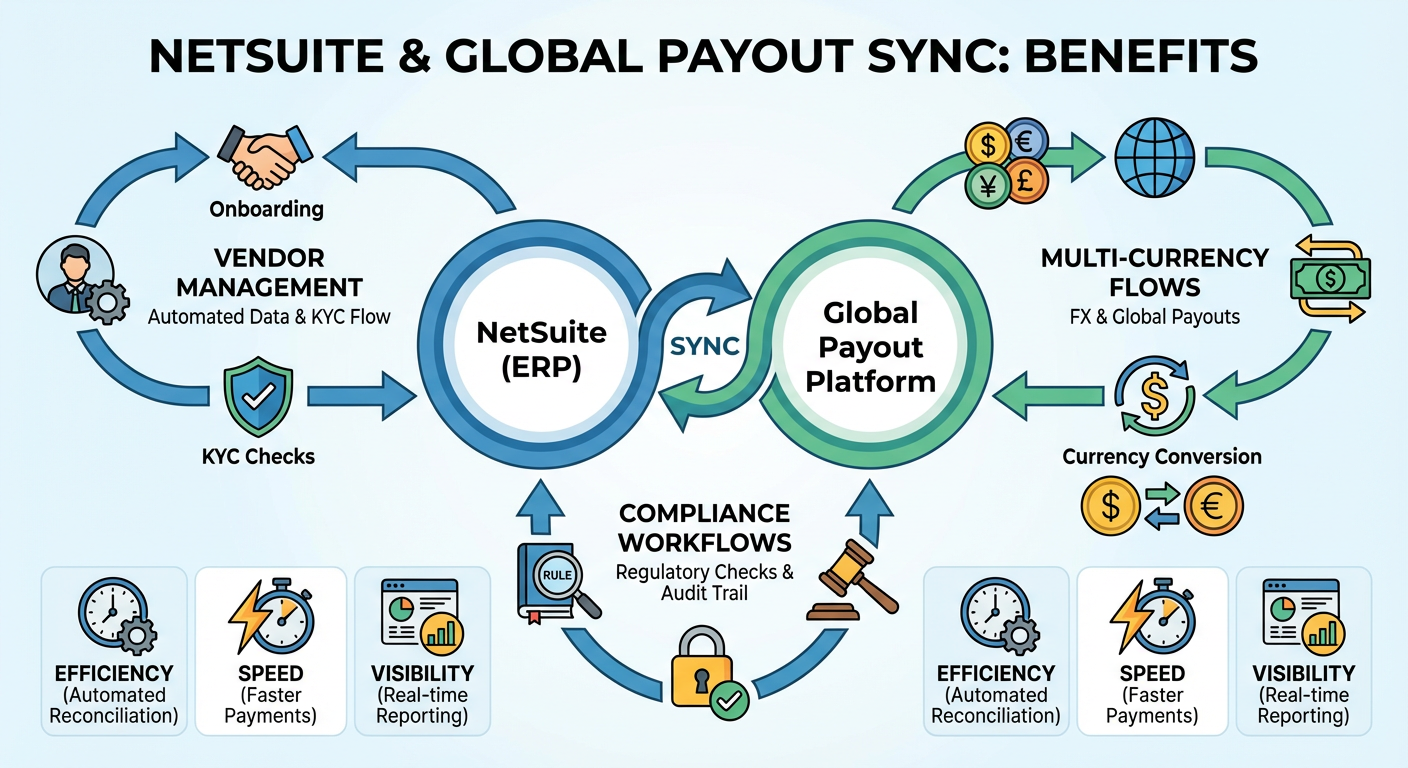
While traditional wires can take days and incur hidden intermediary fees, the use of stablecoins like USDT or USDC as a settlement utility is rising. For companies scaling quickly, this removes the 'administrative tax' of traditional banking hours. Forward-thinking CFOs are now exploring how Settling Creator Payouts in Crypto for Global Reach: The Ultimate Integration Guide can reduce friction without compromising the NetSuite audit trail.
Solving the W-8/W-9 and IVA Trap in Mexico
One of the most frequent mistakes US companies make when paying Mexican entities is failing to collect the proper documentation for IRS and SAT compliance simultaneously. If you are a US entity paying a Mexican contractor, you must have a valid Form W-8BEN or W-8BEN-E on file to justify zero US withholding.
Using an automated platform ensures that a payment cannot be triggered until the digital tax form is signed and validated. This prevents the 'IRS Roulette' that many firms play. For a deeper dive into these rules, see our guide on W-8 vs.
W-9: 7 Critical Rules to Avoid the IRS Audit Trap with Global Contractors. In Mexico specifically, you also need to ensure that the Value Added Tax (IVA) is correctly accounted for if the service is deemed to be 'rendered' within Mexican territory, even if the client is abroad.
Strategic Benefits of a Unified Payout Ecosystem
- Real-Time GL Sync: Every payment made in MXN (Mexican Pesos) is instantly pushed back to NetSuite as a 'Vendor Payment,' automatically closing the open Bill. \n\n2. \n\n3. Fraud Prevention: Leverage AI-driven anomaly detection to identify duplicate invoices or suspicious bank account changes before the SPEI transfer is initiated.
This is critical as you face The 5-Step Blueprint to Stopping Real-Time Payout Fraud Before It Kills Your Margins.
Conclusion: The Path to Touchless Finance
' It's about creating a unified financial operating system that respects the local nuances of markets like Mexico while maintaining the global integrity of your ERP. By automating the data ingestion, compliance validation, and multi-currency disbursement phases, companies can scale to thousands of partners while actually reducing their finance headcount. The transition from manual chaos to touchless finance is no longer a luxury-it is a prerequisite for global competition.