

The term 'vendor management' often evokes images of overflowing inboxes, complex spreadsheets, and tedious manual data entry. For years, the accounts payable (AP) department has been viewed as a pure cost center-a necessary but cumbersome part of doing business. The software designed to 'help' often became just another silo, a digital filing cabinet that did little to address the core operational friction of managing and paying a global network of vendors, freelancers, and partners.
This traditional model is actively holding back high-growth companies.
However, a fundamental shift is underway. The market for vendor management solutions is not just growing; it's evolving. 89 billion in 2025 to a staggering USD 72 billion by 2033. This growth isn't just about digitizing old processes.
It signals a move towards a new paradigm: a unified, strategic financial operating system that transforms vendor management from a back-office burden into a competitive advantage. The era of 'Touchless Finance' is here, and platforms that can't adapt are already obsolete.
The Great Unbundling: From Siloed Software to a Unified Financial OS
For too long, the finance tech stack has been a patchwork of disconnected tools. One system for invoices, another for vendor onboarding, a third for payments, and a messy collection of spreadsheets to bridge the gaps. This fragmentation is the single biggest operational tax on a scaling business.
It creates data silos, prevents real-time visibility, and introduces countless opportunities for human error, fraud, and compliance failures. The result is a finance team that spends its time on administrative triage rather than strategic analysis.
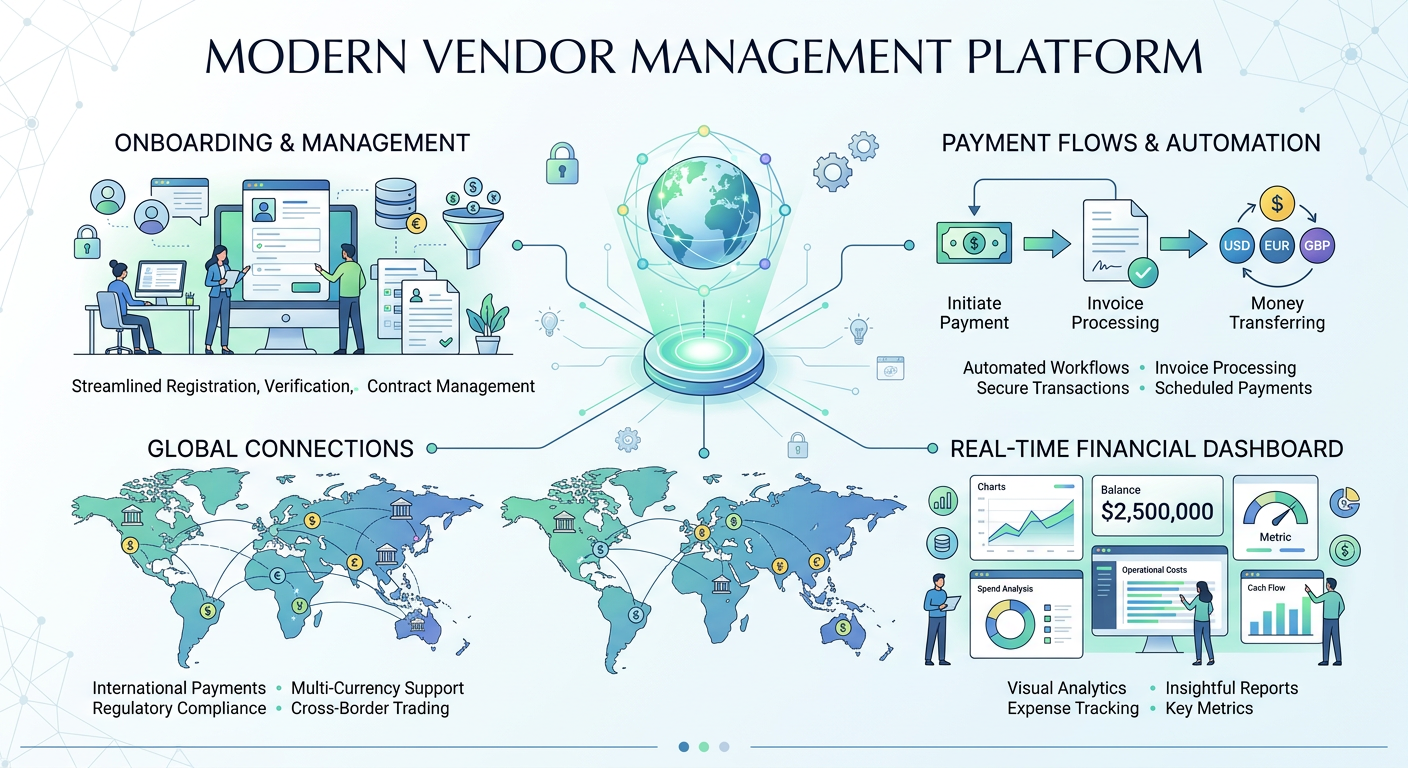
The future, and present, of vendor management lies in a unified platform model. Think of it as a financial operating system for your business. This approach consolidates the entire vendor lifecycle-from onboarding and compliance to invoicing, payments, and reconciliation-into a single source of truth. It's an 'Operations-First FinTech' mindset, where the technology is designed not just to move money, but to streamline the complex operational workflows that surround every single transaction.
Moving Beyond Basic AP Automation
First-generation AP automation software was a step in the right direction, but its scope was limited. These tools focused primarily on invoice processing, using optical character recognition (OCR) to digitize paper invoices. While helpful, this only addresses a small piece of the puzzle. True vendor management automation encompasses the entire workflow, from the moment a new vendor needs to be added to the final reconciliation entry in your ERP.
Modern platforms provide self-service vendor portals that dramatically reduce administrative workload. Instead of hounding vendors for tax forms and payment details via email, you provide them with a secure portal to enter and manage their own information. This not only lightens the load on your AP team but also improves data accuracy and creates a better experience for your partners. As described in these best practices for accounts payable vendor management, automation takes the guesswork out by providing real-time data in one unified view.
The Power of Universal Connectors and Deep ERP Integration
A vendor management platform that doesn't seamlessly integrate with your core financial systems is not a solution; it's just another problem. The goal of automation is to eliminate manual data transfer, not create new opportunities for it. This is where the concept of universal connectors becomes critical. A truly modern platform must be built with an API-first approach, enabling deep, bidirectional synchronization with your entire ecosystem.
This means more than just a surface-level connection. Robust platforms offer deep ERP integrations, syncing data in real-time with systems like NetSuite, QuickBooks, Xero, and SAP. This ensures that when a payment is made, it's not just sent; it's also instantly and accurately reconciled against the corresponding invoice and vendor record in your accounting system. This level of integration is foundational to achieving 'Touchless Finance' and finally closing the loop between procurement, payables, and accounting, something explored in-depth in our guide, Beyond the Spreadsheet: 6 Ways to Fix Your Fragmented Global Payment Operations Before They Tank Your Margins.
Global Operations: The New Scale-or-Die Battleground
The modern economy is global. High-growth digital companies-from ad networks and creator economy platforms to marketplaces and AI agencies-rely on a distributed network of vendors and partners spanning the globe. Paying this network efficiently and compliantly is an immense operational challenge. Legacy payment systems, with their high wire fees, opaque currency conversion rates, and multi-day settlement times, are simply not equipped for this reality.
3 billion by 2034. Businesses are realizing that managing a global vendor base isn't just a payment issue-it's a massive compliance, tax, and operational risk issue. Attempting to manage this complexity with spreadsheets and manual processes is a recipe for disaster, leading to payment errors, regulatory fines, and damaged partner relationships.
The process often causes what we call an 'onboarding bleed', a constant drain on resources that you can learn how to fix in Stop the Onboarding Bleed: How Automated Vendor Workflows are Global Operations by 2026.
Navigating the Labyrinth of Global Tax and Payment Compliance
When you pay a vendor in another country, you trigger a cascade of compliance requirements. This includes everything from KYC (Know Your Customer) and AML (Anti-Money Laundering) checks to tax form collection like W-8s for foreign entities and W-9s for US persons. Manually collecting, validating, and managing these forms for thousands of vendors is an impossible task at scale. Failure to do so correctly can result in hefty IRS penalties and payment blockages.
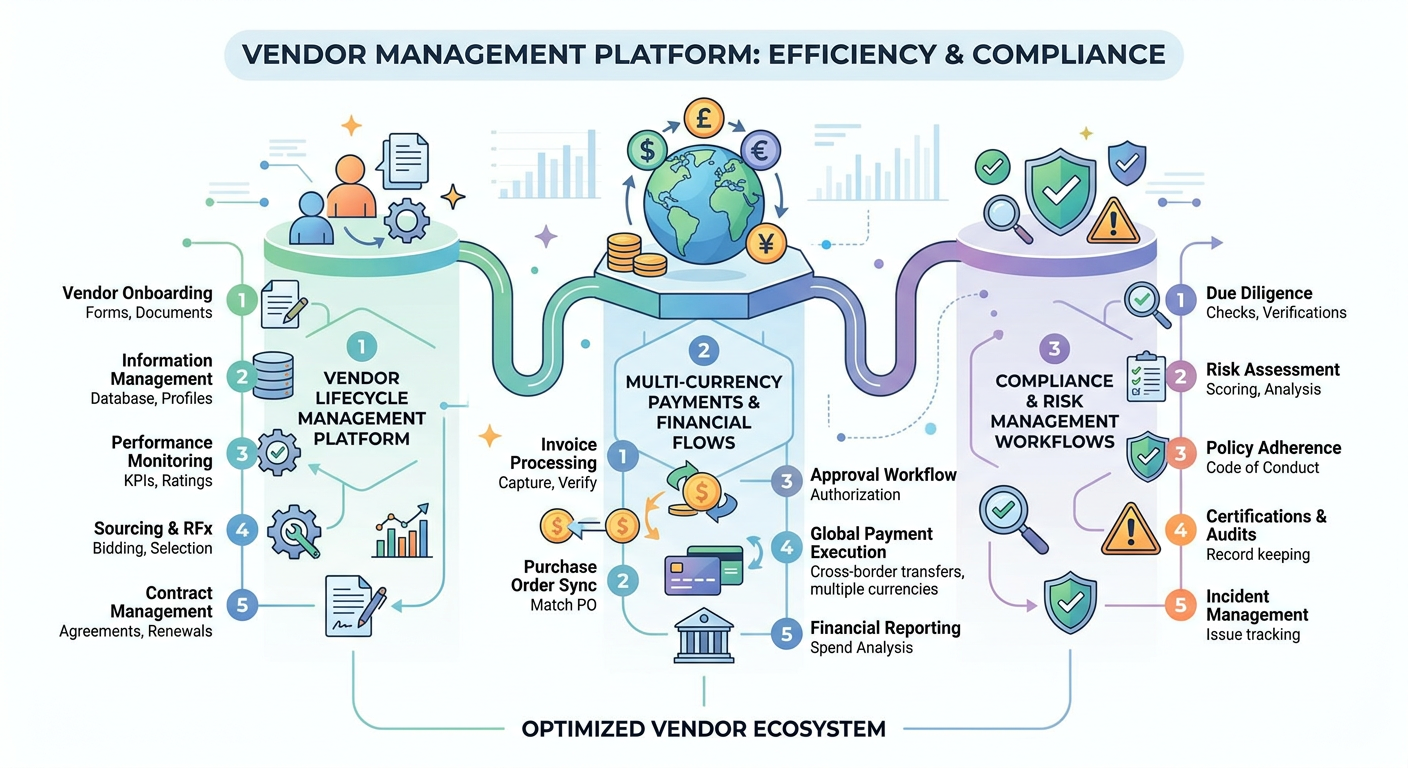
A modern vendor management platform automates this entire process. The system can intelligently request the correct tax form based on the vendor's location and entity type during onboarding. It validates the information in real-time to ensure accuracy and stores the documents securely for audit purposes. Furthermore, these platforms provide customizable workflows that can be tailored to an organization's specific compliance policies and risk appetite, ensuring adherence to frameworks like GDPR, PSD2, and FinCEN guidelines.
Crypto & Stablecoins: Utility Beyond the Hype
While the world of digital assets is often filled with speculation, the underlying technology offers powerful utility for global payment operations. For businesses paying partners in countries with volatile local currencies or underdeveloped banking infrastructure, stablecoins like USDT and USDC provide a frictionless settlement layer. They offer a fast, low-cost way to transfer value across borders without the delays and high fees associated with traditional correspondent banking.
Leading vendor platforms are now integrating crypto payouts as an option, not as a speculative investment, but as a practical tool for treasury management. This allows companies to offer partners the choice of receiving payment in their local fiat currency or in a stablecoin. This flexibility is a significant competitive advantage, particularly in the creator economy and for global affiliate networks looking for payment optionality.
From Cost Center to Strategic Finance Engine
Perhaps the most profound shift is in the role of the AP function itself. With automation handling the manual, repetitive tasks, finance teams are liberated to focus on higher-value strategic initiatives. The data consolidated within a unified vendor management platform becomes a rich source of business intelligence. Finance leaders can analyze spending trends, negotiate better terms with vendors, and optimize cash flow with unprecedented clarity.
This transition is supported by innovative financial products being built directly into these platforms. Features like 'Advanced Payment' provide instant liquidity to vendors, allowing them to get paid early on approved invoices. This isn't just a convenience; it's a powerful tool for strengthening your supply chain. For a large enterprise, considering Supply Chain Finance integration alongside automated payments can help achieve payment term goals while supporting key suppliers.
The Hidden Costs of Percentage-Based Fees
As payment volume grows, the transaction fees charged by traditional payment providers can become a significant drain on profitability. Many processors charge a percentage of the transaction value, which penalizes companies for scaling. A 2% fee may seem small on a single transaction, but when processing millions of dollars in payouts, it quickly erodes your margins.
As payment volume grows, the transaction fees charged by traditional payment providers can become a significant drain on profitability. Many processors charge a percentage of the transaction value, which penalizes companies for scaling. A fee may seem small on a single transaction, but when processing millions of dollars in payouts, it quickly erodes your margins.
The superior model for high-volume businesses is a predictable, flat-fee per transaction pricing structure. This approach decouples your costs from your growth, ensuring that your payout expenses remain stable and predictable, even as your business expands. Moving to this model is a crucial step for any company looking to optimize its financial operations and is a core GTM strategy we cover in our guide, How to Stop Sending Profit to the Banks: The Blueprint for Reducing High-Volume Vendor Transaction Fees by 70%. This allows you to reinvest savings into growth instead of sending your profits to the bank.
Choosing the Right Platform for the 'Touchless Finance' Future
The North America Vendor Management System Market alone is expanding at a significant rate, and with this growth comes a confusing array of choices. When evaluating a platform, it's crucial to look beyond surface-level features. The key is to find a partner that provides a true financial operating system designed for the complexities of a global, high-growth business.
Check for the depth of its ERP integrations, the breadth of its global payment network, and the sophistication of its compliance automation.
Don't settle for a simple payment solution or a digitized version of your old spreadsheet. Demand a platform that unifies onboarding, compliance, payments, and reconciliation into a single, seamless workflow. Setting up a supplier payment automation system is a project that aligns finance, accounting, and IT. By choosing a comprehensive platform, you're not just buying software; you're investing in a scalable infrastructure that will support your growth for years to come, removing the administrative tax that kills scaling companies and paving the way for a truly 'Touchless Finance' operation.