

Stop Playing IRS Roulette: The High-Stakes Guide to Automating International Influencer Tax Forms before 2026
For high-growth influencer agencies and ad networks, the dream is universal scale. The reality, however, is often a mounting pile of W-8BEN forms, expired VAT IDs, and the looming threat of a 30% IRS withholding penalty. As you expand into 150+ countries, the 'Administrative Tax'-the hidden cost of manual compliance-can quickly erode the very margins that make the creator economy profitable.
The challenge is binary: either you build a 'Touchless Finance' workflow that handles global tax documentation at the point of onboarding, or you face the 'Compliance Cliff.' Failing to collect a valid W-8 or W-9 doesn't just create an accounting headache; it creates a massive financial liability. If your platform is paying out millions to creators in Europe, Asia, and Latin America without the proper documentation, you are effectively self-insuring against a federal audit.
In this guide, we compare the three primary approaches to managing international influencer tax compliance: Manual Workflows, Fragmented Tech Stacks, and Unified Payout Operations.
The Compliance Spectrum: Three Ways to Manage Global Tax Forms
When scaling a creator network, most CFOs and Operations Managers find themselves at a crossroads. The method you choose to collect tax data dictates whether you scale linearly (adding more headcount for every 100 influencers) or exponentially (maintaining a lean team while paying thousands).
- The Manual Spreadsheet Method (The Legacy Error) rural
This is the 'startup' phase of compliance. Operations teams send PDF forms via email, store them in a Google Drive, and manually track expiration dates in a spreadsheet. While it costs 'nothing' in software fees, the hidden costs are catastrophic.
Manual collection is the primary driver of the Administrative Tax that kills scaling companies. Beyond the friction caused for the influencer, the risk of data entry error-such as a mistyped Taxpayer Identification Number (TIN)-ensures that 10-15% of your filings will likely fail an audit.
- The Fragmented Tech Stack (The Integration Nightmare)
To solve the manual mess, many firms use a patchwork of tools: a digital signature app for forms, a KYC provider for identity verification, and a separate bank portal for payments. The problem? These systems don't talk to each other.
A creator might sign a tax form in DocuSign, but if that data doesn't automatically trigger the payment release in your financial system, your team is still stuck in 'Where is my money?' hell. This fragmentation is often where multi-currency chaos begins, as tax withholdings are calculated on the wrong currency values or at the wrong time.
- The Unified Payout Operations Model (Touchless Finance)
The gold standard for 2026 is a platform that bridges the gap between data ingestion and disbursement. In this model, tax form collection is a mandatory step in a 'Zero-Touch' onboarding workflow. The platform automatically identifies whether an influencer needs a W-8 (international) or W-9 (US), validates the TIN in real-time, and applies the correct treaty rates for withholding.
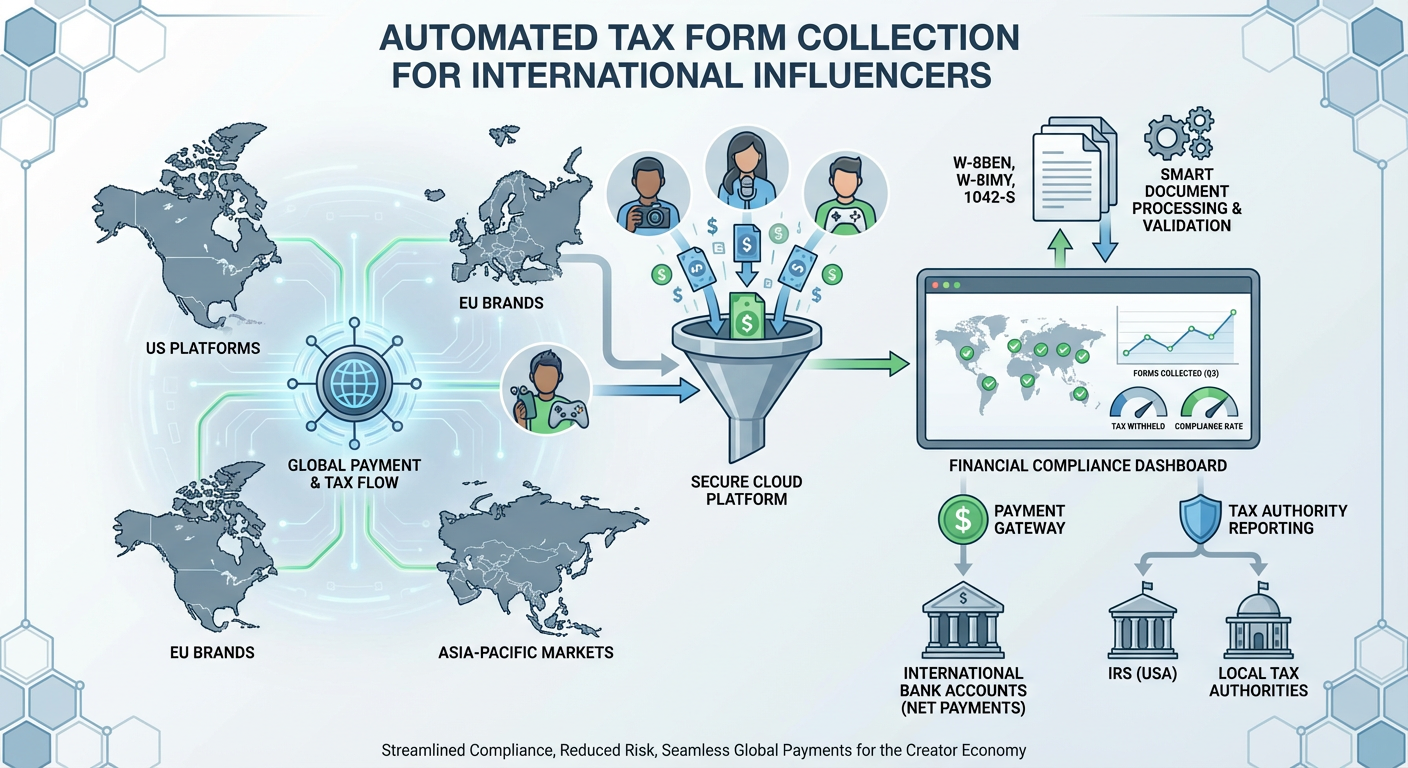
The Comparison: Manual vs. Fragmented vs. Unified Compliance
To understand the ROI of automation, we must look at how these three approaches perform across key operational metrics.
Onboarding Speed: Manual processes take days of back-and-forth. Unified systems reduce this to minutes. For an influencer agency, speed is a competitive advantage; creators will gravitate toward platforms that pay them faster without the 'compliance friction.' Managing this via real-time tracking ensures that both the agency and the creator have visibility into the tax status.
Audit Readiness: Under an IRS audit, your firm must prove that every payment made to a non-US person was backed by a valid W-8BEN or W-8BEN-E. A unified system provides an immutable audit trail, linking the tax form directly to the transaction record. This is especially critical when dealing with the VAT Trap in the UK and EU, where incorrect reporting can lead to massive back-tax liabilities.
Cost Scaling: Organizations using manual methods see their 'Cost Per Payout' increase as they grow. Conversely, those using a flat-fee, automated model see their overhead drop. By automating the tax collection, you eliminate the need for an army of AP clerks.
The Modern Compliance Stack: Essential Features for 2026
If you are evaluating a solution to handle your international influencer tax compliance, certain features are no longer optional. The global regulatory landscape is tightening, and 'best effort' compliance is no longer a defense.
Automated TIN Validation and IRS Matching
A tax form is only as good as the data on it. Advanced platforms use real-time TIN (Taxpayer Identification Number) matching to ensure the name and number provided match IRS records. This prevents the nightmare scenario of discovering thousands of invalid forms at the end of the fiscal year when it's time to issue 1099s and 1042-S forms. This proactive stance is the first line of defense in stopping payout fraud.
Dynamic Form Selection Logic
Most influencers aren't tax experts. Asking a 19-year-old creator in Brazil to 'upload a W-8BEN' is a recipe for failure. A smart onboarding portal asks simple questions-'Are you a US citizen?' 'Are you an individual or a business?'-and then generates the correct form automatically. This ensures the correct W-8 vs. W-9 logic is applied without manual intervention.
Stablecoin Settlement for International Compliance
Wait, what does crypto have to do with tax docs? In the modern era, stablecoin settlement is becoming a preferred utility layer for global payments. However, paying in USDT or USDC doesn't absolve you of tax obligations. A unified platform ensures that even if you pay via a blockchain rail, the tax form is collected and the value is recorded in fiat for compliant reporting. This allows you to scale faster without creating a secondary 'crypto-only' compliance silo.
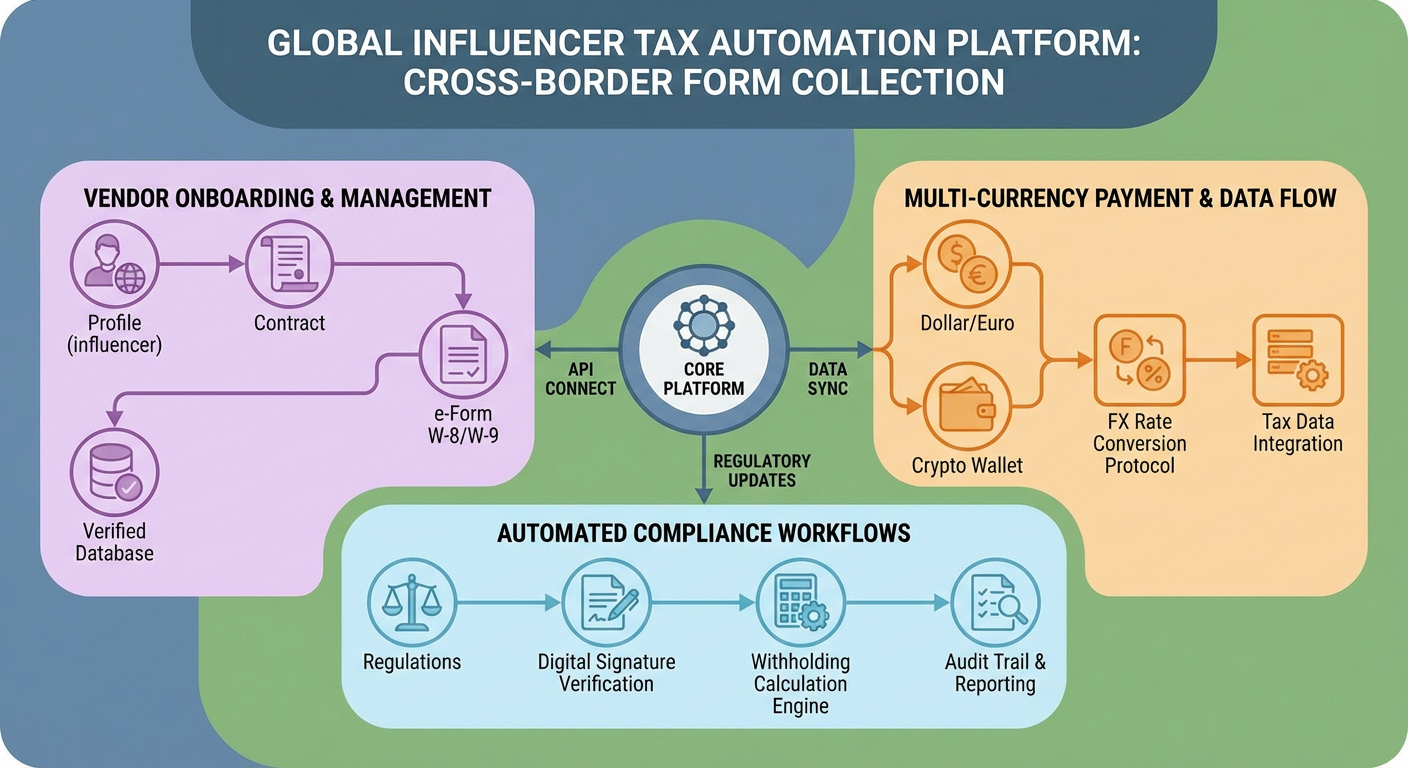
The Cost of Inaction: Why 2026 is the Deadline
The IRS and international tax authorities are increasingly focusing on the gig and creator economies. Platforms like Payouts.com provide the 'Financial Operating System' needed to navigate this transition. With 600+ ERP integrations (including NetSuite and QuickBooks), the data from your tax-compliant onboarding flows directly into your ledger.
For agencies operating in high-growth corridors, failing to automate this year means risking the Compliance Cliff that is expected to hit by 2026. Regulatory bodies are demanding more transparent reporting, moving from annual summaries to real-time or near-real-time transaction monitoring. Any business still relying on manual tax form collection will find it impossible to keep pace.
Conclusion: Moving Toward Touchless Finance
Standardizing international influencer tax form collection is not just about staying out of trouble; it’s about operational agility. When you remove the friction of W-8/W-9 collection, you free your finance team to focus on strategic growth rather than paperwork. By moving to a unified platform that handles everything from data ingestion to multi-currency disbursement, you ensure that your global expansion is built on a foundation of compliance, not a house of (manual) cards.