

For any US-based business operating on a global scale, managing payments to foreign entities is a core operational function. Whether you're an ad network paying international publishers, a creator economy platform working with global influencers, or a marketplace onboarding vendors from around the world, you are a withholding agent in the eyes of the IRS. This role comes with a significant administrative burden, most notably the collection and validation of Form W-8BEN-E from your foreign payees.
The Form W-8BEN-E, or the "Certificate of Status of Beneficial Owner for United States Tax Withholding and Reporting (Entities)," is a critical document. Its purpose is to establish that a foreign entity is the beneficial owner of the income being paid, to claim a reduced rate of, or exemption from, the standard 30% US tax withholding under an applicable tax treaty. Failure to collect this form correctly can result in penalties, back-withholding obligations, and significant financial risk for your business.
Manually chasing, receiving, and validating these forms is an operational bottleneck that simply doesn’t scale.
This guide provides a step-by-step framework for moving beyond manual workflows. By implementing an automated system for W-8BEN-E collection and validation, you can create a "touchless" financial operation that ensures compliance, reduces administrative overhead, and allows your team to focus on strategic growth rather than paperwork. It’s a foundational element of building a resilient global payment infrastructure.
Step 1: Centralize Vendor Onboarding and Data Collection
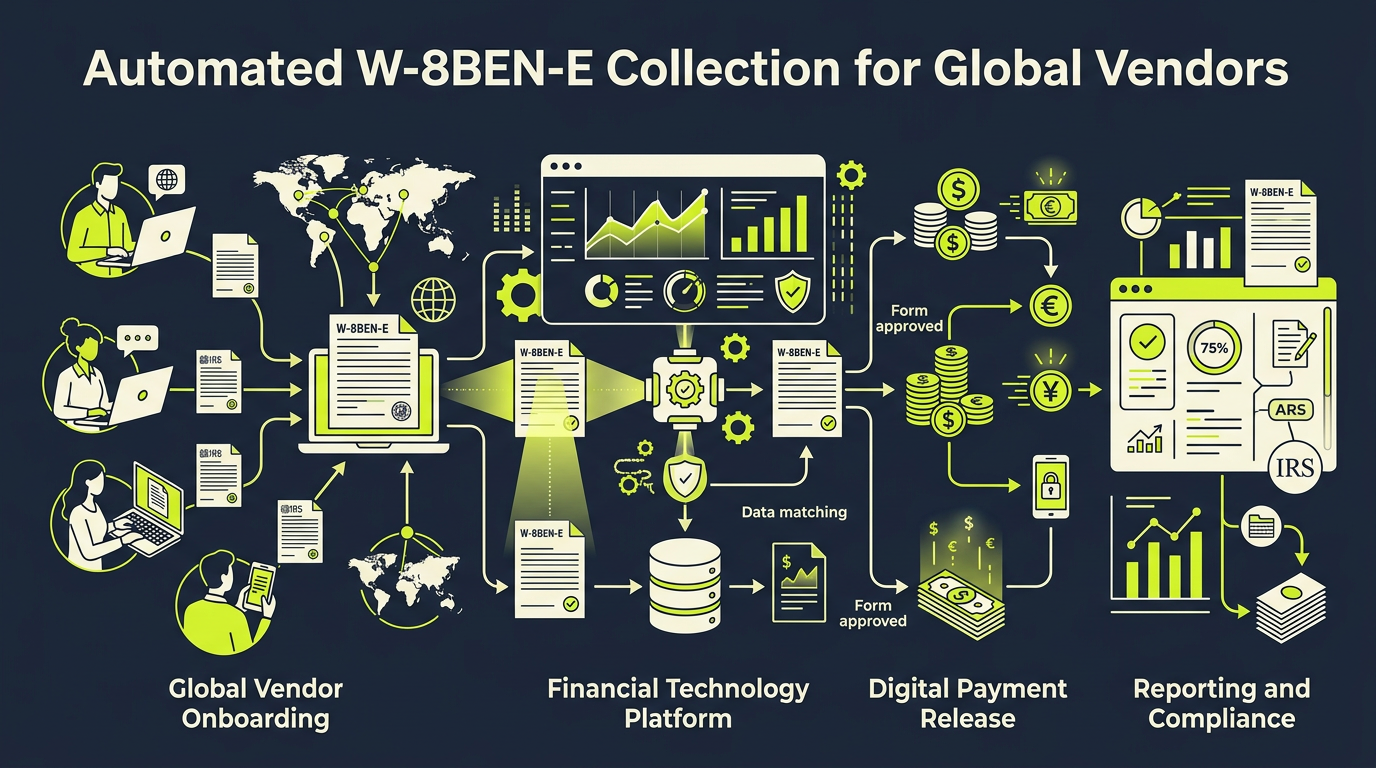
The first step toward automation is to eliminate fragmented, manual data entry points. Chasing vendors for tax forms via email is inefficient and insecure. A robust global payout platform acts as a single source of truth, integrating tax compliance directly into the vendor onboarding process. This creates a seamless experience for your international partners and a standardized, auditable data trail for your finance team.
Build a Unified Vendor Portal
A self-service vendor portal is the cornerstone of modern payout operations. Instead of your AP team manually requesting information, vendors are prompted to provide all necessary details themselves upon signup. This includes their legal entity information, payment method preferences (across 135+ currencies), and, crucially, their tax status. The system should intelligently guide them through the process.
For a US-based vendor, the system would prompt for a W-9. For a foreign entity, it triggers the W-8BEN-E workflow. This logic removes the guesswork for your team and ensures the correct tax documentation is collected from day one. By making this part of the standard onboarding flow, you embed compliance directly into your operations, preventing payment delays and compliance gaps down the line.
Integrate with Your Existing Systems
True automation requires seamless data flow. A solution with a robust API and pre-built integrations is critical. Look for platforms that offer extensive connectivity with over 600 ERP systems, including major players like NetSuite, QuickBooks, Xero, and SAP. This ensures that once a vendor completes their onboarding and submits their W-8BEN-E, their information is automatically synced with your financial and operational systems.
This eliminates the need for manual data entry, which is not only time-consuming but also a primary source of errors. When your payout platform communicates directly with your ERP, you achieve a level of operational efficiency that allows you to scale your vendor network without proportionally increasing your finance headcount. This is a key principle of the "touchless finance" model.
Step 2: Implement a Digitized and Validated W-8BEN-E Workflow
Once you have a centralized onboarding system, the next step is to digitize the W-8BEN-E collection process itself. Simply providing a downloadable PDF on your website is not an automated solution. A modern payout platform provides a fully digital, wizard-based experience that guides the foreign entity through the form step-by-step.
This approach dramatically reduces errors and incomplete submissions. As noted in guidance on Form W-8BEN-E explained, accurate completion is essential for the foreign party to receive correct withholding treatment. An automated system can validate inputs in real-time, checking for character formatting, confirming that all mandatory fields are completed, and ensuring the final document is electronically signed in a compliant manner.
Automate Form Validation and TIN Matching
The complexity of the W-8BEN-E form is a significant challenge. It requires the foreign entity to identify its Chapter 3 and Chapter 4 status, which determines the proper treaty benefits. An automated system can simplify this by asking a series of clear questions and then populating the form correctly based on the user’s answers. This removes the burden of interpretation from both your vendor and your AP team.
Furthermore, a key compliance check is validating the Taxpayer Identification Number (TIN). A best-in-class automation platform can perform TIN matching against IRS databases in real-time. This instantly flags any discrepancies, allowing the vendor to correct them before the form is even submitted. This proactive validation is crucial for avoiding IRS penalties and ensuring you have defensible documentation on file.
Secure Electronic Signature and Document Storage
The question often arises: can Form W-8BEN-E be signed electronically? The answer is yes, provided certain IRS requirements are met. The process must be secure, document the identity of the signer, and record the date and time of the signature. An automated payout platform handles this seamlessly, providing a compliant e-signature workflow as part of the digital collection process.
Once signed, the completed W-8BEN-E is stored securely in the vendor’s profile within the payout platform. This creates a centralized, audit-ready repository for all your tax documents. No more searching through email attachments or shared drives. When it’s time for an audit or year-end reporting, all the necessary documentation is organized and instantly accessible.
Step 3: Connect Tax Compliance to the Payment Process
Collecting the W-8BEN-E is only half the battle. The information on that form must directly inform how you process payments. An integrated system ensures that the tax, legal, and payment functions of your operation are not siloed but work together harmoniously. The goal is to create rules-based payment workflows that automatically apply the correct withholding.
For example, if a vendor from a country with a tax treaty claims a 10% withholding rate on their W-8BEN-E, the system should automatically apply that rate to all qualifying payments. If a vendor fails to provide a valid form, the system should default to the statutory 30% withholding. This automation removes the risk of human error in calculating and remitting withholding tax, which is a major source of compliance failures.
Rules-Based Withholding and Automated Remittance
A "touchless" system uses the validated W-8BEN-E to create automated payment rules. This ensures every payment to every foreign vendor has the correct tax withholding applied, without manual intervention. This is particularly critical for businesses making thousands of payments to freelancers, affiliates, or creators across the globe. The rising complexity of global tax regulations makes manual oversight untenable.
This automated approach is a core pillar of a modern financial operating system. It moves tax compliance from a reactive, year-end fire drill to a proactive, integrated part of your payment flow. This shift is essential for companies looking to manage global payouts at scale, a challenge detailed in the guide Global Affiliate Payouts, Simplified.
Step 4: Automate Expiration Tracking and Re-solicitation
A Form W-8BEN-E is not valid forever. Generally, it remains in effect for a period starting on the date the form is signed and ending on the last day of the third succeeding calendar year. For example, a form signed on September 30, 2024, will typically expire on December 31, 2027. Manually tracking these expiration dates for hundreds or thousands of vendors is a logistical nightmare.

Failure to secure a new form before the old one expires means you can no longer rely on it to grant treaty benefits. You must revert to the 30% statutory withholding rate. Automating this re-solicitation process is a critical, yet often overlooked, component of a complete compliance strategy. The goal is to streamline global tax compliance by removing these manual failure points.
Proactive Notifications and Automated Form Requests
An automated platform will monitor the validity period of every W-8BEN-E on file. Well before the expiration date, the system can trigger automated email notifications to the vendor, informing them that their form is nearing expiration and providing a direct link to submit a new one. This proactive communication ensures a smooth transition and prevents payment disruptions. You can configure the notification cadence-for example, 90, 60, and 30 days prior to expiration.
If a vendor fails to submit a new form before the old one expires, the system can automatically place a hold on their payments or change their withholding status to the default 30% rate. This rules-based enforcement protects your business from non-compliance without requiring manual intervention from your team. This level of automation is crucial for managing an international team and is a best practice for handling Form W-8BEN-E correctly.
The Strategic Advantage of Touchless Tax Compliance
Automating W-8BEN-E collection is more than just an administrative fix; it is a strategic imperative for any company scaling globally. 66 billion by 2034-manual processes cannot keep pace with the complexity of cross-border commerce and regulation. Organizations that embrace automation remove the \"administrative tax\" that slows growth and introduces risk.
By implementing a unified vendor portal, digitizing form collection and validation, connecting tax status to payments, and automating re-solicitation, you build a resilient financial operating system. This frees up your finance and operations teams to focus on high-value activities that drive the business forward. For businesses in the creator economy, this is a particularly acute challenge, as detailed in our guide, Streamline Global Creator Tax Compliance.
Ultimately, a
Ultimately, a "touchless" approach to global tax compliance allows you to onboard vendors faster, ensure accurate and timely payments, and operate with confidence in over 150 countries. It transforms a complex, high-risk function into a scalable, automated, and efficient component of your global growth engine.