

In the world of global business, a rejected payment is far more than a simple operational hiccup. It's a costly disruption that triggers a cascade of manual work-hours spent on investigation, communication, and re-processing. For high-growth digital companies, particularly ad networks, creator economy platforms, and marketplaces paying out to hundreds or thousands of global vendors, this "administrative tax" becomes a significant brake on scaling.
The cost of these failures isn't just in the time lost; it's in strained vendor relationships and delayed strategic focus.
The conventional approach to this problem has been reactive-improving the speed at which finance teams can fix errors. However, this model is fundamentally flawed and unsustainable. As payment ecosystems grow more complex, with diverging regulations and payment rails, the volume of potential failures increases exponentially.
The only viable path forward is to shift from a reactive stance to a proactive one: architecting a financial operating system that designs payment rejections out of the process from the very beginning. This guide outlines how an integration-first approach to accounts payable (AP) automation makes a zero-rejection future possible.
The Anatomy of a Failed Payment: Why Manual AP Systems Buckle Under Pressure
To eliminate rejections, one must first understand their source. The overwhelming majority of payment failures do not originate from complex banking errors but from simple, preventable issues rooted in manual processes and fragmented systems. As businesses scale globally, these seemingly minor cracks widen into chasms, swallowing finance team resources and causing significant operational drag.
Data Fragmentation and Manual Entry Errors
The most common culprit is incorrect beneficiary data. A single transposed digit in a bank account number, a misspelled name, or an outdated IBAN can cause a payment to be rejected by the receiving bank. This problem is magnified when data is manually copied and pasted between systems-from a performance marketing platform to an Excel sheet, and then into a banking portal. Each manual transfer point is an opportunity for human error to derail a transaction, a problem explored in detail when companies try to move Beyond the Spreadsheet: 6 Ways to Fix Your Fragmented Global Payment Operations Before They Tank Your Margins.
This fragmentation creates a system of record that is unreliable and difficult to audit. When a payment fails, the finance team must embark on a forensic journey back through spreadsheets and email chains to find the source of the error. This is not just inefficient; it's an unscalable workflow that crumbles as transaction volume grows, turning what should be a simple payout into a multi-day investigation.
Navigating the Shifting Sands of Global Compliance
Payment rejections are increasingly driven by compliance missteps. As national regulators adapt rules to their own domestic growth and competitiveness goals, the global financial landscape is becoming more localized and complex. A payment can be flagged and rejected for any number of reasons: incomplete KYC/AML information, failure to pass a sanctions screen, or incorrect tax documentation for the vendor's jurisdiction. As the 2026 Global Financial Services Regulatory Outlook highlights, regulators are intensifying their focus on digital assets, operational resilience, and the interconnectedness between banks and non-banks, adding layers of complexity to cross-border transactions.
For a company managing global payouts manually, staying abreast of these changes across 150+ countries is an impossible task. A compliance framework that was sufficient last quarter may be inadequate today. Without an automated system that bakes these compliance checks directly into the payment workflow, companies expose themselves to not only payment rejections but also significant regulatory risk.
The Integration-First Approach: Building a Resilient Payout Architecture
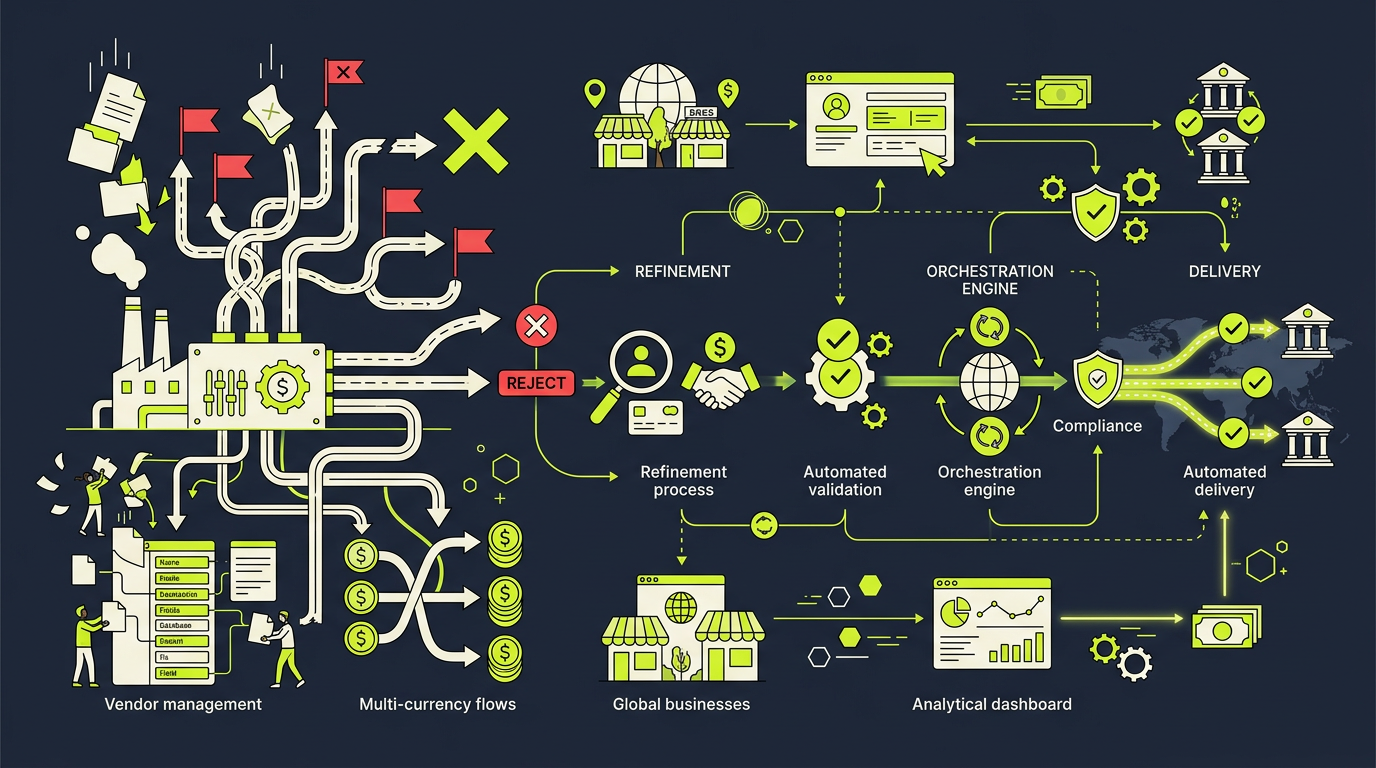
The solution lies in creating a 'touchless' financial workflow where data flows seamlessly and intelligently from its source to the point of final settlement. This is achieved not by purchasing another standalone tool, but by implementing a unified platform that serves as the central nervous system for all payment operations. An integration-first approach is essential for any business planning to execute international payouts successfully.

Universal Connectors in Action: The NetSuite Integration Example
Consider how this works in practice with an ERP like NetSuite. com uses a Universal Connector to establish a direct, bi-directional sync. When an invoice is approved in NetSuite, the payment data-vendor details, amount, currency, and invoice number-is automatically pushed to the platform.
This single action eliminates manual entry, eradicating the primary source of payment rejections. Recent tech advancements, such as Card Straight-Through Processing (STP), further automate card payment processing and settlement by depositing funds directly into supplier accounts.
This automation extends beyond initiation. Once the payment is processed through the network across 150+ countries, the final status (successful or failed) is automatically synced back to the ERP, closing the reconciliation loop in real-time. This creates a permanent, auditable record within the core system without a single manual keystroke.
By leveraging intelligent payment preferences, companies can enable configurable payment rules for speed and cost, a resilient architecture that can be deployed regardless of a company's existing tech stack.
Automating Compliance at the Point of Onboarding
A truly proactive approach to payment integrity begins before the first invoice is ever generated. The most effective way to prevent compliance-related rejections is to validate vendor data at the point of entry. This is accomplished through a self-service vendor portal that automates the entire onboarding workflow. When a new creator, affiliate, or supplier joins your network, they are guided through a digital process tailored to their specific country.
S. entities, W-8BEN/BEN-E for foreign entities) and validates them in real time. It also performs automated validation of local banking details, ensuring the format is correct for the destination country before the information is even saved.
This approach is critical to Stop the Onboarding Bleed: How Automated Vendor Workflows are Global Operations by 2026, turning a high-friction, error-prone process into a scalable, compliant, and touchless experience by ensuring data meets ISO 20022 standards for enriched data and real-time payments.
Advanced Strategies for Zero-Failure Disbursements in 2026
Preventing rejections goes beyond data integrity and compliance; it involves payment strategy. The future of payments is defined by leveraging enriched data and advanced solutions to optimize every transaction for speed, cost, and reliability. As Deloitte notes, trends like real-time infrastructure and data standardization are becoming central to payment strategies, driven by evolving consumer and business needs.
Intelligent Payment Routing and Currency Management
A common reason for rejection that is often invisible to the payer is routing a payment through an inefficient or incorrect payment rail. K. payment via SWIFT instead of the local Faster Payments Service, for example, can lead to delays, higher fees, or outright failure.
An advanced payout platform removes this guesswork through intelligent payment routing. When a payment is initiated, the system automatically selects the optimal rails based on the destination country, currency, and amount, ensuring the highest probability of success at the lowest cost.
This automated orchestration eliminates the manual decision-making that often leads to errors. Furthermore, by processing payments in large, automated batches, organizations can gain better visibility into payment flows and reduce per-transaction costs, a key benefit of automating recurring international payments. Coupled with a transparent, flat-fee per-transaction model, this predictability is a cornerstone of scalable financial operations, directly contrasting with percentage-based models that penalize growth.
Leveraging Stablecoins as a Frictionless Settlement Utility
Looking toward 2026, the discussion around digital assets is maturing from speculative investment to practical utility. As Deloitte's analysis on the future of payments confirms, stablecoin adoption is a key trend for enabling new efficiencies. For global businesses, stablecoins like USDT and USDC are emerging as a powerful settlement layer to bypass the friction and delays of the traditional correspondent banking system in certain regions.
By using stablecoins as an internal settlement rail, a payout platform can move value across borders almost instantly and with finality, converting it back to the desired local fiat currency at the last mile. This is not about crypto trading or investment; it is the strategic use of a new technology to solve an old problem. It dramatically reduces the number of intermediaries, which in turn reduces the number of potential failure points, making it a crucial tool for ensuring payment delivery in hard-to-reach markets.
Ultimately, the goal of a zero-rejection AP process is not a utopian vision but a practical objective achievable through strategic automation and integration. By building a financial operating system that validates data at the source, automates compliance, and intelligently routes payments, companies can eliminate the administrative tax of failed payments. This allows finance teams to shift their focus from fixing errors to fueling growth, finally enabling the promise of truly touchless finance at a global scale.