

For decades, the Enterprise Resource Planning (ERP) system has been the monolithic core of enterprise finance. It promised a single source of truth, an all-in-one solution for accounting, procurement, project management, and, by extension, payments. Yet, for scaling mid-market companies with global ambitions, this ERP-centric model is showing its age. The very architecture designed for unified control is now becoming a bottleneck, especially in the accounts payable and global payout functions.
The modern digital economy moves at a speed and scale that legacy ERP payment modules were never designed for. High-growth marketplaces, creator economy platforms, and ad networks must pay thousands of vendors, influencers, and affiliates across dozens of countries, each with unique currency and compliance needs. Attempting to manage this complexity within a rigid ERP framework creates an enormous 'administrative tax'-a burden of manual workflows, data reconciliation, and operational friction that directly inhibits growth.
This operational drag is forcing a strategic re-evaluation in the office of the CFO. The conversation is shifting from 'Which ERP is best?' to 'How can we build a more agile finance stack?' The answer lies in decoupling payment execution from the ERP core and embracing a new layer of financial technology: the ERP-agnostic payout connector. This is not about replacing the ERP, but augmenting it with specialized, operations-first tools built for the complexities of modern global commerce.
The Legacy ERP Bottleneck in Global Payables
Enterprise Resource Planning systems excel at being the book of record. They are foundational for financial reporting, consolidation, and core accounting. However, their capabilities in payment execution often lag significantly.
Many ERPs were built for a different era of business-one characterized by predictable, low-volume B2B payments to domestic vendors via ACH or wire transfer. Their infrastructure is not optimized for the high-volume, multi-currency, cross-border payouts that define the digital economy.
As businesses scale globally, finance teams discover their ERP's limitations the hard way. The system may lack robust multi-currency support, forcing manual currency conversions and exposing the business to high FX fees. Its ability to onboard international vendors and handle complex tax compliance forms, like W-8BEN and W-8BEN-E, is often rudimentary at best.
This leads to broken processes, compliance risks, and a poor experience for the global partners who are critical to the company's success.
When Your ERP Can't Keep Pace with Global Growth
For a CFO at a scaling mid-market company, signs of the ERP bottleneck are clear. The finance team spends an inordinate amount of time on manual payment runs, data entry, and fixing failed transactions. Closing the books takes longer each month due to the need to reconcile payment data from multiple sources back to the general ledger. These are not just inconveniences; they are symptoms of a financial operating system that is failing to scale, a problem highlighted in discussions around AP and payment best practices.
The issue is compounded by the very nature of mid-market growth. These companies are often the fastest adopters of cloud ERP solutions, migrating from entry-level accounting software to systems like NetSuite, SAP, or Microsoft Dynamics. Yet even these modern platforms can require expensive, custom-built integrations for global payments that are brittle and difficult to maintain. A strategic guide for mid-market CFOs often involves a commitment to partnership and strategic process review, recognizing that the ERP alone isn't the whole solution.
The Hidden Costs of ERP-Native Payment Processing
The direct costs of using an ERP for global payouts are often obscured. ' Instead, they manifest as high cross-border transaction fees based on a percentage of the payment value, unfavorable foreign exchange rates, and the significant labor cost associated with manual reconciliation and error handling. These costs erode margins and directly impact profitability, especially in the revenue band where the 3-5% of revenue investment is common for mid-market systems.
Furthermore, there's a strategic opportunity cost. When the finance team is bogged down in the operational weeds of payment execution, they are unable to focus on higher-value activities like financial planning and analysis (FP&A), cash flow optimization, and strategic guidance. This is a critical problem for companies in a landscape where the Spend & AP Automation market is currently valued at $12B and growing at an 18% CAGR, reflecting a broader trend toward efficiency and cost reduction.

The Rise of the Composable Finance Stack
In response to the rigidity of monolithic systems, forward-thinking CFOs are embracing a 'composable' approach to their finance technology. The modern finance stack is no longer about finding one system to do everything. Instead, it's about selecting best-of-breed solutions for specific functions and ensuring they integrate seamlessly. The ERP remains the financial core, the single source of truth for the general ledger, but it is liberated from tasks it performs poorly.
The shift from on-premise to cloud-based financial software has been a significant driver of this trend, enabling easier integration via APIs. This allows for specialized solutions in areas like AP automation, expense management, and global payouts to be 'bolted on' to the core ERP. This modular architecture provides greater flexibility and security, as SOC, ISO, NIST, and PCI compliance are becoming table stakes, incentivizing organizations to adopt modern software.
Decoupling Payments from the Core ERP
Decoupling the payout function is the logical next step in this evolution. It acknowledges that global mass payouts are a specialized operational discipline, not just a feature of an accounting system. This function requires dedicated expertise in cross-border compliance, multi-rail payment networks (including both traditional banking and crypto), currency management, and vendor data validation. Forcing an ERP to manage this is like asking a general accountant to be a global treasury expert.
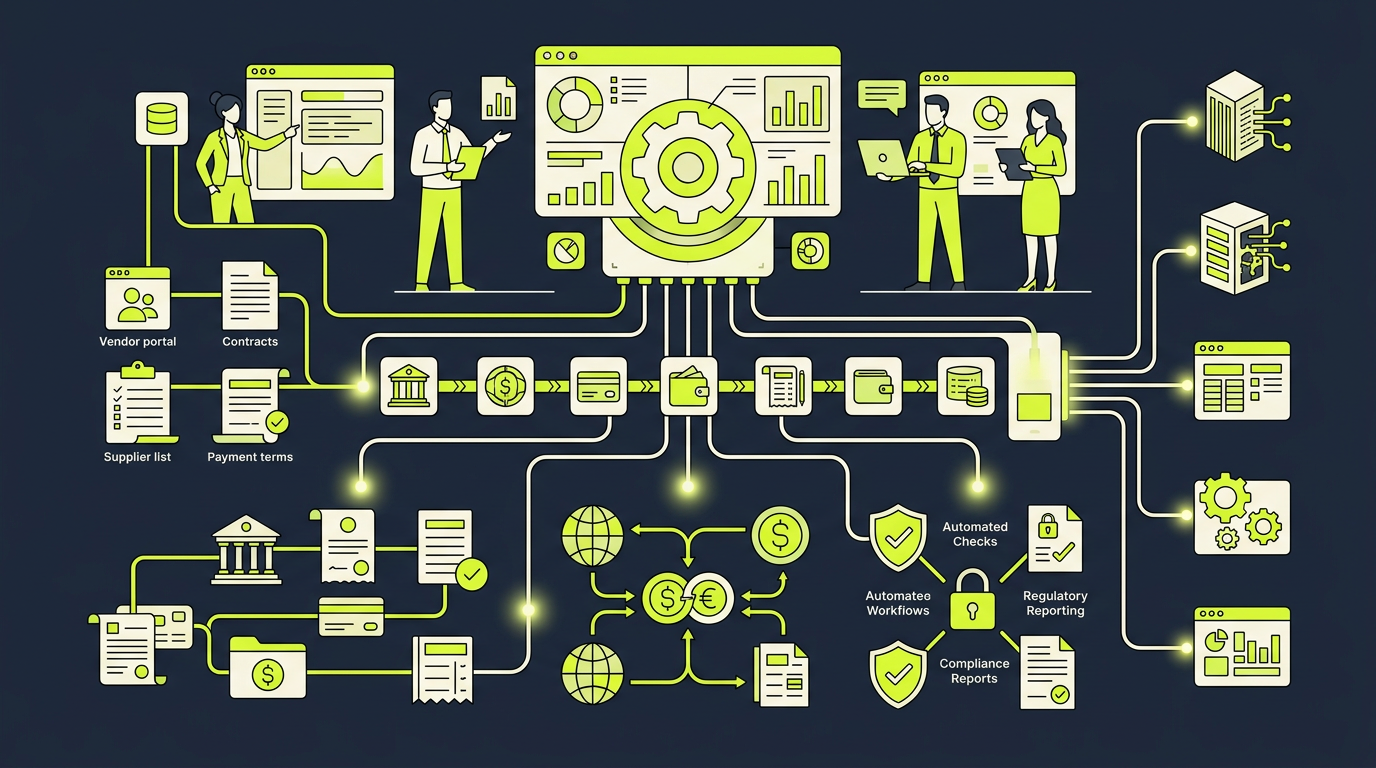
By externalizing the payout process to a dedicated platform, finance teams remove the operational burden without sacrificing control. Approved bills and payment instructions flow from the ERP to the payout platform, which then handles the entire lifecycle of the payment-from KYC/AML and tax form collection to currency conversion and final disbursement. The detailed status of each payment is then automatically reconciled back to the ERP, ensuring the general ledger remains perfectly in sync.
The Role of an Operations-First FinTech Layer
This is where an 'Operations-First FinTech' platform becomes critical. Unlike traditional banks or payment gateways focused solely on moving money, an operations-first platform addresses the entire workflow surrounding the payment. It starts with data ingestion and vendor onboarding, manages global tax compliance, and provides a self-service portal for payees to manage their own information.
This holistic approach fundamentally solves the underlying operational chaos, underscoring best practices for automating accounting-it's the operational workflow that matters.
For the CFO, this means transforming accounts payable from a cost center into a strategic asset. Automation removes the administrative tax, freeing up human capital. A flat-fee per-transaction pricing model provides predictable costs, unlike the percentage-based fees of many payment processors that penalize scale. This layer becomes the financial operating system for the business's external stakeholder payments, working in concert with the ERP.
What is an ERP-Agnostic Payout Connector?
An ERP-agnostic payout connector is a specialized software layer designed to integrate with any ERP system to automate and manage global payment operations. Instead of being a native module within a single ERP ecosystem, it acts as a universal bridge, connecting the company's book of record (the ERP) to a global network of payment rails and compliance tools. This approach provides maximum flexibility, allowing a business to choose the best ERP for its needs without being locked into its limited payment capabilities.
At its core, this connector is powered by a robust set of APIs and pre-built integrations. For example, modern platforms offer deep connections with suites like NetSuite, QuickBooks, Xero, and SAP. This ensures that data flows seamlessly between systems, eliminating the need for manual CSV uploads or brittle, custom-coded solutions.
Universal Connectivity: Beyond Point-to-Point Integrations
A key differentiator of a true payout connector is its 'universal' nature. It's not just about connecting one ERP to one payment gateway. It's about connecting any ERP to a vast network of payment options for international vendors. This includes traditional methods like local bank transfers and global wires, as well as modern options tailored for various industries, such as agriculture firms utilizing cloud ERP to eliminate manual work.
This multi-rail approach provides redundancy and optimizes payments for speed and cost. For instance, a payment to a freelancer in Europe might be best routed via SEPA, while a payment to a creator in a hyper-inflationary economy might be best settled instantly via a stablecoin like USDT or USDC. The platform makes these complex routing decisions automatically, abstracting the complexity away from the finance team.
Key Capabilities for Mid-Market CFOs
When evaluating an ERP-agnostic solution, CFOs should look for a unified platform that combines several key capabilities. Self-service vendor portals are essential for offloading the burden of data collection and management. The platform should automate the collection and validation of W-9 and W-8 series tax forms to ensure global compliance. Robust accounting automation must include two-way data sync for real-time reconciliation with the ERP.
Furthermore, the solution must provide tools for managing permissions and approval workflows, ensuring financial controls are maintained even as the process is automated. For businesses that work with creators or vendors who need immediate payment, features like Advanced Payment, which provides instant liquidity, can be a powerful competitive differentiator. Finally, the ability to issue virtual and prepaid cards offers a secure and controllable way to manage vendor spend, helping CFOs navigate a shifting regulatory environment. accounting automation software can help manage these processes.
Strategic Advantages for the Office of the CFO
Adopting an ERP-agnostic payout strategy is more than an IT decision; it's a strategic financial move. It provides the operational agility needed to enter new markets quickly, onboard global talent without friction, and scale payment volume without a corresponding increase in finance headcount. This efficiency translates directly to the bottom line, preserving capital for growth initiatives rather than administrative overhead.
This approach also de-risks technology decisions. A business can switch ERP providers in the future without having to completely re-engineer its entire global payment infrastructure. The payout layer remains constant, providing operational continuity. This modularity is the hallmark of a resilient, future-proof finance technology stack.
Future-Proofing Your Finance Operations
The world of finance and technology is in constant flux. New payment rails, compliance regulations, and business models emerge continuously. A specialized payout platform is architected to adapt to this change. Whether it's supporting a new stablecoin, complying with emerging tax laws in a specific country, or integrating with the next generation of AI-powered ERPs, the platform's dedicated focus ensures it stays ahead of the curve.
For the CFO, this means peace of mind. They are no longer beholden to their ERP vendor's product roadmap for critical payment functionality. Instead, they partner with a specialist whose entire business is built on providing best-in-class payment operations. This allows the finance team to move from a reactive to a proactive stance, confident in their ability to support the company's most ambitious scaling goals.
Data Unification and Global Tax Compliance
While decoupling payments, an agnostic platform simultaneously unifies payment-related data. All vendor information, tax forms, payment histories, and compliance checks are centralized in one place. This creates a single source of truth for payout operations that complements the ERP's role as the single source of truth for accounting.
This unified data is crucial for global tax compliance. With automated W-8/W-9 collection and validation, the platform ensures that every payment is compliant from the point of onboarding. It can automatically calculate and handle tax withholding, generate year-end reporting forms like 1099s and 1042-S, and provide a clear audit trail for all activities.
This transforms compliance from a high-risk manual process into a streamlined, automated workflow, giving CFOs the confidence to operate globally.